
Catalogue Search | MBRL


Are you sure you want to remove the book from the shelf?

{{itemTitle}}
3,142
result(s) for
"stephen douglas"
Sort by:


Lincoln's tragic pragmatism : Lincoln, Douglas, and moral conflict
A New York Times Book Review Editors' Choice
In 1858, challenger Abraham Lincoln debated incumbent Stephen Douglas seven times in the race for a U.S. Senate seat from Illinois. More was at stake than slavery in those debates. In Lincoln's Tragic Pragmatism, John Burt contends that the very legitimacy of democratic governance was on the line. In a United States stubbornly divided over ethical issues, the overarching question posed by the Lincoln-Douglas debates has not lost its urgency: Can a liberal political system be used to mediate moral disputes? And if it cannot, is violence inevitable?
\"John Burt has written a work that every serious student of Lincoln will have to read...Burt refracts Lincoln through the philosophy of Kant, Rawls and contemporary liberal political theory. His is very much a Lincoln for our time.\"
—Steven B. Smith, New York Times Book Review
\"I'm making space on my overstuffed shelves for Lincoln's Tragic Pragmatism. This is a book I expect to be picking up and thumbing through for years to come.\"
—Jim Cullen, History News Network
\"Burt treats the [Lincoln-Douglas] debates as being far more significant than an election contest between two candidates. The debates represent profound statements of political philosophy and speak to the continuing challenges the U.S. faces in resolving divisive moral conflicts.\"
—E. C. Sands, Choice
eBook


When Lincoln Came to Egypt
In When Lincoln Came to Egypt , George W.Smith provides a detailed record of Abraham Lincoln's travel in the southernmost region of Illinois, commonly referred to as Egypt.These visits began in 1830, before Lincoln had held public office, and continued through 1858, when he debated Stephen A.
eBook

Stephen A. Douglas and Antebellum democracy
\"This thematic biography demonstrates how Stephen Douglas's path from a conflicted youth in Vermont to dim prospects in New York to overnight stardom in Illinois led to his identification with the Democratic Party and his belief that the federal government should respect the diversity of states and territories. His relationships with his mother, sister, teachers, brothers-in-law, other men and two wives are explored in depth. When he conducted the first cross-country campaign by a presidential candidate in American history, few among the hundreds of thousands that saw him in 1860 knew that his wife and he had just lost their infant daughter or that Douglas controlled a large Mississippi slave plantation. His story illuminates the gap between democracy then and today. The book draws on a variety of previously unexamined sources\"-- Provided by publisher.
Book
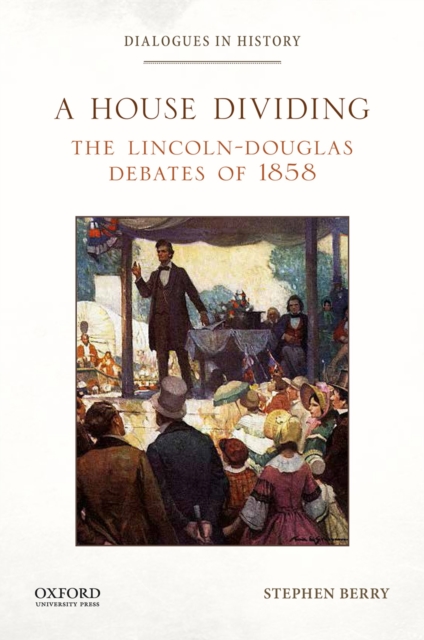
A House Dividing
A House Dividing: The Lincoln-Douglas Debates of 1858 updates the Lincoln-Douglas debates for the sound-bite era. Instead of 100,000 words, this volume in the Dialogues in History series gives students 20,000 words from the debates. Rather than long, uncontested ramblings, it offers rapid-fire accusations and responses. Despite their reputations as intellectual heavyweights, Lincoln and Douglas were not above mudslinging; their arguments prove surprisingly studded with ad hominem attacks, political grandstanding, and gross appeals to the candidates' respective bases.Historians generally agree on Civil War causality: a disagreement over the right of slaveholding in the territories caused secession; a disagreement over the right of secession caused the Civil War. A House Dividing places these political disagreements at the center of the narrative. Watching the cut-and-thrust of past political theater draws students into discussions of the continued importance of the political process as the place where the national agenda is set and executed.
eBook


Slavery, race and conquest in the tropics : Lincoln, Douglas, and the future of Latin America
\"Slavery, Race, and Conquest in the Tropics challenges the way historians interpret the causes of the American Civil War. Using Abraham Lincoln and Stephen Douglas's famed rivalry as a prism, Robert E. May shows that when Lincoln and fellow Republicans opposed slavery in the West, they did so partly from evidence that slaveholders, with Douglas's assistance, planned to follow up successes in Kansas by bringing Cuba, Mexico, and Central America into the Union as slave states. A skeptic about \"Manifest Destiny,\" Lincoln opposed the war with Mexico, condemned Americans invading Latin America, and warned that Douglas's \"popular sovereignty\" doctrine would unleash U.S. slaveholders throughout Latin America. This book internationalizes America's showdown over slavery, shedding new light on the Lincoln-Douglas rivalry and Lincoln's Civil War scheme to resettle freed slaves in the tropics\"-- Provided by publisher.
Book

Abraham Lincoln, Stephen Douglas, and the “Galesburg Challenge”
In this essay, I explore the historical challenge that Abraham Lincoln posed to Stephen Douglas at the fifth debate in Galesburg. During an argument regarding the morality of slavery and the meaning and significance of the American regime, Douglas contended that the nation was legally founded on white supremacy. Lincoln, however, affirmed that based on all available historical evidence, the Founders intended to include all humans when they said in the Declaration of Independence, based on their understanding of natural law, that “all men are created equal.” To demonstrate his confidence in this belief, Lincoln challenged Douglas to provide primary source evidence that anyone, prior to the 1850s, ever said that the black race was not included in the Declaration. Studying Lincoln’s natural law challenge and the responses it received offers a new perspective on the importance of the original meaning of the Declaration’s equality principle, grounded in the law of nature, as well as how Lincoln thought about that principle—particularly in contrast to rivals like Douglas and Roger Taney.
Journal Article