
Catalogue Search | MBRL


Are you sure you want to remove the book from the shelf?

{{itemTitle}}
1,574
result(s) for
"street names"
Sort by:


Swastikas on Jacob-Schiff-Straße: The Peculiar History of Jewish Street Names in Frankfurt, 1872–1938
This article uses the history of Jewish street names in Frankfurt to challenge prevailing narratives about World War I's deleterious effect on Jewish integration in Germany. It also shows how spatial theory can raise new questions and enrich our understanding of the nature and markers of Jewish integration. By naming streets after prominent local and national Jews between 1872 and 1933, Frankfurt's municipal government used urban space to physically reinforce the idea that Jews were an integral part of their city's history and culture. The continued presence of many of these 49 Jewish street names during the five years following the Nazi Party's seizure of power suggests a surprising tenacity of certain elements of Jewish integration at a local level into the early years of the Third Reich. In the end, only an outside edict from Berlin brought about the final “aryanization” of Frankfurt's streets.
Journal Article


Visualizando las diferencias. Análisis de los nombres de las calles de Cuenca (Ecuador)
El ejercicio de nombrar calles en ciudades como Cuenca, en Ecuador, continúa siendo un tema controversial tanto en su desarrollo como urbe como desde la creación de políticas públicas. Este trabajo analiza, a través de una lectura crítica, las nomenclaturas de las calles de la ciudad utilizando como herramienta la visualización de información. A través de una metodología interdisciplinaria que incluye el análisis crítico-histórico, la perspectiva de género y la visualización de información, este artículo muestra el proceso de categorización para la clasificación de las calles de la zona urbana de Cuenca. Los gráficos propuestos y los mapas interactivos, seis en total, permiten realizar una visión de las categorías por su contenido estadístico, geolocalización o longitud, entre otros parámetros. En este sentido, el papel desempeñado por la visualización de datos como herramienta de comunicación hace posible nuevas narrativas y modos de ver la ciudad.
Journal Article

Popular responses to city-text changes: street naming and the politics of practicality in a post-socialist martyr city
The cultural politics of attributing names and the popular responses to the naming process of the urban landscape are core issues in 'critical toponymies'. In many Romanian cities there are place names that articulate a collective memory agenda with respect to the 1989 Revolution, and Timişoara stands at the forefront of streets bearing martyr names. However, there have been recent calls for more attention to the popular responses to place-naming practices. This paper explores these calls by addressing the issue of users of urban street place names. It also highlights the need to introduce the theory of 'the politics of practicality' in place- and street-name studies. We seek to explain if Timişoarians are (un)happy with the new 'martyr city-text' and how social justice and the contextualisation of the conflict as a case of the practical and the ideological are interrelated. By analysing the concerns of local service workers and by surveying local people's opinion on the use of the martyrs' names, we look to determine to what extent they accept or reject the new names and their use. In particular, pride and recognition versus everyday difficulties in martyr name uses produce major tensions at a local level. Therefore social justice (restitution) issues created local conflict over the uses of new names, and the politics of practicality in the martyrs' case shaped how political and symbolic changes are received by the people. This paper is developing and challenging previous work on place and street naming in geography by considering, beyond the understanding that conflicts over naming are symbolic or ideological, that ordinary citizens use, connect with, and depend upon street names in practical terms: they internalise and react differently to the costs of rewriting the city-text.
Journal Article
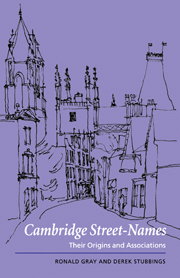
Cambridge Street-Names
This book, first published in 2000, draws on the great wealth of associations of street-names in Cambridge. It is not a dictionary, but it provides a series of entries on such topics as the Reformation, George IV and his wife, twentieth-century British scientists, businessmen, Elizabethan times, medieval Cambridge, mayors, millers, and builders. It includes hermits and coal merchants, field marshals and laundresses, martyrs and bombers, unscrupulous politicians and the founder of a Christian community, Cromwell and Newton, an Anglo-Saxon queen and the discoverer of Uranus - all people who lived in or often visited Cambridge. The ancient Stourbridge fair is included, along with castles and boat-races, sewage pumps and the original Hobson of 'Hobson's Choice'. Who was St Tibb? Where did Dick Turpin hide? Where was the medieval takeaway? Unlike earlier works, this is a history of everybody for everybody.
eBook

Streetonomics: Quantifying culture using street names
Quantifying a society’s value system is important because it suggests what people deeply care about—it reflects who they actually are and, more importantly, who they will like to be. This cultural quantification has been typically done by studying literary production. However, a society’s value system might well be implicitly quantified based on the decisions that people took in the past and that were mediated by what they care about. It turns out that one class of these decisions is visible in ordinary settings: it is visible in street names . We studied the names of 4,932 honorific streets in the cities of Paris, Vienna, London and New York. We chose these four cities because they were important centers of cultural influence for the Western world in the 20 th century. We found that street names greatly reflect the extent to which a society is gender biased, which professions are considered elite ones, and the extent to which a city is influenced by the rest of the world. This way of quantifying a society’s value system promises to inform new methodologies in Digital Humanities; makes it possible for municipalities to reflect on their past to inform their future; and informs the design of everyday’s educational tools that promote historical awareness in a playful way.
Journal Article
Sequencing toponymic change: A quantitative longitudinal analysis of street renaming in Sibiu, Romania
Recent scholarship in critical toponymy studies has refashioned the understanding of street names from innocent labels to nominal loci of historical memory and vectors of collective identity that are embroiled with power relations. Urban nomenclatures consist of more than mere linguistic signposts deployed onto space to facilitate navigation. Street names are also powerful signposts that indicate the political regime and its socio-cultural values. Drawing on these theoretical insights, this paper is focused on Sibiu (Romania) and explore the city’s shifting namescape in a longitudinal perspective spanning one century and a half of modern history (1875–2020). The analysis is based on a complete dataset of street names and street name changes registered across five political regimes (Habsburg Empire, Kingdom of Romania, Romanian People’s Republic, Socialist Republic of Romania, and post-socialist Romania). A series of multiple logistic regression models were carried out to determine the factors that influence toponymic change. The statistical results point out several significant predictors of street renaming: (1) the streets’ toponymic characteristics (politicized or neutral name); (2) artery rank (public squares and large avenues or ordinary streets and alleys); and (3) topographic features (a street’s size and centrality). Such a quantitative approach coupled with a longitudinal perspective contributes to the scholarly literature on place-naming practices in three major ways: firstly, by advancing an innovative methodological framework and analytical model for the study of street name changes; secondly, by delineating with statistical precision the factors that model toponymic change; and thirdly, by embedding these renaming practices observed especially after significant power shifts in the broader historical context of the changes brought in the city’s street nomenclature.
Journal Article

Habit, Memory, and the Persistence of Socialist-Era Street Names in Postsocialist Bucharest, Romania
The critical study of toponymy has paid considerable attention to the renaming of urban places following revolutionary political change. Such renaming is intended to institutionalize a new political agenda through shaping the meanings in everyday practices and landscapes. Renaming, however, might not always be successful, and this article examines this issue with reference to a market in Bucharest, Romania. Originally named Piaţa Moghioroş during the socialist era to commemorate a leading Communist Party activist, the market was renamed in the postsocialist period. Yet, more than two decades on, the original name remains in widespread everyday use. Using a mixed-method approach, we seek to advance the critical toponymies literature by exploring the persistence of the socialist-era name within everyday practice. Although many authors have highlighted the issue of popular resistance to an unpopular renaming, we find little evidence of conscious resistance, and instead we explore the importance of habit within everyday practices as an explanation, drawing on an understanding of habit derived from sociocognitive psychology. This perspective proposes that habits are stable and hard to break if the broader context in which they are situated is stable. We suggest that this explanation, rather than popular contestation, has more to offer in understanding the persistence of the toponym Piaţa Moghioroş. We thus highlight the importance of considering how the \"users\" of place names react to the changes of such names and create their own meanings in relation to them in ways unintended by elites.
Journal Article

Paris nouveau et Paris futur
Extrait: \"Il y a quatre cents ans, lorsque Quasimodo, accoudé sur la balustrade des tours de Notre-Dame, regardait Paris étendu sous ses pieds, voici ce qu'il voyait: un océan de toits aigus, de pignons taillés, de clochetons sculptés, de tourelles accrochées aux angles des murs; un luxuriant fouillis de pyramides de pierre, d'obélisques d'ardoises, de donjons massifs, de tours aériennes, de flèches brodées en dentelles.\" À PROPOS DES ÉDITIONS LIGARAN: Les éditions LIGARAN proposent des versions numériques de grands classiques de la littérature ainsi que des livres rares, dans les domaines suivants: • Fiction: roman, poésie, théâtre, jeunesse, policier, libertin.
• Non fiction: histoire, essais, biographies, pratiques.
eBook