
Catalogue Search | MBRL


Are you sure you want to remove the book from the shelf?

{{itemTitle}}
4,003,076
result(s) for
"televisions"
Sort by:
Television's moment
Television was one of the forces shaping the cultural revolution of the 1960s and 1970s, when a blockbuster TV series could reach up to a third of a country’s population. This book explores television’s impact on social change by comparing three sitcoms and their audiences. The shows in focus – Till Death Us Do Part in Britain, All in the Family in the United States, and One Heart and One Soul in West Germany – centered on a bigoted anti-hero and his family. Between 1966 and 1979 they saturated popular culture, and managed to accelerate as well as deradicalize value changes and collective attitudes regarding gender roles, sexuality, religion, and race.
eBook

Reacting to Reality Television
The unremitting explosion of reality television across the schedules has become a sustainable global phenomenon generating considerable popular and political fervour.
The zeal with which television executives seize on the easily replicated formats is matched equally by the eagerness of audiences to offer themselves up as television participants for others to watch and criticise. But how do we react to so many people breaking down, fronting up, tearing apart, dominating, empathising, humiliating, and seemingly laying bare their raw emotion for our entertainment? Do we feel sad when others are sad? Or are we relieved by the knowledge that our circumstances might be better? As reality television extends into the experiences of the everyday, it makes dramatic and often shocking the mundane aspects of our intimate relations, inviting us as viewers into a volatile arena of mediated morality.
This book addresses the impact of this endless opening out of intimacy as an entertainment trend that erodes the traditional boundaries between spectator and performer demanding new tools for capturing television's relationships with audiences. Rather than asking how the reality television genre is interpreted as 'text' or representation the authors investigate the politics of viewer encounters as interventions, evocations, and more generally mediated social relations.
The authors show how different reactions can involve viewers in tournaments of value, as women viewers empathise and struggle to validate their own lives. The authors use these detailed responses to challenge theories of the self, governmentality and ideology.
A must read for both students and researchers in audience studies, television studies and media and communication studies.
eBook

Equal Time
Equal Time: Television and the Civil Rights Movement explores the crucial role of network television in reconfiguring new attitudes in race relations during the civil rights movement. Due to widespread coverage, the civil rights revolution quickly became the United States' first televised major domestic news story. This important medium unmistakably influenced the ongoing movement for African American empowerment, desegregation, and equality. Aniko Bodroghkozy brings to the foreground network news treatment of now-famous civil rights events including the 1965 Selma voting rights campaign, integration riots at the University of Mississippi, and the March on Washington, including Martin Luther King's I Have a Dream speech. She reveals how TV executives worked through the ethical dilemmas they faced, how reporters and camera operators dealt with very real dangers of reporting events, how reports were constructed and aired to support integration, and how interviews were selected to project an image of a South ready for change. Television networks also looked to the entertainment industry to address the question of race relations, as prime-time comedies and dramas could no longer ignore the changes in American life. Bodroghkozy examines the most high-profile and controversial television series of the era to feature African American actors-- East Side/West Side, Julia, and Good Times --to reveal how entertainment programmers sought to represent a rapidly shifting consensus on what blackness and whiteness meant and how they now fit together.
eBook

Redesigning Women
In the 1990s, American televison audiences witnessed an unprecedented rise in programming devoted explicitly to women. Cable networks such as Oxygen Media, Women's Entertainment Network, and Lifetime targeted a female audience, and prime-time dramatic series such as Buffy the Vampire Slayer, Judging Amy, Gilmore Girls, Sex and the City, and Ally McBeal empowered heroines, single career women, and professionals struggling with family commitments and occupational demands. After establishing this phenomenon's significance, Amanda D. Lotz explores the audience profile, the types of narrative and characters that recur, and changes to the industry landscape in the wake of media consolidation and a profusion of channels. _x000B_Employing a cultural studies framework, Lotz examines whether the multiplicity of female-centric networks and narratives renders certain gender stereotypes uninhabitable, and how new dramatic portrayals of women have redefined narrative conventions. Redesigning Women also reveals how these changes led to narrowcasting, or the targeting of a niche segment of the overall audience, and the ways in which the new, sophisticated portrayals of women inspire sympathetic identification while also commodifying viewers into a marketable demographic for advertisers.
eBook

Global TV
pA reporter for the emLos Angeles Times/em once noted that “ emI Love Lucy/em is said to be on the air somewhere in the world 24 hours a day.” That Lucy’s madcap antics can be watched anywhere at any time is thanks to television syndication, a booming global marketplace that imports and exports TV shows. Programs from different countries are packaged, bought, and sold all over the world, under the watch of an industry that is extraordinarily lucrative for major studios and production companies. In strongGlobal TV/strong, Denise D. Bielb and C. Lee Harrington seek to understand the machinery of this marketplace, its origins and history, its inner workings, and its product management. In so doing, they are led to explore the cultural significance of this global trade, and to ask how it is so remarkably successful despite the inherent cultural differences between shows and local audiences. How do culture-specific genres like American soap operas and Latin emtelenovelas/em so easily cross borders and adapt to new cultural surroundings? Why is emThe Nanny/em, whose gum-chewing star is from Queens, New York, a smash in Italy? Importantly, Bielby and Harrington also ask which kinds of shows fail. What is lost in translation? Considering such factors as censorship and other such state-specific policies, what are the inevitable constraints of crossing over? Highly experienced in the field, Bielby and Harrington provide a unique and richly textured look at global television through a cultural lens, one that has an undeniable and complex effect on what shows succeed and which do not on an international scale./p
eBook

Transmedia Television
The early years of the twenty-first century have seen dramatic changes within the television industry. The development of the internet and mobile phone as platforms for content directly linked to television programming has offered a challenge to the television set’s status as the sole domestic access point to audio-visual dramatic content. Viewers can engage with ‘television’ without ever turning a television set on. Whilst there has already been some exploration of these changes, little attention has been paid to the audience and the extent to which these technologies are being integrated into their daily lives. Focusing on a particular period of rapid change and using case studies including Spooks, 24 and Doctor Who, Transmedia Television considers how the television industry has exploited emergent technologies and the extent to which audiences have embraced them. How has television content been transformed by shifts towards multiplatform strategies? What is the appeal of using game formats to lose oneself within a narrative world? How can television, with its ever larger screens and association with domesticity, be reconciled with the small portable, public technology of the mobile phone? What does the shift from television schedules to online downloading mean for our understanding of ‘the television audience’? Transmedia Television will consider how the relationship between television and daily life has been altered as a result of the industry’s development of emerging new media technologies, and what ‘television’ now means for its audiences.
eBook

From Memory to History
Our understanding of history is often mediated by popular culture, and television series set in the past have provided some of our most indelible images of previous times. Yet such historical television programs always reveal just as much about the era in which they are produced as the era in which they are set; there are few more quintessentially late-90s shows than That ‘70s Show, for example. From Memory to History takes readers on a journey through over fifty years of historical dramas and sitcoms that were set in earlier decades of the twentieth century. Along the way, it explores how comedies like M*A*S*H and Hogan’s Heroes offered veiled commentary on the Vietnam War, how dramas ranging like Mad Men echoed current economic concerns, and how The Americans and Halt and Catch Fire used the Cold War and the rise of the internet to reflect upon the present day. Cultural critic Jim Cullen is lively, informative, and incisive, and this book will help readers look at past times, present times, and prime time in a new light.
eBook

Ordinary television : analyzing popular TV
Other books on Television tend to ignore ′ordinary′ television - lifestyle programmes and ′reality TV′, just the sort of programmes which increasing dominate the schedules. Bonner provides a distinctive angle on the content of television and the relations between television genres and audiences.
eBook

Connecting The Wire
Critically acclaimed as one of the best television shows ever produced, the HBO series The Wire (2002–2008) is a landmark event in television history, offering a raw and dramatically compelling vision of the teeming drug trade and the vitality of life in the abandoned spaces of the postindustrial United States. With a sprawling narrative that dramatizes the intersections of race, urban history, and the neoliberal moment, The Wire offers an intricate critique of a society riven by racism and inequality. In Connecting The Wire, Stanley Corkin presents the first comprehensive, season-by-season analysis of the entire series. Focusing on the show’s depictions of the built environment of the city of Baltimore and the geographic dimensions of race and class, he analyzes how The Wire’s creator and showrunner, David Simon, uses the show to develop a social vision of its historical moment, as well as a device for critiquing many social “givens.\" In The Wire’s gritty portrayals of drug dealers, cops, longshoremen, school officials and students, and members of the judicial system, Corkin maps a web of relationships and forces that define urban social life, and the lives of the urban underclass in particular, in the early twenty-first century. He makes a compelling case that, with its embedded history of race and race relations in the United States, The Wire is perhaps the most sustained and articulate exploration of urban life in contemporary popular culture.
eBook
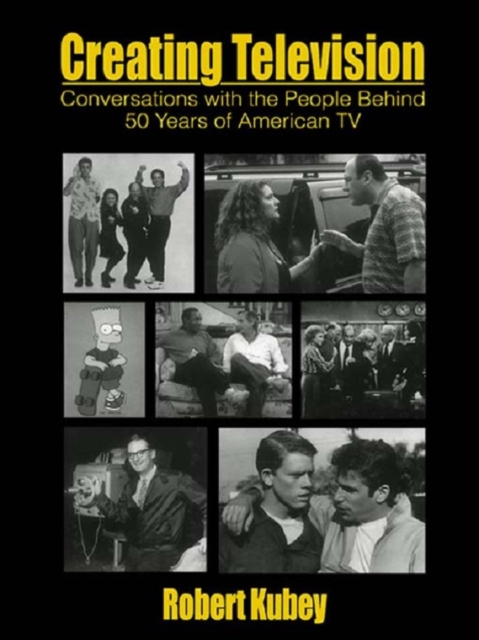
Creating Television
Creating Television brings television and its creators to life, presenting fascinating in-depth interviews with the creators of American TV. Having interviewed more than 100 television professionals over the course of his 15 years of research, Professor Robert Kubey presents here the 40 conversations that provide the most illuminating insights about the industry and the people working in it. These interviews bring television's creators to life, revealing their backgrounds, work, and thoughts about the audience and the television programs they create. Each interview tells a compelling tale of an individual's struggles and successes within a complex collaborative and highly commercial medium, offering readers rare insights on the human component in television's development. Featured in this volume are actors, agents, writers, directors, producers, and executives, representing television's earliest days through to the present day. Spanning shows from I Love Lucy and The Tonight Show through to Seinfeld, The Simpsons, and The Sopranos, these creators share the stories of how they gained entry to the industry and built their careers, offering readers a rare opportunity to meet, up close, the people involved in creating many of the most famous and successful programs in the medium's history, and linking the creators' personal histories to the television programs they create. With its unique insights on the people responsible for making television, this volume will be of interest to scholars and researchers in television history, sociology of culture, human creativity, television production, media studies, and mass media ethics. It will also be a popular reader for undergraduate and graduate students in courses addressing television, mass culture, media and society, American Studies, creativity, television history, and media ethics.
eBook