
Catalogue Search | MBRL


Are you sure you want to remove the book from the shelf?

{{itemTitle}}
7,536
result(s) for
"temps"
Sort by:

Enjoy time : stop rushing, get more done
More often than not we describe ourselves as time-pressured, timed-out, and too busy. While managing time has always been an important challenge, technology's rise, the idea of instant connectivity across time-zones, and the age of expectation all hours, has led to the very concept of time being given a make-over. So what do we mean by time - do we own it? Can we control it? Is it something to 'enjoy'? Starting with how and why we have reached this 'rush-egenic era', 20 lessons guide you through how perception has a massive impact on our sense of time, why responses and language effects our productivity, and, how liberating yourself from time, can in fact mean you use time (and it uses you) in the best way. Starting with the technical, we travel through individual behaviours and attitudes, before looking at the environmental factors that contribute to our day to day, taking in the elements that work for and against us as we 'chase time', before we take on our habits to challenge how we can be inspired to give more time to our day to day. Lastly, we time travel to a place of liberation and look at how to enjoy time. For if time is man's greatest invention, can we not once again reinvent it to better suit our needs?
BOOK
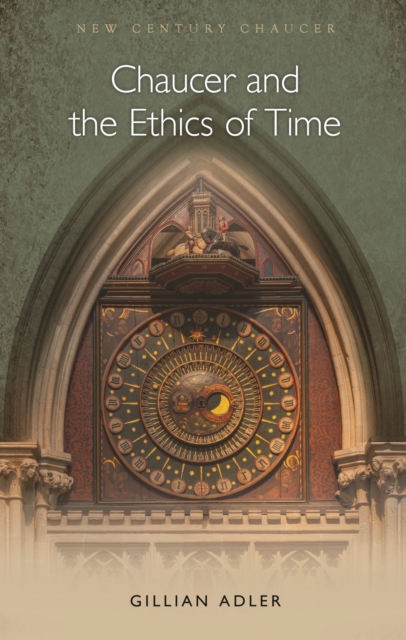
Chaucer and the Ethics of Time
Geoffrey Chaucer wrote at a turning point in the history of timekeeping, but many of his poems demonstrate a greater interest in the moral dimension of time than in the mechanics of the medieval clock. Chaucer and the Ethics of Time examines Chaucer's sensitivity to the insecurity of human experience amid the temporal circumstances of change and time-passage, as well as strategies for ethicising historical vision in several of his major works. While wasting time was sometimes viewed as a sin in the late Middle Ages, Chaucer resists conventional moral dichotomies and explores a complex and challenging relationship between the interior sense of time and the external pressures of linearism and cyclicality. Chaucer's diverse philosophical ideas about time unfold through the reciprocity between form and discourse, thus encouraging a new look at not only the characters' ruminations on time in the tradition of St Augustine and Boethius, but also manifold narrative sequences and structures, including anachronism.
eBook

In all weathers : a journey through rain, fog, wind, ice and everything in between
The culture of the UK a place founded on wind-blown migration and the navigation of storm-whipped seas is undoubtedly weather-soaked. Yet our weather is too often deemed as simply good (sunny) or bad (anything else). Our discussions and, even more importantly, our likelihood of venturing outside are governed by that simplistic judgement. But in a landmass where annual sunshine averages about 1300 hours (just 54 days), that is a long time to be miserably cooped up indoors. In All Weathers is a mission to redress the balance to look again at our most widely accessed experience of the natural world and realise it can be beautiful, sublime, even fun, no matter the forecast. From the howling winds of Skye to the fen-sucked fogs of East Anglia, Matt Gaw embarks on a series of walks in weather of all kinds across Britain to explore and understand the science of weather, how it is changing, its role in folklore and cultural history, and its psychological impact on us. This is not about simply braving inclement conditions for the sake of it our wind, rain, fog, ice and snow but to actively seek them out and enjoy them. With our rapidly changing climate, we need to embrace the elements, to throw open the doors, windows and soul to the inspiring wildness of weather.
Book

Transformations of Time and Temporality in Medieval and Renaissance Art
A multifaceted picture of the dynamic concepts of time and temporality is demonstrated in medieval and Renaissance art, as adopted in speculative, ecclesiastical, socio-political, propagandist, moralistic, and poetic contexts. Questions regarding perception of time are investigated through innovative aspects of Renaissance iconography.
eBook

HBR guide to getting the right work done
\"In the HBR Guide to Getting the Right Work Done, you'll discover how to focus your time and energy where they will yield the greatest reward. Not only will you end each day knowing you made progress-your improved productivity will also set you apart from the pack. Whether you're a new professional or an experienced one, this guide will help you: Prioritize and stay focused; Work less but accomplish more; Stop bad habits and develop good ones; Break overwhelming projects into manageable pieces; Conquer e-mail overload; Write to-do lists that really work.
Book

Event-based neuromorphic systems
\"Neuromorphic electronic engineering takes its inspiration from the functioning of nervous systems to build more power efficient electronic sensors and processors. Event-based neuromorphic systems are inspired by the brain's efficient data-driven communication design, which is key to its quick responses and remarkable capabilities. This cross-disciplinary text establishes how circuit building blocks are combined in architectures to construct complete systems. These include vision and auditory sensors as well as neuronal processing and learning circuits that implement models of nervous systems.Techniques for building multi-chip scalable systems are considered throughout the book, including methods for dealing with transistor mismatch, extensive discussions of communication and interfacing, and making systems that operate in the real world. The book also provides historical context that helps relate the architectures and circuits to each other and that guides readers to the extensive literature. Chapters are written by founding experts and have been extensively edited for overall coherence.This pioneering text is an indispensable resource for practicing neuromorphic electronic engineers, advanced electrical engineering and computer science students and researchers interested in neuromorphic systems.Key features: Summarises the latest design approaches, applications, and future challenges in the field of neuromorphic engineering. Presents examples of practical applications of neuromorphic design principles. Covers address-event communication, retinas, cochleas, locomotion, learning theory, neurons, synapses, floating gate circuits, hardware and software infrastructure, algorithms, and future challenges\"--
eBook

Get stuff done : a guide to managing your time and being productive
\"There is no shortage of obligations, pressures, and chaos coming at teens. Homework, sports, after school clubs, youth groups, chores, a part time job, family, and friends are all vying for a teen's time. Teens need to make sure they get to places on time, have all their assignme nts turned in, and spend time with the people who play an important role in their lives. They need to take control of the mayhem and make sense of what's coming at them. To get stuff done, they need to manage their time. There are tips, tricks, and skills that can help, but they also need to be aware of the disruptions and procrastination traps that can steal their time and productivity\"-- Provided by publisher.
Book
The Cambridge Introduction to Marcel Proust
Proust's A la recherche du temps perdu (In Search of Lost Time, 1913–27) changed the course of modern narrative fiction. This Introduction provides an account of Proust's life, the socio-historical and cultural contexts of his work and an assessment of his early works. At its core is a volume-by-volume study of In Search of Lost Time, which attends to its remarkable superstructure, as well as to individual images and the intricacies of Proust's finely-stitched prose. The book reaches beyond stale commonplaces of madeleines and memory, alerting readers to Proust's verbal virtuosity, his preoccupations with the fleeting and the unforeseeable, with desire, jealousy and the nature of reality. Lively, informative chapters on Proust criticism and the work's afterlives in contemporary culture provide a multitude of paths to follow. The book charges readers with the energy and confidence to move beyond anecdote and hearsay and to read Proust's novel for themselves.
eBook

Timing Canada : the shifting politics of time in Canadian literary culture
\"From punch clocks to prison sentences, from immigration waiting periods to controversial time-zone boundaries, from Indigenous grave markers that count time in centuries rather than years, to the fact that free time is shrinking faster for women than for men--time shapes the fabric of Canadian society every day, but in ways that are not always reasonable or consistent. In Timing Canada, Paul Huebener draws from cultural history, time-use surveys, political statements, literature, and visual art to craft a detailed understanding of how time operates as a form of power in Canada. Time enables everything we do--as Margaret Atwood writes, \"without it we can't live.\" However, time also disempowers us, divides us, and escapes our control. Huebener transforms our understanding of temporal power and possibility by using examples from Canadian and Indigenous authors--including Jeannette Armstrong, Joseph Boyden, Dionne Brand, Timothy Findley, Lucy Maud Montgomery, and Gabrielle Roy, and many others--who witness, question, dismantle, and reconstruct the functioning of time in their works. As the first comprehensive study of the cultural politics of time in Canada, Timing Canada develops foundational principles of critical time studies and everyday temporal literacy, and demonstrates how time functions broadly as a tool of power, privilege, and imagination within a multicultural and multi-temporal nation.\"-- Provided by publisher.
Book

The Growth of A la recherche du temps perdu
For forty years, scholars have had access to a vast array of documents that reveal the stages by which a few modest episodes grew into the vast and complex structure the world reveres as Marcel Proust's unique novel,A la recherche du temps perdu. Although many soundings have been made in this corpus, which comprises manuscript pages, exercise books, typescripts, and publisher's proofs, Anthony Pugh's study is the first attempt to provide a comprehensive view of the story that the documents reveal, at least in the years before the outbreak of war in 1914.
A crucial feature of the research is the rigorous establishment of the chronological sequence of the documents, a task complicated by Proust's habit of returning to sketches already written, amplifying them with extensive additions in the margins and on the facing pages, often reorganizing them, and finally reworking them in another form, sometimes physically intercalating pages of the first version into the new one. Anthony Pugh analyses with scrupulous care every document, facing all the multi-faceted problems they present, and showing why many solutions, some of them widely accepted by Proust scholars, have to be questioned.
It emerges from this investigation that however unsystematic Proust was in his method of composing, there is an inner logic in the way he oscillates between writing new incidents and editing texts already extant. Now, for the first time, the whole story of the way in whichA la recherche du temps perdugrew during the first six years of its gestation is told in full, both in its general thrust and in its fine details.
eBook