
Catalogue Search | MBRL


Are you sure you want to remove the book from the shelf?

{{itemTitle}}
6,344
result(s) for
"terror"
Sort by:

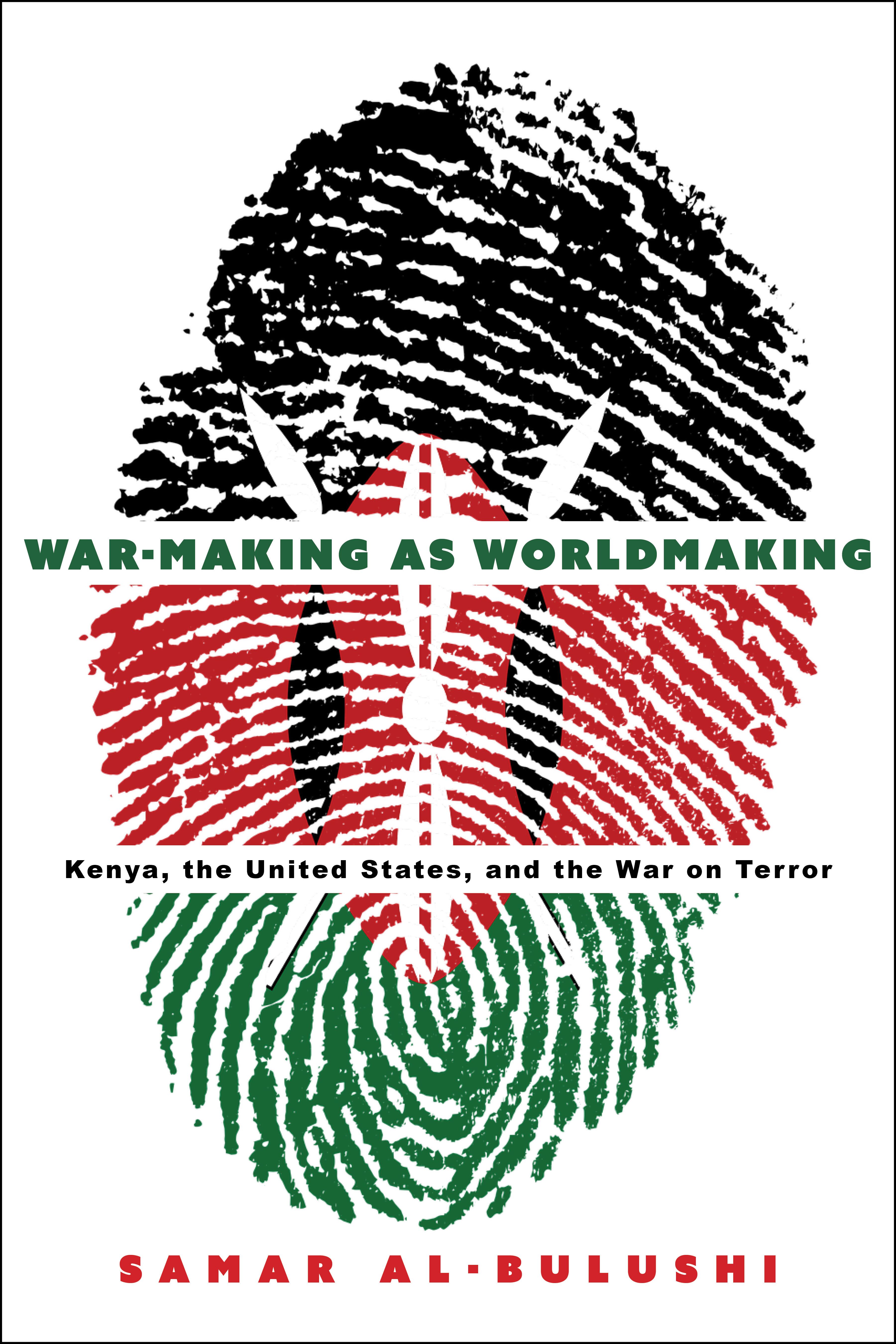
War-Making as Worldmaking
Since Kenya's invasion of Somalia in 2011, the Kenyan state has been engaged in direct combat with the Somali militant group Al-Shabaab, conducting airstrikes in southern Somalia and deploying heavy-handed police tactics at home. As the hunt for suspects has expanded within Kenya, Kenyan Muslims have been subject to disappearances and extrajudicial killings at the hands of U.S.-trained Kenyan police. War-Making as Worldmaking explores the entanglement of militarism, imperialism, and liberal-democratic governance in East Africa today. Samar Al-Bulushi argues that Kenya's emergence as a key player in the \"War on Terror\" is closely linked—but not reducible to—the U.S. military's growing proclivity to outsource the labor of war. Attending to the cultural politics of security, Al-Bulushi illustrates that the war against Al-Shabaab has become a means to produce new fantasies, emotions, and subjectivities about Kenya's place in the world. Meanwhile, Kenya's alignment with the U.S. provides cover for the criminalization and policing of the country's Muslim minority population. How is life lived in a place that is not understood to be a site of war, yet is often experienced as such by its targets? This book weaves together multiple scales of analysis, asking what a view from East Africa can tell us about the shifting configurations and expansive geographies of post-9/11 imperial warfare.
eBook
On fear, horror, and terror : giving utterance to the unutterable
This volume brings together essays that examine a vast gamut of different contemporary cultural manifestations of fear, anxiety, horror, and terror. Topics range from the feminine sublime in American novels to the monstrous double in horror fiction, (in)security at music festivals, the uncanny in graphic novels, epic heroes' Being-towards-death and authenticity, atrocity and history in Central European art, the theme of old age in absurdist literature, and iterations of the \"home invasion\" subgenre in post-9/11 popular culture. This diversity of insights and methodologies ensures a kaleidoscopic look at a cluster of phenomena and experiences that often manage to both be immediately and universally recognizable and defy straightforward categorization or even description.
Book

Many Labs 4: Failure to Replicate Mortality Salience Effect With and Without Original Author Involvement
Interpreting a failure to replicate is complicated by the fact that the failure could be due to the original finding being a false positive, unrecognized moderating influences between the original and replication procedures, or faulty implementation of the procedures in the replication. One strategy to maximize replication quality is involving the original authors in study design. We (N = 17 Labs and N = 1,550 participants, after exclusions) experimentally tested whether original author involvement improved replicability of a classic finding from Terror Management Theory (Greenberg et al., 1994). Our results were non-diagnostic of whether original author involvement improves replicability because we were unable to replicate the finding under any conditions. This suggests that the original finding was either a false positive or the conditions necessary to obtain it are not fully understood or no longer exist. Data, materials, analysis code, preregistration, and supplementary documents can be found on the OSF page: https://osf.io/8ccnw/
Journal Article


From the ‘Old’ to the ‘New’ Suspect Community
The ‘war on terror’ has emerged as the principal conflict of our time, where ‘Islamic fanaticism’ is identified as the greatest threat to Western liberal democracies. Within the United Kingdom, and beyond, this political discourse has designated Muslims as the new ‘enemy within’—justifying the introduction of counter-terrorist legislation and facilitating the construction of Muslims as a ‘suspect community’. In this paper, we develop Hillyard's (1993) notion of the ‘suspect community’ and evidence how Muslims have replaced the Irish as the main focus of the government's security agenda whilst also recognizing that some groups have been specifically targeted for state surveillance. We conclude that the categorization of Muslims as suspect may be serving to undermine national security rather than enhance it.
Journal Article


Voices from S-21
The horrific torture and execution of hundreds of thousands of Cambodians by Pol Pot's Khmer Rouge during the 1970s is one of the century's major human disasters. David Chandler, a world-renowned historian of Cambodia, examines the Khmer Rouge phenomenon by focusing on one of its key institutions, the secret prison outside Phnom Penh known by the code name \"S-21.\" The facility was an interrogation center where more than 14,000 \"enemies\" were questioned, tortured, and made to confess to counterrevolutionary crimes. Fewer than a dozen prisoners left S-21 alive. During the Democratic Kampuchea (DK) era, the existence of S-21 was known only to those inside it and a few high-ranking Khmer Rouge officials. When invading Vietnamese troops discovered the prison in 1979, murdered bodies lay strewn about and instruments of torture were still in place. An extensive archive containing photographs of victims, cadre notebooks, and DK publications was also found. Chandler utilizes evidence from the S-21 archive as well as materials that have surfaced elsewhere in Phnom Penh. He also interviews survivors of S-21 and former workers from the prison. Documenting the violence and terror that took place within S-21 is only part of Chandler's story. Equally important is his attempt to understand what happened there in terms that might be useful to survivors, historians, and the rest of us. Chandler discusses the \"culture of obedience\" and its attendant dehumanization, citing parallels between the Khmer Rouge executions and the Moscow Show Trails of the 1930s, Nazi genocide, Indonesian massacres in 1965-66, the Argentine military's use of torture in the 1970s, and the recent mass killings in Bosnia and Rwanda. In each of these instances, Chandler shows how turning victims into \"others\" in a manner that was systematically devaluing and racialist made it easier to mistreat and kill them. More than a chronicle of Khmer Rouge barbarism, Voices from S-21 is also a judicious examination of the psychological dimensions of state-sponsored terrorism that conditions human beings to commit acts of unspeakable brutality. The horrific torture and execution of hundreds of thousands of Cambodians by Pol Pot's Khmer Rouge during the 1970s is one of the century's major human disasters. David Chandler, a world-renowned historian of Cambodia, examines the Khmer Rouge phenomenon
eBook


Children Subjected to Forced Separation and Wartime Trauma: Focus on Hostage Twins in the Hamas-Israel War
An especially critical task is to raise awareness of the effects of war on children, in general, and with reference to specific children whose circumstances might enhance their vulnerability. Starting points, from which we begin our discussion, are the abduction and separation of 3-year-old identical twins during the Hamas attacks on the South of Israel, on October 7, 2023. Emphasis is given to these twins’ circumstances and to all children’s heightened vulnerability to the detrimental effects of war-related trauma, including mental health issues such as anxiety, depression, and post-traumatic stress disorder. Specific attention is given to the profound bond between identical twins and the devastating consequences of separation on their immediate and long-term emotional well-being. Drawing on research findings surrounding children at war and on historical evidence for the effects of twin separation on individuals exposed to war, our commentary underscores the urgent need for awareness and condemnation of the direct targeting of children. We advocate the preservation of family ties as essential for fostering children’s resilience and emotional support. We also call upon professional organizations and the international community to prioritize the reunification of children with their families as a moral imperative in safeguarding the well-being and future of innocent children exposed to terrorism and conflict in war-torn regions.
Journal Article