
Catalogue Search | MBRL


Are you sure you want to remove the book from the shelf?

{{itemTitle}}
52,320
result(s) for
"the Netherlands"
Sort by:

Anne Frank
In 1942, a young Jewish girl named Anne Frank received a diary from her parents for her thirteenth birthday. Today, millions of people have read the compelling, heartfelt diary entries Frank recorded while living in hiding to escape Nazi persecution. Her work is an invaluable account of the Holocaust, an iconic classic of war literature, and a testament to her own hopeful and unbreakable spirit. This biography introduces readers to Frank's life and the legacy she left behind, complete with photographs and fact boxes. Readers will be inspired by Frank's incredible story and her essential contribution to recorded history.
BOOK

A tiny spot on the earth
In this survey of the Dutch political culture of the nineteenth and twentieth centuries, Piet de Rooij reveals that the \"polder model\" often used to describe economic and social policymaking based on consensus is a myth. Instead, modern political culture in the Dutch Low Countries began with a revolution and is rife with rivalries among political and ideological factions. He argues that because of its extremely open economy, the country is vulnerable to external political, cultural, and economic pressures, and Dutch politics is a balancing act between profiting from international developments and maintaining sovereignty. The sudden rise of populism and Euroscepticism at the turn of the millennium, then, indicated a loss of this balance. Shining new light on the political culture of the Netherlands, this book provides insights into the polder model and the principles of pillarization in Dutch society.
eBook

Anne Frank
Presents information about Anne Frank, including her childhood in Holland, her years in hiding, her death, and her legacy.
BOOK

Matters of exchange : commerce, medicine, and science in the Dutch golden age
A new and unexpected history of the Dutch pursuit of commerce in the 16th and 17th centuries and how it triggered the Scientific Revolution
In this wide-ranging and stimulating book, a leading authority on the history of medicine and science presents convincing evidence that Dutch commerce—not religion—inspired the rise of science in the sixteenth and seventeenth centuries. Harold J. Cook scrutinizes a wealth of historical documents relating to the study of medicine and natural history in the Netherlands and elsewhere in Europe, Brazil, South Africa, and Asia during this era, and his conclusions are fresh and exciting. He uncovers direct links between the rise of trade and commerce in the Dutch Empire and the flourishing of scientific investigation. Cook argues that engaging in commerce changed the thinking of Dutch citizens, leading to a new emphasis on such values as objectivity, accumulation, and description. The preference for accurate information that accompanied the rise of commerce also laid the groundwork for the rise of science globally, wherever the Dutch engaged in trade. Medicine and natural history were fundamental aspects of this new science, as reflected in the development of gardens for both pleasure and botanical study, anatomical theaters, curiosity cabinets, and richly illustrated books about nature. Sweeping in scope and original in its insights, this book revises previous understandings of the history of science and ideas.
eBook

Erasmus, man of letters
The name Erasmus of Rotterdam conjures up a golden age of scholarly integrity and the disinterested pursuit of knowledge, when learning could command public admiration without the need for authorial self-promotion. Lisa Jardine, however, shows that Erasmus self-consciously created his own reputation as the central figure of the European intellectual world. Erasmus himself-the historical as opposed to the figural individual-was a brilliant, maverick innovator, who achieved little formal academic recognition in his own lifetime. What Jardine offers here is not only a fascinating study of Erasmu.
eBook

Dutch Scholarship in the Age of Empire and Beyond
How was it possible for the Koninklijk Instituut voor Taal-, Land- en Volkenkunde (KITLV) to grow from a learned society with fewer than a hundred members and only one partly salaried employee in 1851 into a modern professional institute with 1800 members and a staff of over fifty in 2001? This book provides the answer to this question.
eBook
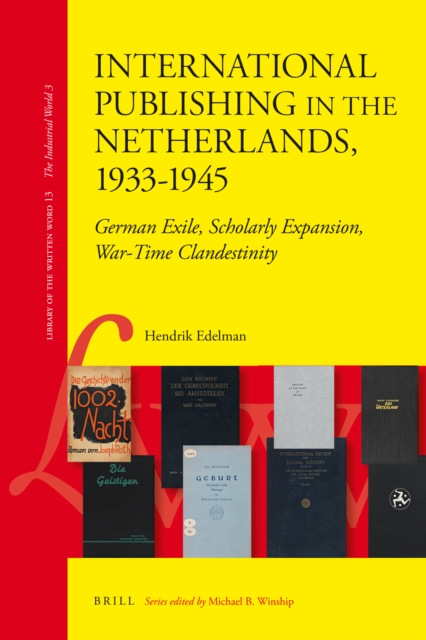
International Publishing in the Netherlands, 1933-1945
International publishing in the Netherlands experienced a remarkable revival after 1933, when the German Nazi government forced many prominent writers and researchers into exile. In a series of bio-bibliographical portraits of major participating Dutch publishers, this book documents the impact of German exile and changes in scholarly publishing.
eBook

Family, Culture and Society in the Diary of Constantijn Huygens Jr, Secretary to Stadholder-King William of Orange
Starting with the analysis of the diary kept by Constantijn Huygens Jr in the second half of the 17th century, this book sketches a panoramic view of life among Dutch regents and at the court of William and Mary, including an eyewitness account of the Glorious Revolution, and highlighting themes such as scientific progress, book and art collecting.
eBook

Emerging Memory
This incisive volume brings together postcolonial studies, visual culture and cultural memory studies to explain how the Netherlands continues to rediscover its history of violence in colonial Indonesia. Dutch commentators have frequently claimed that the colonial past and especially the violence associated with it has been 'forgotten' in the Netherlands. Uncovering 'lost' photographs and other documents of violence has thereby become a recurring feature aimed at unmasking a hidden truth. The author argues that, rather than absent, such images have been consistently present in the Dutch public sphere and have been widely available in print, on television and now on the internet. Emerging Memory: Photographs of Colonial Atrocity in Dutch Cultural Remembrance shows that between memory and forgetting there is a haunted zone from which pasts that do not fit the stories nations live by keep on emerging and submerging while retaining their disturbing presence.
eBook

Dutch Deltas
In Dutch Deltas, Werner Scheltjens examines the emergence, functions and structure of the Low Countries' maritime transport system between ca. 1300 and 1850. Scheltjens introduces the delta as a suitable geographical unit of analysis for understanding the regional economic origins of communities of maritime transporters. The author proves that changes in maritime trade networks and in the structure of regional economies entailed a process of specialisation, which led to the emergence of 'professional' maritime transport communities and the development of an integrated maritime transport market with Amsterdam and Rotterdam as its main centres.Dutch Deltas offers the first comprehensive study of the economic geography of the Low Countries' maritime transport sector and its long-term development between 1300 and 1850.
eBook