
Catalogue Search | MBRL


Are you sure you want to remove the book from the shelf?

{{itemTitle}}
955
result(s) for
"the enlightenment movement"
Sort by:
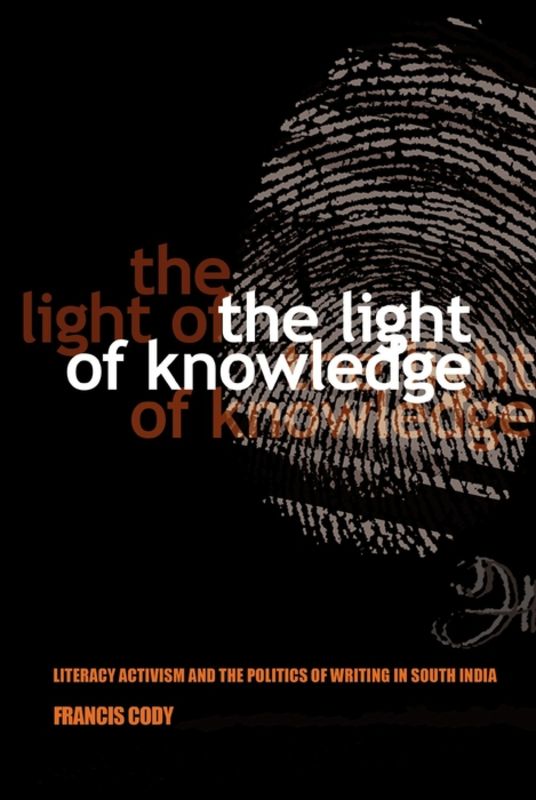
The Light of Knowledge
Since the early 1990s hundreds of thousands of Tamil villagers in southern India have participated in literacy lessons, science demonstrations, and other events designed to transform them into active citizens with access to state power. These efforts to spread enlightenment among the oppressed are part of a movement known as the Arivoli Iyakkam (the Enlightenment Movement), considered to be among the most successful mass literacy movements in recent history. In The Light of Knowledge, Francis Cody's ethnography of the Arivoli Iyakkam highlights the paradoxes inherent in such movements that seek to emancipate people through literacy when literacy is a power-laden social practice in its own right. The Light of Knowledge is set primarily in the rural district of Pudukkottai in Tamil Nadu, and it is about activism among laboring women from marginalized castes who have been particularly active as learners and volunteers in the movement. In their endeavors to remake the Tamil countryside through literacy activism, workers in the movement found that their own understanding of the politics of writing and Enlightenment was often transformed as they encountered vastly different notions of language and imaginations of social order. Indeed, while activists of the movement successfully mobilized large numbers of rural women, they did so through logics that often pushed against the very Enlightenment rationality they hoped to foster. Offering a rare behind-the-scenes look at an increasingly important area of social and political activism, The Light of Knowledge brings tools of linguistic anthropology to engage with critical social theories of the postcolonial state.
eBook

The Light of Knowledge
Cowinner of the Society for Linguistic Anthropology’s Edward Sapir Book Prize Since the early 1990s hundreds of thousands of Tamil villagers in southern India have participated in literacy lessons and other events designed to transform them into active citizens with access to state power. These efforts are part of a movement known as the Arivoli Iyakkam (the Enlightenment Movement), one of the most successful mass literacy movements in recent history. This rich ethnographic account of highlights the paradoxes inherent in such movements that seek to emancipate people through literacy. “A work of linguistic anthropology that makes crucial contributions to the study of literacy and language ideologies. It is also a broadly ranging work of social theory that will be of interest to students and scholars of the postcolonial state and neoliberal governmentality in South Asia and beyond, and of activism and social movements more generally.”—Anthropological Quarterly
eBook

Improving the Criteria for Transmission Line Routing beyond the Techno-Economics: The Case of Afghanistan
It is not always the technical, financial, and environmental aspects of power projects that decisions are based on. There are many other political, social, and local issues shaping the decision-making processes. This research shows how political and social issues challenged the decision-making process of a high-voltage transmission line routing and how to avoid such unwanted consequences in similar projects. Our insights reveal the importance of risk, conflict, and stakeholder management techniques and strategies in successfully delivering power projects. When planning large energy projects, it is of utmost importance to engage and consult stakeholders, especially direct recipients, civil society, political parties, people’s representatives, and experts, in addition to the techno-economic considerations. Finally, it is suggested that there should be an authority at the country level responsible for deciding on routing, siting, prioritizing, and the strategic planning of power projects.
Journal Article

The Religious Enlightenment and the English Jesus-Centered Deists
In most of the twentieth century, the Enlightenment was seen as a time when religious belief was incompatible with Enlightenment values of reason, toleration, and science. David Sorkin maintains that many religious Protestants, Catholics, and Jews emphasized toleration and reason while participating in the secular public sphere. Sorkin asserts that these people were part of the religious Enlightenment. This article focuses on a group of ten English deists who identified themselves as deists, claimed to be Christian, and devoted their writings to explaining their concept of true Christianity. This article argues that these ten deists, whom I label “Jesus-centered deists”, were much more religious than other deists. Like the Protestants, Catholics, and Jews that Sorkin considers part of the religious Enlightenment, these deists emphasized toleration and used reason to defend their conception of God and genuine Christianity. Furthermore, these deists participated in discussions in the public sphere about secular Enlightenment concerns. Unlike stereotypical Enlightenment deists, these Jesus-centered deists did not believe in an inactive and impersonal God. Instead, they believed in a loving and kind God who performed miracles and made revelations. They also emphasized developing a closer relationship with God through prayer. These deists should be included in the religious Enlightenment.
Journal Article

The German Enlightenment and the Rise of Historicism
The German Enlightenment and the Rise of Historicism
traces the thought of a large and neglected group of German
thinkers and their encounter with the ideas and ideal of the
Enlightenment from 1740 to 1790. Concentrating on the nature of
their historical consciousness, Peter Hanns Reill addresses two
basic issues in the interpretation of the Enlightenment: to what
degree can one speak of the unity of the Enlightenment and to what
extent can the Enlightenment be characterized as \"modern\"? Reill
attempts to revise the traditional interpretation of the
Enlightenment as an age insensitive to the postulates of modern
historical thought and to dissolve the alleged opposition of the
Enlightenment to later intellectual developments such as Idealism.
He argues that German Enlightened thinkers generated the general
presuppositions upon which modern historical thought is founded.
Asserting that the Enlightenment was not a unitary movement, Reill
shows how each phase of it had unique elements and made
contributions to Enlightenment thought as a whole. Exploring the
forms of thought, the mental climate, and the different
intellectual milieus in which the German thinkers operated, Reill
demonstrates that they were confronted by two opposing intellectual
traditions: German Pietism and rationalism. In attempting to
reconcile both without submerging one into the other, these
Enlightenment thinkers turned to historical speculation and
learning. They discussed the relation between religious and
rationalistic assumptions, the transformation of the concepts of
religion and law, the interaction between aesthetic and historical
thought, the creation of a theory of understanding to support the
new idea of history, the use of causation in historical analysis,
and the rediscovery of the Middle Ages. Reill reveals how they
anticipated the work of more famous thinkers of the nineteenth
century and establishes the conceptual similarities between
thinkers generally thought to be more different than alike. This
title is part of UC Press's Voices Revived program, which
commemorates University of California Press's mission to seek out
and cultivate the brightest minds and give them voice, reach, and
impact. Drawing on a backlist dating to 1893, Voices Revived makes
high-quality, peer-reviewed scholarship accessible once again using
print-on-demand technology. This title was originally published in
1975.
eBook
A Far Cry from Pluralistic Individualism: Enlightenment Toleration Revisited
In order to highlight the unprecedented character of Enlightenment toleration theories and their decisive role in the intellectual history of modern freedoms, these theories are often depicted as principled, based on individual rights, and aimed at doctrinal pluralism. In contrast, earlier defenses of toleration are usually portrayed as pragmatic, based on reason of state, and aimed at doctrinal consensus. This article challenges the notion that Enlightenment thinkers advocated toleration primarily in the name of pluralism and individual freedom. Instead, it suggests that most of them drew the line between what should and should not be tolerated based on pragmatic considerations aimed at advancing the common interest of political communities, strengthening the state’s power over religious authority, and reuniting societies divided by theological quarrels and wars of religion.
Journal Article
Don Quixote vs. La Palisse (Or: Meaning vs. Truth)
This essay follows the shifting interpretations of Don Quixote from Enlightenment satire to romantic idealism, Nietzschean self-mythmaking, and Camus’s absurdism, to track the growth of a tension between truth and meaning. While Enlightenment readers saw Cervantes’ knight as a pitiable fool at odds with reality, early German romantics recast him as a noble idealist resisting a fact-bound, spiritually thinned modernity. Nietzsche, both engaging with and departing from these romantic views, made Quixote both a warning about cruel disillusionment and a model for life-affirming self-creation—a “self-aware Quixotism” that turns fable into reality. Camus distilled this tradition into two absurd archetypes: La Palisse, embodying meaningless lucidity, and Don Quixote, embracing meaningful illusion. Doubting reconciliation, he urged a modest balance between evidence and lyricism. Today, with scientific lucidity racing ahead and meaning fracturing into curated feeds, the tension between romantic meaning-making and Enlightenment truth-telling endures. Confronting it without surrendering either reality or wonder remains a central philosophical challenge.
Journal Article
The Changing Image of the Church in the Thought of the Enlightened Catholic Intelligentsia
In the last half century, the approach that identifies the influence of the Enlightenment in the academic and public activities of the ecclesiastical intellectuals has taken root in the history of ideas, including in Central and Eastern Europe. One of the aims of this trend is to identify the reform ideas that emerged among the leaders of Christian churches and non-Christian religious communities to modernize pastoral practice. As one of the most important results, the changes that took place in the second half of the 18th century are no longer seen as the inevitable consequence of external forces, primarily from the state, but also as the derivative of internal aspirations in dialog with the ‘Zeitgeist’. Previous scholarly work, however, rarely examined the theoretical considerations behind the reform of religious practice, which can in fact be explained by changes in the image of the church among the ecclesiastical intelligentsia. The study aims to illustrate these changes in the ecclesiastical image by means of three contemporary texts, focused on the episcopal oath and the reform of the clergy.
Journal Article
The Anti-Enlightenment Tradition
In this masterful work of historical scholarship, Zeev Sternhell, an internationally renowned Israeli political scientist and historian, presents a controversial new view of the fall of democracy and the rise of radical nationalism in the twentieth century. Sternhell locates their origins in the eighteenth century with the advent of the Anti-Enlightenment, far earlier than most historians.
The thinkers belonging to the Anti-Enlightenment (a movement originally identified by Friederich Nietzsche) represent a perspective that is antirational and that rejects the principles of natural law and the rights of man. Sternhell asserts that the Anti-Enlightenment was a development separate from the Enlightenment and sees the two traditions as evolving parallel to one another over time. He contends that J. G. Herder and Edmund Burke are among the real founders of the Anti-Enlightenment and shows how that school undermined the very foundations of modern liberalism, finally contributing to the development of fascism that culminated in the European catastrophes of the twentieth century.
eBook
Anti-Semitism, Islamophobia and Anti-Zionism: Discrimination and Political Construction
This article argues that from the end of the 19thcentury, the debate about anti-Semitism became a marker for a wider dispute focusing on the meaning of national identity. Integrating the Jews into the polity was part, and even a justification, of the Enlightenment political project and of the democratic state. However, while the Jewish question was fundamental for politics and philosophy in the Enlightenment, in our time, as the Enlightenment fades, the Muslim question takes its place. This article argues that the goal of integrating Muslims into the Western democratic polity under a culturally blind, egalitarian and secular type of non-discrimination has proven to be unsuccessful. Moreover, rather than pitting racist nationalists against liberal democrats, it has triggered a “civic confrontation” in liberal political thought, between liberal multiculturalists and supporters of religious freedom who understand, on the one hand, and secular democratic integrationists, on the other.
Journal Article