
Catalogue Search | MBRL


Are you sure you want to remove the book from the shelf?

{{itemTitle}}
4,050
result(s) for
"traders"
Sort by:

Slave traders by invitation : West Africa's Slave Coast in the precolonial era
\"The Slave Coast, roughly the shores of present-day Benin and Togo, was the epicentre of the Atlantic Slave Trade. But it was also an inhospitable, surf-ridden coastline, subject to crashing breakers and devoid of permanent human settlement. Nor was it easily accessible from the interior due to a lagoon which ran parallel to the coast. The local inhabitants were not only sheltered against incursions from the sea, but were also locked off from it. Yet, paradoxically, it was this coastline that witnessed a thriving long-term commercial relationship between Europeans and Africans, based on the trans-Atlantic slave trade. How did it come about? How was it all organized? And how did the locals react to the opportunities these new trading relations offered them? The Kingdom of Dahomey is usually cited as the Slave Coast's archetypical slave raiding and slave trading polity. An inland realm, it was a latecomer to the slave trade, and simply incorporated a pre-existing system by dint of military prowess, which ultimately was to prove radically counterproductive. Fuglestad's book seeks to explain the Dahomean 'anomaly' and its impact on the Slave Coast's societies and polities.\"--Book jacket.
Book
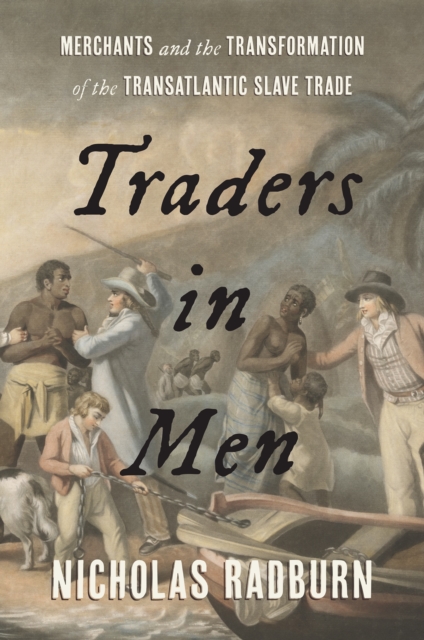
Traders in Men
BA sweeping new history that reveals how British, African, and American merchants developed the transatlantic slave trade/BBR / BR /B\"This is a landmark study given its clear status as easily the best researched and most comprehensive book on the British slave trade to date.\"-David Eltis, coauthor of IAtlas of the Transatlantic Slave Trade/I/BBR / BR /B\"A masterful account of one of the most brutal moments in the history of capitalist modernity. Radburn brilliantly details all aspects of the process of commodification of human beings in the Liverpool slave trade, vividly depicting the long journeys endured by Africans in Africa, across the Atlantic, and in the Americas.\"-Leonardo Marques, Universidade Federal Fluminense/BBR / BR / During the eighteenth century, Britain's slave trade exploded in size. Formerly a small and geographically constricted business, the trade had, by the eve of the American Revolution, grown into a transatlantic system through which fifty thousand men, women, and children were enslaved every year.BR / BR / In this wide-ranging history, Nicholas Radburn explains how thousands of merchants collectively transformed the slave trade by devising highly efficient but violent new business methods. African brokers developed commercial infrastructure that facilitated the enslavement and sale of millions of people. Britons invented shipping methods that quelled enslaved people's constant resistance on the Middle Passage. And American slave traders formulated brutal techniques through which shiploads of people could be quickly sold to colonial buyers. Truly Atlantic-wide in its vision, this study shows how the slave trade dragged millions of people into its terrible vortex and became one of the most important phenomena in world history.
eBook


The Merchant of Havana
LAJSA Book Award Winner, 2017, Latin American Jewish
Studies Association As Cuba industrialized in the
nineteenth century, an epochal realignment of the social order
occurred. In this period of change, two seemingly disparate, yet
nevertheless intertwined, ideological forces appeared:
anti-Semitism and abolitionism. As the antislavery movement became
organized in Cuba, the argument grew that Jews participated in the
African slave trade and in New World slavery, and that this
participation gave Jews extraordinary influence in the new Cuban
economy and culture. What was remarkable about this anti-Semitism
was the decidedly small Jewish population on the island in this
era. This form of anti-Semitism, Silverstein reveals, sprang almost
exclusively from mythological beliefs.
eBook


High-Frequency Trading and Price Discovery
We examine the role of high-frequency traders (HFTs) in price discovery and price efficiency. Overall HFTs facilitate price efficiency by trading in the direction of permanent price changes and in the opposite direction of transitory pricing errors, both on average and on the highest volatility days. This is done through their liquidity demanding orders. In contrast, HFTs' liquidity supplying orders are adversely selected. The direction of HFTs' trading predicts price changes over short horizons measured in seconds. The direction of HFTs' trading is correlated with public information, such as macro news announcements, market-wide price movements, and limit order book imbalances.
Journal Article

Hedge fund market wizards : how winning traders win
\"Hedge Fund Market Wizards will be a modern day sequel to the highly successful Market Wizards and New Market Wizards written over 20 years ago. These two earlier volumes have become classics in the investment literature and have been read by virtually every hedge fund manager, as well as by a much broader lay audience. This new volume in the series will follow the same effective formula used by its predecessors. The book will devote a chapter to each of a broad array of highly successful traders, ranging widely in the markets they trade and their methodologies, but sharing in their achievement of superior performance. Each chapter, following the original format, will include an introductory section, a core section based on an interview with the trader, and a conclusion section that seeks to draw useful trading and investment lessons illustrated by the trader's approach and advice\"-- Provided by publisher.
BOOK

Do Prices Reveal the Presence of Informed Trading?
Using a comprehensive sample of trades from Schedule 13D filings by activist investors, we study how measures of adverse selection respond to informed trading. We find that on days when activists accumulate shares, measures of adverse selection and of stock illiquidity are lower, even though prices are positively impacted. Two channels help explain this phenomenon: (1) activists select times of higher liquidity when they trade, and (2) activists use limit orders. We conclude that, when informed traders can select when and how to trade, standard measures of adverse selection may fail to capture the presence of informed trading.
Journal Article

The trading game : a confession
Ever since he was a kid, kicking broken footballs on the streets of East London in the shadow of Canary Wharf's skyscrapers, Gary wanted something better. Something a whole lot bigger. Then he won a competition run by a bank: 'The Trading Game'. The prize: a golden ticket to a new life, as the youngest trader in the whole city. A place where you could make more money than you'd ever imagined. Where your colleagues are dysfunctional maths geniuses, overfed public schoolboys and borderline psychopaths, yet they start to feel like family. Where soon you're the bank's most profitable trader, dealing in nearly a trillion dollars. A day. Where you dream of numbers in your sleep - and then stop sleeping at all. But what happens when winning starts to feel like losing? The story of the dark heart of an intoxicating world - from someone who survived the game and then blew it all wide open.
Book

Analysis of Big Trader Positions, Firm Profitability, Price Volatility and Their Impact on Sharia Stock Market Prices (A Study of the Jakarta Islamic Index on the Indonesia Stock Exchange)
An intriguing anomaly emerged in the Indonesian market between 2021 and 2023. While the broader Indonesia Sharia Stock Index (ISSI) exhibited a general upward trend (bullish), the Jakarta Islamic Index (JII), which tracks the 30 largest and most liquid Sharia stocks, experienced a persistent decline (bearish). This divergence is a novel phenomenon, as both indices had moved in a coherent manner in the preceding five-year period (2015–2020). This anomaly challenges the Efficient Market Hypothesis (EMH), which posits that stock prices reflect all available information and that such sustained divergence should not occur in an efficient market. This study analyzes the influence of big trader positions, firm profitability, and price volatility on the market price of Sharia stocks, focusing on the Jakarta Islamic Index (JII) in the Indonesia Stock Exchange from 2021 to 2023. The anomaly of JII's declining (bearish) trend amid the rising (bullish) trend of the Indonesia Sharia Stock Index (ISSI) forms the research background. The research objective is to empirically test the direct effects of big trader positions on firm profitability, price volatility, and sharia stock prices, as well as the mediating roles of profitability and price volatility in these relationships. A quantitative approach using quarterly panel data from 18 consistently listed JII stocks was employed. Data analysis was conducted using SEM-PLS. Key findings show that big traders’ positions do not significantly affect profitability or move JII prices, even as JII prices declined during net buying. However, big traders significantly reduce volatility, acting as market stabilizers. Profitability strongly and positively influences JII prices, while low volatility is linked to price declines. Profitability does not mediate the impact of big traders, but volatility does: net buying lowers volatility, which subsequently reduces JII prices. The study offers theoretical contributions to market microstructure and signaling theories, as well as practical insights for investors and regulators in Islamic capital markets.
Journal Article