
Catalogue Search | MBRL


Are you sure you want to remove the book from the shelf?

{{itemTitle}}
4,702
result(s) for
"union certification"
Sort by:

Elemental Tests of the Traditional Rational Voting Model
A simple, robust, quasi-linear, structural general equilibrium rational voting model indicates turnout by voters motivated by the possibility of deciding the outcome is bell-curved in the ex-post winning margin and inversely proportional to electorate size. Applying this model to a large set of union certification elections, which often end in ties, yields exacting, lucid tests of the theory. Voter turnout is strongly related to election closeness, but not in the way predicted by the theory. Thus this relation is generated by some other mechanism, which is indeterminate, as no existing theory explains the nonlinear patterns of turnout in the data.
Journal Article

WHAT BUSINESSES ATTRACT UNIONS? UNIONIZATION OVER THE LIFE CYCLE OF U.S. ESTABLISHMENTS
What types of businesses attract unions? The study develops a theory of union learning and organizing to provide an answer to this question. A union monitors the productivity of establishments in an industry and uses this information to decide which ones to organize. An establishment becomes unionized if the union wins a certification election, the outcome of which can be influenced by costly actions taken by the two parties. The model offers predictions on the nature of union selection, which are examined empirically. Data on union certification elections, matched with data on establishment characteristics, are used to explore where union activity is concentrated.
Journal Article
The Eyes of the Needles: A Sequential Model of Union Organizing Drives, 1999-2004
This paper models three stages of the union organizing drive, using a new dataset covering more than 22,000 drives that took place between 1999 and 2004. The correlated sequential model tracks drives through all of their potential stages: holding an election, winning an election, and reaching first contracts. Only one-seventh of organizing drives that filed an election petition with the NLRB managed to reach a first contract within a year of certification. The model, which controls for the endogeneity of unfair labor practice (ULP) charges, finds that a ULP charge was associated with a 30% smaller cumulative chance of reaching such a contract. ULP charges had less effect on the votes cast than on the decision to hold an election and the ability to reach a first contract. A sequential model such as this one could be extended to test between some competing theories about the determinants of union organizing.
Journal Article

What Leads Organizational Members to Collectivize? Injustice and Identification as Precursors of Union Certification
This paper presents the results of two studies that examine the impact of both social psychological and economic concerns on organizational members' decisions to support or oppose union formation. The studies test the predictions that procedural justice judgments and social identification-two social psychological factors that shape the nature of how people relate to their organizations-have a significant influence on people's support for union certification and on the votes they cast in a union certification election. Importantly, it was predicted that these effects would emerge even after accounting for the influence of people's economic concerns, which have been the primary focus of previous efforts to understand whether people support union formation. The results confirm these predictions and demonstrate that respondents' positions on the unionization issue are shaped by procedural justice (Studies 1 and 2) and social identity (Study 2) even after accounting for economic factors. Furthermore, Study 2 shows that the impact of procedural justice judgments on union certification was partially mediated by social identity. More generally, the results highlight the importance of integrating both social psychological and economic concerns in models designed to explain organizational phenomena such as the formation of unions.
Journal Article

Contractual Wages and the Wage Cushion under Different Bargaining Settings
How does a typically European bargaining system, with collective bargaining and national minimum wage, coexist with low unemployment and high wage flexibility? A unique data set on workers, firms, and collective bargaining contracts in Portugal is used to analyze the determinants of both the contractual wage and the wage cushion (difference between contractual and actual wages). The results indicate that the wage cushion stretches the returns to worker and firm attributes, whereas it shrinks the returns to union power. Therefore, firm‐specific arrangements partly offset collective bargaining, granting firms certain freedom when setting wages. Contractual wages reflect trade unions' egalitarian policy.
Journal Article
UNION STATUS AND DOUBLE-BREASTING AT MULTINATIONAL COMPANIES IN THREE LIBERAL MARKET ECONOMIES
The relationships among employee representation, formal union status, and employer strategies within and across institutional regimes offer a variegated landscape in the context of globalization. Key questions remain as to the relative weight of macro- and micro-level influences on union status at subsidiaries of multinational companies (MNCs). This study analyzes data gathered through coordinated surveys of MNC subsidiaries in Canada, Ireland, and the United Kingdom and tests the extent to which union status and double-breasting depend on home-country variation, host-country influences, and particular organizational characteristics. The authors find support for a combination of effects on both union status and double-breasting. Further analyses test explicit variations on union status within each host context and support arguments that effects depend on the particularities of national industrial relations regimes.
Journal Article


Mutualism beyond the “Mutual”: The Collective Development of a New Zealand Single Industry Town Hospital
This paper discusses mutualism and its links to labourism. It is argued that rather than being contradictory, mutualism is incorporated into union activities in a range of ways beyond formal mutual and cooperative institutions, dependent on contextual differences in the labour movement. Using the case of mutual union and company involvement in the development of a public hospital in a single industry town in New Zealand during the 1960s and 1970s, we find evidence that the goals of management and the unions converged despite tensions at the site of production, and notions of cooperation for the benefit of workers and the wider community were brought to bear. As the workplace was an essential part of the town, the union's interests were not limited to the workplace, but formed part of the social fabric of the town. Through this case, we see that engaging in mutualistic activities does not always demonstrate a weakening union agenda, but rather a method unions may employ towards improved worker welfare. Additionally, this example reminds us that union members are members of wider communities, families and societies, and that the boundaries between worker welfare in the workplace and those outside the workplace are not always easily drawn.
Journal Article
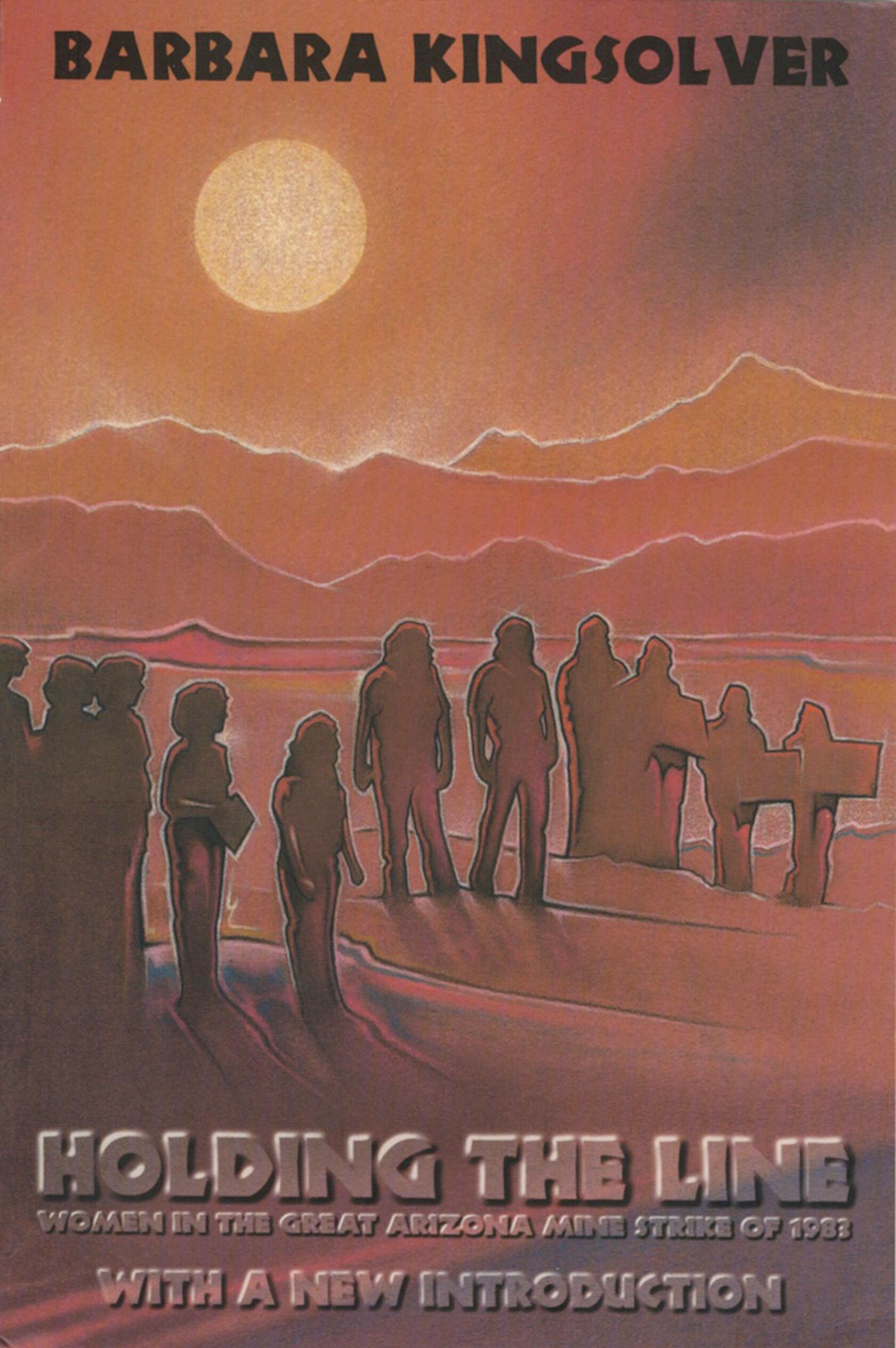
Holding the Line
Holding the Line, Barbara Kingsolver's first non-fiction book, is the story of women's lives transformed by an a signal event. Set in the small mining towns of Arizona, it is part oral history and part social criticism, exploring the process of empowerment which occurs when people work together as a community. Like Kingsolver's award-winning novels,Holding the Lineis a beautifully written book grounded on the strength of its characters.
Hundreds of families held the line in the 1983 strike against Phelps Dodge Copper in Arizona. After more than a year the strikers lost their union certification, but the battle permanently altered the social order in these small, predominantly Hispanic mining towns. At the time the strike began, many women said they couldn't leave the house without their husband's permission. Yet, when injunctions barred union men from picketing, their wives and daughters turned out for the daily picket lines. When the strike dragged on and men left to seek jobs elsewhere, women continued to picket, organize support, and defend their rights even when the towns were occupied by the National Guard. \"Nothing can ever be the same as it was before,\" said Diane McCormick of the Morenci Miners Women's Auxiliary. \"Look at us. At the beginning of this strike, we were just a bunch of ladies.\"
eBook