
Catalogue Search | MBRL


Are you sure you want to remove the book from the shelf?

{{itemTitle}}
12,744
result(s) for
"united states immigration policies"
Sort by:

Open borders and international migration policy : the effects of unrestricted immigration in the United States, France, and Ireland
Although philosophers debate the morality of open borders, few social scientists have explored what would happen if immigration were no longer limited. This book looks at three examples of temporarily unrestricted migration in Miami, Marseille, and Dublin and finds that the effects were much less catastrophic than opponents of immigration claim.
eBook

The politics of immigration in France, Britain, and the United States : a comparative study
Updated through 2012 with all-new material in every chapter, Schain's book provides a detailed, comparative look at the policies that drive and inform immigration politics in three Western countries, and shows how immigration policy has political sources far beyond labor market needs.
eBook
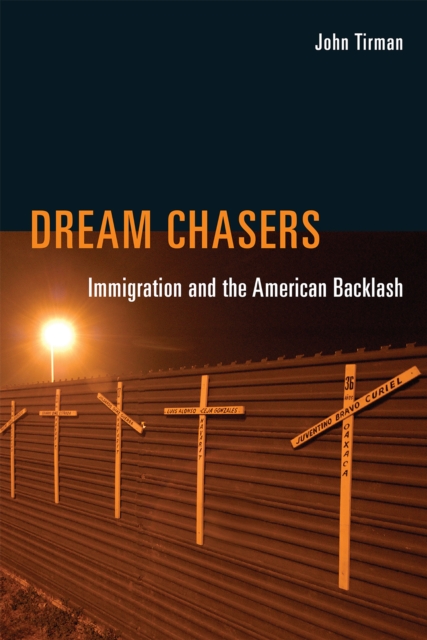
Dream Chasers
Illegal immigration continues to roil American politics. The right-wing media stir up panic over \"anchor babies,\" job stealing, welfare dependence, bilingualism, al-Qaeda terrorists disguised as Latinos, even a conspiracy by Latinos to \"retake\" the Southwest. State and local governments have passed more than 300 laws that attempt to restrict undocumented immigrants' access to hospitals, schools, food stamps, and driver's licenses. Federal immigration authorities stage factory raids that result in arrests, deportations, and broken families -- and leave owners scrambling to fill suddenly open jobs. The DREAM Act, which would grant permanent residency to high school graduates brought here as minors, is described as \"amnesty.\" And yet polls show that a majority of Americans support some kind of path to citizenship for those here illegally. What is going on? In this book, John Tirman shows how the resistance to immigration in America is more cultural than political. Although cloaked in language about jobs and secure borders, the cultural resistance to immigration expresses a fear that immigrants are changing the dominant white, Protestant, \"real American\" culture.Tirman describes the \"raid mentality\" of our response to immigration, which seeks violent solutions for a social phenomenon. He considers the culture clash over Chicano ethnic studies in Tucson, examines the consequences of an immigration raid in New Bedford, and explores the civil rights activism of young \"Dreamers.\" The current \"round them up, deport them, militarize the border\" approach, Tirman shows, solves nothing.
eBook

How race is made in America
How Race Is Made in America examines Mexican Americans—from 1924, when American law drastically reduced immigration into the United States, to 1965, when many quotas were abolished—to understand how broad themes of race and citizenship are constructed. These years shaped the emergence of what Natalia Molina describes as an immigration regime, which defined the racial categories that continue to influence perceptions in the United States about Mexican Americans, race, and ethnicity. Molina demonstrates that despite the multiplicity of influences that help shape our concept of race, common themes prevail. Examining legal, political, social, and cultural sources related to immigration, she advances the theory that our understanding of race is socially constructed in relational ways—that is, in correspondence to other groups. Molina introduces and explains her central theory, racial scripts, which highlights the ways in which the lives of racialized groups are linked across time and space and thereby affect one another. How Race Is Made in America also shows that these racial scripts are easily adopted and adapted to apply to different racial groups.
eBook
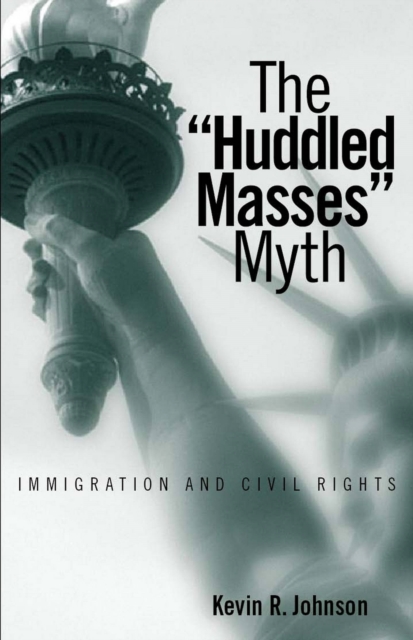
The Huddled Masses Myth
Despite rhetoric that suggests that the United States opens its doors to virtually anyone who wants to come here, immigration has been restricted since the nation began. In this book, Kevin R. Johnson argues that immigration policy reflects the social hierarchy that prevails in American society as a whole and that immigration reform is intertwined with the struggle for civil rights.The \"Huddled Masses\" Myth focuses on the exclusion of people of color, gays and lesbians, people with disabilities, the poor, political dissidents, and other disfavored groups, showing how bias shapes the law. In the nineteenth century, for example, virulent anti-Asian bias excluded would-be immigrants from China and severely restricted those from Japan. In our own time, people fleeing persecution and poverty in Haiti generally have been treated much differently from those fleeing Cuba. Johnson further argues that although domestic minorities (whether citizens or lawful immigrants) enjoy legal protections and might even be courted by politicians, they are regarded as subordinate groups and suffer discrimination. This book has particular resonance today as the public debates the uncertain status of immigrants from Arab countries and of the Muslim faith.
eBook

Opening the floodgates : why America needs to rethink its borders and immigration laws
Seeking to re-imagine the meaning and significance of the international border, Opening the Floodgates makes a case for eliminating the border as a legal construct that impedes the movement of people into this country.
Open migration policies deserve fuller analysis, as evidenced by President Barack Obama’s pledge to make immigration reform a priority. Kevin R. Johnson offers an alternative vision of how U.S. borders might be reconfigured, grounded in moral, economic, and policy arguments for open borders. Importantly, liberalizing migration through an open borders policy would recognize that the enforcement of closed borders cannot stifle the strong, perhaps irresistible, economic, social, and political pressures that fuel international migration.
Controversially, Johnson suggests that open borders are entirely consistent with efforts to prevent terrorism that have dominated immigration enforcement since the events of September 11, 2001. More liberal migration, he suggests, would allow for full attention to be paid to the true dangers to public safety and national security.
eBook

American Gulag
Before September 11, 2001, few Americans had heard of immigration detention, but in fact a secret and repressive prison system run by the U.S. Immigration and Naturalization Service has existed in this country for more than two decades. InAmerican Gulag,prisoners, jailers, and whistle-blowing federal officials come forward to describe the frightening reality inside these INS facilities. Journalist Mark Dow's on-the-ground reporting brings to light documented cases of illegal beatings and psychological torment, prolonged detention, racism, and inhumane conditions. Intelligent, impassioned, and unlike anything that has been written on the topic, this gripping work of investigative journalism should be read by all Americans. It is a book that will change the way we see our country.American Gulagtakes us inside prisons such as the Krome North Service Processing Center in Miami, the Corrections Corporation of America's Houston Processing Center, and county jails around the country that profit from contracts to hold INS prisoners. It contains disturbing in-depth profiles of detainees, including Emmy Kutesa, a defector from the Ugandan army who was tortured and then escaped to the United States, where he was imprisoned in Queens, and then undertook a hunger strike in protest. To provide a framework for understanding stories like these, Dow gives a brief history of immigration laws and practices in the United States-including the repercussions of September 11 and present-day policies. His book reveals that current immigration detentions are best understood not as a well-intentioned response to terrorism but rather as part of the larger context of INS secrecy and excessive authority.American Gulagexposes the full story of a cruel prison system that is operating today with an astonishing lack of accountability.
eBook

Uncharted Terrains
\"We must secure our borders\" has become an increasingly common refrain in the United States since 2001. Most of the \"securing\" has focused on the US-Mexico border. In the process, immigrants have become stigmatized, if not criminalized. This has had significant implications for social scientists who study the lives and needs of immigrants, as well as the effectiveness of programs and policies designed to help them. In this groundbreaking book, researchers describe their experiences in conducting field research along the southern US border and draw larger conclusions about the challenges of contemporary border research.
Each chapter raises methodological and ethical questions relevant to conducting research in transnational contexts, which can frequently be unpredictable or even volatile. The volume addresses the central question of how can scholars work with vulnerable migrant populations along the perilous US-Mexico border and maintain ethical and methodological standards, while also providing useful knowledge to stakeholders? Not only may immigrants be afraid to provide information that could be incriminating, but researchers may also be reluctant to allow their findings to become the basis of harsher law enforcement, unjustly penalize the subjects of their research, and inhibit the formulation of humane and effective immigration policy based on scholarly research.All of these concerns, which are perfectly legitimate from the social scientists' point of view, can put researchers into conflict with legal authorities. Contributors acknowledge their quandaries and explain how they have dealt with them. They use specific topics-reproductive health issues and sexually transmitted diseases among immigrant women, a study of undocumented business owners, and the administration of the Mexican Household Survey in Phoenix, among others-to outline research methodology that will be useful for generations of border researchers.
eBook
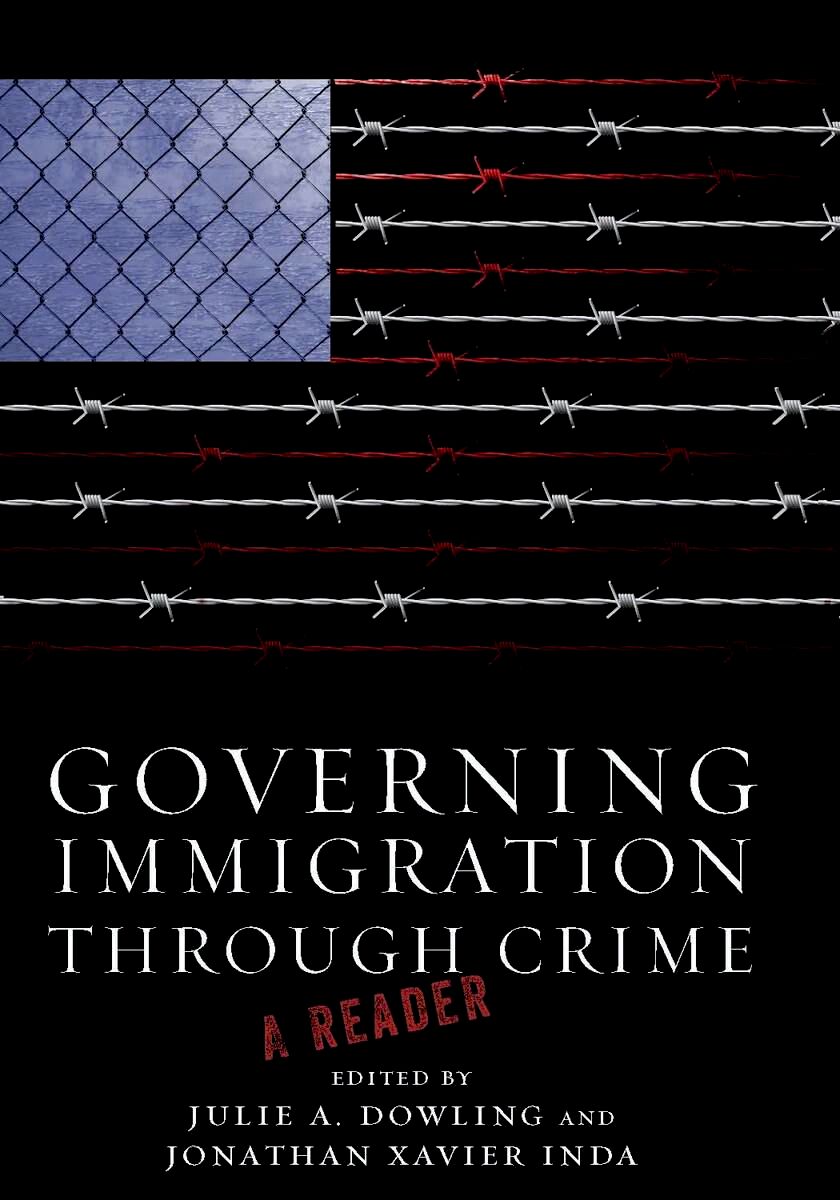
Governing immigration through crime : a reader
In the United States, immigration is generally seen as a law and order issue. Amidst increasing anti-immigrant sentiment, unauthorized migrants have been cast as lawbreakers. Governing Immigration Through Crime offers a comprehensive and accessible introduction to the use of crime and punishment to manage undocumented immigrants. Presenting key readings and cutting-edge scholarship, this volume examines a range of contemporary criminalizing practices: restrictive immigration laws, enhanced border policing, workplace audits, detention and deportation, and increased policing of immigration at the state and local level. Of equal importance, the readings highlight how migrants have managed to actively resist these punitive practices. In bringing together critical theorists of immigration to understand how the current political landscape propagates the view of the \"illegal alien\" as a threat to social order, this text encourages students and general readers alike to think seriously about the place of undocumented immigrants in American society.
eBook

The New Americans
This book sheds light on one of the most controversial issues of the decade. It identifies the economic gains and losses from immigration-for the nation, states, and local areas-and provides a foundation for public discussion and policymaking. Three key questions are explored:
What is the influence of immigration on the overall economy, especially national and regional labor markets?
What are the overall effects of immigration on federal, state, and local government budgets?
What effects will immigration have on the future size and makeup of the nation's population over the next 50 years?
The New Americans examines what immigrants gain by coming to the United States and what they contribute to the country, the skills of immigrants and those of native-born Americans, the experiences of immigrant women and other groups, and much more. It offers examples of how to measure the impact of immigration on government revenues and expenditures-estimating one year's fiscal impact in California, New Jersey, and the United States and projecting the long-run fiscal effects on government revenues and expenditures. Also included is background information on immigration policies and practices and data on where immigrants come from, what they do in America, and how they will change the nation's social fabric in the decades to come.
eBook