
Catalogue Search | MBRL


Are you sure you want to remove the book from the shelf?

{{itemTitle}}
1,501
result(s) for
"vehicle attitude control"
Sort by:
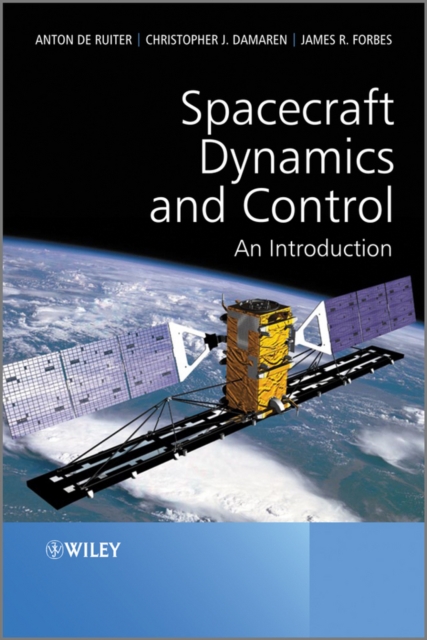
Spacecraft dynamics and control
Provides the basics of spacecraft orbital dynamics plus attitude dynamics and control, using vectrix notation Spacecraft Dynamics and Control: An Introduction presents the fundamentals of classical control in the context of spacecraft attitude control. This approach is particularly beneficial for the training of students in both of the subjects of classical control as well as its application to spacecraft attitude control. By using a physical system (a spacecraft) that the reader can visualize (rather than arbitrary transfer functions), it is easier to grasp the motivation for why topics in control theory are important, as well as the theory behind them. The entire treatment of both orbital and attitude dynamics makes use of vectrix notation, which is a tool that allows the user to write down any vector equation of motion without consideration of a reference frame. This is particularly suited to the treatment of multiple reference frames. Vectrix notation also makes a very clear distinction between a physical vector and its coordinate representation in a reference frame. This is very important in spacecraft dynamics and control problems, where often multiple coordinate representations are used (in different reference frames) for the same physical vector. Provides an accessible, practical aid for teaching and self-study with a layout enabling a fundamental understanding of the subject Fills a gap in the existing literature by providing an analytical toolbox offering the reader a lasting, rigorous methodology for approaching vector mechanics, a key element vital to new graduates and practicing engineers alike Delivers an outstanding resource for aerospace engineering students, and all those involved in the technical aspects of design and engineering in the space sector Contains numerous illustrations to accompany the written text. Problems are
included to apply and extend the material in each chapter Essential reading for graduate level aerospace engineering students, aerospace professionals, researchers and engineers.
eBook

Reliability control for uncertain half-car active suspension systems with possible actuator faults
Active suspension systems have received increased importance for improving automotive safety and comfort. In active suspensions, actuators are placed between the car body and wheel-axle, and are able to both add and dissipate energy from the system, which enables the suspension to control the attitude of the vehicle, to reduce the effects of the vibrations, and then to increase ride comfort and vehicle road handling. However, the attained benefits are paralleled with the increasing possibility of component failures. In this study, a fault-tolerant control approach is proposed to deal with the problem of fault accommodation for unknown actuator failures of active suspension systems, where an adaptive robust controller is designed to adapt and compensate the parameter uncertainties, external disturbances and uncertain non-linearities generated by the system itself and actuator failures. Comparative simulation studies are then given to illustrate the effectiveness of the proposed controllers.
Journal Article

Management of linear quadratic regulator optimal control with full-vehicle control case study
Linear quadratic regulator is a powerful technique for dealing with the control design of any linear and nonlinear system after linearization of the system around an operating point. For small systems, which have fewer state variables, the transformation of the performance index from scalar to matrix form can be straightforward. On the other hand, as the system becomes large with many state variables and controllers, appropriate design and notations should be defined to make it easy to automatically implement the technique for any large system without the need to redesign from scratch every time one requires a new system. The main aim of this article was to deal with this issue. This article shows how to automatically obtain the matrix form of the performance index matrices from the scalar version of the performance index. Control of a full-vehicle in cornering was taken as a case study in this article.
Journal Article
Attitude Control of Rockets
This chapter contains sections titled:
Introduction
Attitude Control Plant
Closed‐Loop Attitude Control
Roll Control System
Pitch Control of Rockets
Yaw Control of Rockets
Summary
Exercises
Reference
Book Chapter

Predicting consumers’ intention to adopt hybrid electric vehicles: using an extended version of the theory of planned behavior model
China is a major energy-consuming country and is under great pressure to improve its energy efficiency as well as reduce its carbon emissions. Hybrid electric vehicles (HEVs), as an energy-efficient transport innovation, have the potential to reduce gasoline consumption, carbon emissions and alleviate environmental problems. Diffusion of HEVs’ adoption is a significant initiative. A sample of 433 respondents has been collected in China to predict the customers’ intention to adopt HEVs, using an extended model of the theory of planned behavior (TPB). The empirical results show that the attitude toward HEVs, subjective norm, perceived behavioral control (the three primary elements of the TPB model) and personal moral norm partially mediate the effect of consumers’ environmental concern on their intention to adopt HEVs. Consumers’ environmental concern affects the adoption intention indirectly and is significantly positively related to the attitude toward HEVs, subjective norm, perceived behavioral control and personal moral norm, which in turn influence the adoption intention positively. The results confirm the appropriateness of the TPB model and verify that the extended TPB model has good explanatory power in predicting consumers’ intention to adopt HEVs. Based on the empirical results, we discuss the implications for promoting the adoption of HEVs and provide suggestions for future study.
Journal Article

The social dilemma of autonomous vehicles
Autonomous vehicles (AVs) should reduce traffic accidents, but they will sometimes have to choose between two evils, such as running over pedestrians or sacrificing themselves and their passenger to save the pedestrians. Defining the algorithms that will help AVs make these moral decisions is a formidable challenge. We found that participants in six Amazon Mechanical Turk studies approved of utilitarian AVs (that is, AVs that sacrifice their passengers for the greater good) and would like others to buy them, but they would themselves prefer to ride in AVs that protect their passengers at all costs. The study participants disapprove of enforcing utilitarian regulations for AVs and would be less willing to buy such an AV. Accordingly, regulating for utilitarian algorithms may paradoxically increase casualties by postponing the adoption of a safer technology.
Journal Article
Adaptive neural observer-based backstepping fault tolerant control for near space vehicle under control effector damage
In this study, a theoretical framework for reconfigurable flight control is developed and applied to near space vehicle (NSV) attitude dynamics. First, NSV reentry mode is described. Second, an adaptive neural network observer is proposed, which ensures asymptotic convergence of the state observer error to zero under control effector damage and uncertainty. Next, a reconfigurable command-filter backstepping controller is designed based on the adaptive neural network observer. The authors focus is on the accommodation of the control effector damage, uncertainty and resulting disturbances. It is shown that the presented new control design results in asymptotic convergence of the attitude tracking error to zero. Finally, simulation results are given to demonstrate the effectiveness and potential of the proposed fault tolerant control scheme.
Journal Article

Attitude Tracking Control of All-Terrain Vehicle with Tandem Active–Passive Suspension
When vehicles with traditional passive suspension systems are driving on complex pavement, the large vibration of the body will result in relatively negative effects on ride comfort, vehicle handling, and stability of passengers and goods. Body attitude tracking control based on tandem active–passive suspension can improve vehicle attitude stability and passability by enabling the body attitude to track an ideal position. In addition, the performance limitations of the actuator are considered in the design of the attitude tracking control algorithms. The attitude tracking performances are investigated in both simulations and real car tests. Two control algorithms which adopt linear quadratic regulator (LQR) and model predictive control (MPC) algorithms, are compared and analyzed in terms of theory and control performance. The simulations and real car tests results show that both attitude tracking control algorithms can effectively track the ideal body attitude with acceptable errors under different pavements, and the control effect of MPC is slightly better than that of LQR. In this way, attitude tracking of car body shows a lot of potential when a vehicle is in harsh environments.
Journal Article

Research on trajectory tracking and body attitude control of autonomous ground vehicle based on differential steering
The differential steering can be used not only as the backup system of steer-by-wire, but also as the only steering system. Because the differential steering is realized through the differential moment between the coaxial left and right driving wheels, the sharp reduction of the load on the inner driving wheel will directly lead to the failure of the differential steering when the four-wheel independent drive electric vehicle approaches the rollover. Therefore, this paper not only realizes the trajectory tracking of autonomous ground vehicle through the differential steering, but also puts forward the body attitude control to improve the handling stability. Firstly, the dynamic and kinematic models of differential steering autonomous ground vehicle (DSAGV) and its roll model are established, and the linear three-degree of freedom vehicle model is selected as the reference model to generate the ideal body roll angle. Secondly, a model predictive controller (MPC) is designed to control the DSAGV to track the given reference trajectory, and obtain the required differential moment and the resulting front-wheel steering angle. Then, a sliding mode controller (SMC) is adopted to control the DSAGV to track the ideal body roll angle, and obtain the required roll moment. The simulation results show that the proposed MPC and SMC can not only make the DSAGV realize the trajectory tracking, but also achieve the body attitude control.
Journal Article

Using extended theory of planned behaviour (TPB) to predict adoption intention of electric vehicles in India
Being a major energy consumer, India is under intense pressure to reduce its energy requirements and greenhouse emissions. Electric vehicles (EVs), a sustainable form of automobile transportation, can reduce the country’s dependence on gasoline while greatly reducing its carbon footprints. The study uses an extended TPB model in order to predict adoption intention of 326 customers towards the purchase of EVs. The sample respondents have been taken from 57 dealerships of five different automobile companies. The empirical analysis of the study shows that attitude, subjective norm, perceived behavioural control, moral norm, and environmental concern have a positive relation with adoption intention of buyers. The findings of study also suggest that extended TPB model is appropriate in predicting the adoption intention of the customers towards the EVs. Based on the results, the study discusses the implications for EVs adoption in India and also provides suggestions for future research.
Journal Article