
Catalogue Search | MBRL


Are you sure you want to remove the book from the shelf?

{{itemTitle}}
54
result(s) for
"villes antiques"
Sort by:

Lost cities of the ancient world
\"A fascinating tour of cities that have been lost to history--from the Neolithic period to the late Roman Empire--that offers a fresh perspective on the roots of urban life. The ruins of ancient Athens, Luxor, and Rome are familiar cornerstones of world history, visited by travelers from across the globe. But what about the cities that have dropped off the map? That have been submerged under water, or swallowed up by the sands of time? Where are they, and what can they tell us about our past? In this compendium of forgotten cities, Philip Matyszak explores the trials, tribulations, and triumphs these cities faced, revealing how people have embarked on the shared endeavor of living together since we first settled down twelve thousand years ago. Illustrated throughout with important artifacts, ruins, and maps, Lost Cities of the Ancient World brings to life the sites and settlements across Europe, the Middle East, and beyond that time forgot, from the sunken city of Pavlopetri in the Mediterranean to the deep cave dwellings of Derinkuyu in Turkey. Four thousand years of human history are covered in this volume, offering unique insights into forgotten cities and ways of life. Matyszak reveals a dynamic network of peoples and cultures who fought and traded between themselves, exchanging inventions, ideas, and philosophies, with the result that people as far apart as Catalhöyükin Turkey and Skara Brae in Scotland's Orkney Islands shared a common heritage. By examining the motivations that first drew populations to gather and settle together, as well as the challenges that led to their cities' abandonment, this visually striking and often surprising book offers us a fresh perspective on our urban origins.\" -- Amazon.com.
Book

Technology and urbanism in Late Bronze Age Egypt
This study examines the distribution of high-status materials in addition to archaeological evidence of their production in the settlements known as royal cities during the New Kingdom in ancient Egypt (c.1550-1069 BC). The research focuses on the site sites of Amarna, Gurob, and Malqata, but incorporates Qantir/Pi-Ramesse for comparison.
eBook

The Hellenistic Far East
In the aftermath of Alexander the Great's conquests in the late fourth century B.C., Greek garrisons and settlements were established across Central Asia, through Bactria (modern-day Afghanistan) and into India. Over the next three hundred years, these settlements evolved into multiethnic, multilingual communities as much Greek as they were indigenous. To explore the lives and identities of the inhabitants of the Graeco-Bactrian and Indo-Greek kingdoms, Rachel Mairs marshals a variety of evidence, from archaeology, to coins, to documentary and historical texts. Looking particularly at the great city of Ai Khanoum, the only extensively excavated Hellenistic period urban site in Central Asia, Mairs explores how these ancient people lived, communicated, and understood themselves. Significant and original, The Hellenistic Far East will highlight Bactrian studies as an important part of our understanding of the ancient world.
eBook

Greece and the Augustan Cultural Revolution
This book examines the impact of the Roman cultural revolution under Augustus on the Roman province of Greece. It argues that the transformation of Roman Greece into a classicizing 'museum' was a specific response of the provincial Greek elites to the cultural politics of the Roman imperial monarchy. Against a background of Roman debates about Greek culture and Roman decadence, Augustus promoted the ideal of a Roman debt to a 'classical' Greece rooted in Europe and morally opposed to a stereotyped Asia. In Greece the regime signalled its admiration for Athens, Sparta, Olympia and Plataea as symbols of these past Greek glories. Cued by the Augustan monarchy, provincial Greek notables expressed their Roman orientation by competitive cultural work (revival of ritual; restoration of buildings) aimed at further emphasising Greece's 'classical' legacy. Reprised by Hadrian, the Augustan construction of 'classical' Greece helped to promote the archaism typifying Greek culture under the principate.
eBook
Memory and the City in Ancient Israel
Ancient cities served as the actual, worldly landscape populated
by \"material\" sites of memory. Some of these sites were personal
and others were directly and intentionally involved in the shaping
of a collective social memory, such as palaces, temples,
inscriptions, walls, and gates. Many cities were also sites of
social memory in a very different way. Like Babylon, Nineveh, or
Jerusalem, they served as ciphers that activated and communicated
various mnemonic worlds as they integrated multiple images,
remembered events, and provided a variety of meanings in diverse
ancient communities.
Memory and the City in Ancient Israel contributes to
the study of social memory in ancient Israel in the late Persian
and early Hellenistic periods by exploring \"the city,\" both urban
spaces and urban centers. It opens with a study that compares basic
conceptualizing tendencies of cities in Mesopotamia with their
counterparts in ancient Israel. Its essays then explore memories of
gates, domestic spaces, threshing floors, palaces, city gardens and
parks, natural and \"domesticated\" water in urban settings,
cisterns, and wells. Finally, the studies turn to particular cities
of memory in ancient Israel: Jerusalem, Samaria, Shechem, Mizpah,
Tyre, Nineveh, and Babylon. The volume, which emerged from meetings
of the European Association of Biblical Studies, includes the work
of Stéphanie Anthonioz, Yairah Amit, Ehud Ben Zvi, KÃ¥re Berge,
Diana Edelman, Hadi Ghantous, Anne Katrine Gudme, Philippe
Guillaume, Russell Hobson, Steven W. Holloway, Francis Landy,
Daniel Pioske, Ulrike Sals, Carla Sulzbach, Karolien Vermeulen, and
Carey Walsh.
eBook
Maritime-Related Cults in the Coastal Cities of Philistia during the Roman Period
Maritime-Related Cults in the Coastal Cities of Philistia during the Roman Period questions the origins and the traditions of the cultic rites practised during Roman times along the southern shores of the Land of Israel. This area was known since biblical times as 'Peleshet' (Philistia), after the name of one of the Sea Peoples that had settled there at the beginning of the Iron Age. Philistia's important cities Jaffa, Ashkelon, Gaza and Rafiah were culturally and religiously integrated into the Graeco-Roman world. At the same time, each city developed its own original and unique group of myths and cults that had their roots in earlier periods. Their emergence and formation were influenced by environmental conditions as well as by ethno-social structures and political circumstances. Philistia's port cities served as crossroads for the routes connecting the main centres of culture and commerce in ancient times. Most of their cults were closely associated with the sea, and reflect the existential dependency of the inhabitants on the sea that supplied them with sustenance and livelihood and was regarded as a divine beneficent power. The myths also echo the lives of the sailors, their beliefs and fears derived from encountering the dangers of the sea: storms, floods, reefs and giant fish portrayed as monsters. The population of the cities was of mixed and varied ethnic and cultural origins. This was the result of the waves of conquests and migrations over the ages, yet each city was noted for its unique ethnic components. The book also deals with the political circumstances, which had a decisive impact on the formation of religious life and cultic rites in all four cities. It sheds new light to the understanding of the events and historical processes in the region.
eBook
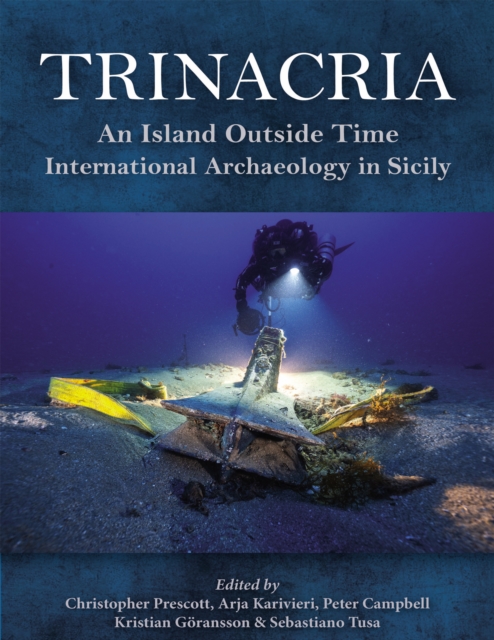
Trinacria, 'An Island Outside Time'
Trinacria, the ancient name for Sicily extending back to Homeric Greek, has understandably been the focus of decades of archaeological research. Recognizing Sicily’s rich prehistory and pivotal role in the history of the Mediterranean, Sebastiano Tusa - professor, head of heritage agencies and councillor for Cultural Heritage for the Sicilian Region - promoted the exploration of the island’s heritage through international collaboration. His decades of fostering research initiatives not only produced rich archaeological results spanning the Palaeolithic to the modern era but brought scholars from a range of schools and disciplines to work together in Sicily. Through his efforts, uniquely productive methodological, theoretical and interpretative networks were created. Their impact extends far beyond Sicily and Italy. To highlight these networks and their results, the Institutum Romanum Finlandiae, the Swedish Institute in Rome, the Norwegian Institute in Rome, the British School at Rome and the Assessorato dei Beni Culturali of Sicily, with generous support from the Swedish Riksbankens Jubileumsfond, assembled this anthology of papers. The aim is to present a selection of the work of and results from contemporary, multi-national research projects in Sicily. The collaboration between the Sicilian and international partners, often in an interdisciplinary framework, has generated important results and perspectives. The articles in this volume present research projects from throughout the island. The core of the articles is concerned with the Archaic through to the Roman period, but diachronic studies also trace lines back to the Stone Age and up to the contemporary era. A range of methods and sources are explored, thus creating an up-to-date volume that is a referential gateway to contemporary Sicilian archaeology.
eBook

Roman imperial cities in the East and in Central-Southern Italy
Ancient cities were sites of social mobility, the coexistence of different ethnic groups, and many cultural activities. Their politics directly involved citizens. This does not seem to be the case for contemporary cities, especially those in southern Italy. There many small and medium-sized towns are no longer attractive to young people, social life is inert, and cultural activities are almost entirely absent. The Ancient Cities project stems from reflections on the contrast between ancient and contemporary cities and aims to suggest new models for social, cultural, and civic development [Publisher's text]
eBook

The Hellenistic settlements in the East from Armenia and Mesopotamia to Bactria and India
This is the third volume of Getzel Cohen’s important work on the Hellenistic settlements in the ancient world. Through the conquests of Alexander the Great, his successors and others, Greek and Macedonian culture spread deep into Asia, with colonists settling as far away as Bactria and India. In this book, Cohen provides historical narratives, detailed references, citations, and commentaries on all the Graeco-Macedonian settlements founded (or refounded) in the East. Organized geographically, Cohen pulls together discoveries and debates from dozens of widely scattered archaeological and epigraphic projects, making a distinct contribution to ongoing questions and opening new avenues of inquiry.
eBook

Trade, Traders and the Ancient City
Trade, exchange and commerce touched the lives of everyone in antiquity, especially those who lived in urban areas. Trade, Traders and the Ancient City addresses the nature of exchange and commerce and the effects it had in cities throughout the ancient world, from the Bronze Age Near East to late Roman northern Italy.Trade, Traders and the Ancient City employs the most recent archaeological, papyrological, epigraphic and literary evidence to present an innovative and timely analysis of the importance and influence of trade in the ancient world.
eBook