
Catalogue Search | MBRL


Are you sure you want to remove the book from the shelf?

{{itemTitle}}
182,666
result(s) for
"visual art"
Sort by:

Visual culture
\"This is a book about how to read visual images: from fine art to photography, film, television, and new media. The third edition of this lively and popular book contains over fifty illustrations, for the first time in colour, as well as new sections and material\"-- Provided by publisher.
Book

The political aesthetics of the Armenian avant-garde
This book addresses late-Soviet and post-Soviet art in Armenia in the context of turbulent transformations from the late 1980s to 2004. It explores the emergence of 'contemporary art' in Armenia from within and in opposition to the practices, aesthetics and institutions of Socialist Realism and National Modernism. This historical study outlines the politics (liberal democracy), aesthetics (autonomous art secured by the gesture of the individual artist), and ethics (ideals of absolute freedom and radical individualism) of contemporary art in Armenia and points towards its limitations. Through the historical investigation, a theory of post-Soviet art historiography is developed, one that is based on a dialectic of rupture and continuity in relation to the Soviet past. As the first English-language study on contemporary art in Armenia, the book is of prime interest for artists, scholars, curators and critics interested in post-Soviet art and culture and in global art historiography.
eBook

Visual art and education in an era of designer capitalism : deconstructing the oral eye
\"The oral eye is a metaphor for the dominance of global designer capitalism. It refers to the consumerism of a designer aesthetic by the 'I' of the neoliberalist subject, as well as the aural soundscapes that accompany the hegemony of the capturing attention through screen cultures. An attempt is made to articulate the historical emergence of such a synoptic machinic regime drawing on Badiou, Bellmer, Deleuze, Guattari, Lacan, Rancière, Virilio, Ziarek, and Zizek to explore contemporary art (post-Situationism) and visual cultural education. Jagodzinski develops the concept of an 'avant-garde without authority, ' 'self-refleXion' and 'in(design)' to further the questions surrounding the posthuman as advanced by theorists such as Hansen, Stiegler and Ziarek's 'force' of art\"-- Provided by publisher.
Book

The Portuguese Restoration of 1640 and Its Global Visualization
The Portuguese Restoration of 1640 ended the dynastic union of Portugal and Spain. This book pioneers in reconstructing the global image discourse related to the event by bringing together visualizations from three decades and four continents. These include paintings, engravings, a statue, coins, emblems, miniatures, a miraculous crosier and other regalia, buildings, textiles, a castrum doloris, drawings, and ivory statues. Situated within the academic field of visual studies, the book interrogates the role of images and depictions before, during, and after the overthrow and how they functioned within the intercontinental communication processes in the Portuguese Empire. The results challenge the conventional notion of center and periphery and reveal unforeseen entanglements as well as an unexpected agency of imagery from the remotest regions under Portuguese control. The book breaks new ground in linking the field of early modern political iconography with transcultural art history and visual studies.
eBook

Picturing Russia : explorations in visual culture
Taking in the entire span of Russia's history, from ancient Kiev to post-Soviet Russia, this book explores her visual culture. It examines the ways that Russians have represented themselves, understood their environment, and used images in social and political contexts.
Book

We Make Each Other Beautiful
We Make Each Other Beautiful focuses on woman of color and queer of color artists and artist collectives who engage in direct political action as a part of their art practice. Defined by public protest, rule-breaking, rebellion, and resistance to governmental and institutional abuse, direct-action \"artivism\" draws on the aims, radical spirit, and tactics of the civil rights and feminist movements and on the struggles for disability rights, queer rights, and immigrant rights to seek legal and social change. Yxta Maya Murray traces the development of artivism as a practice from the Harlem Renaissance to Yoko Ono, Judy Baca, and Marsha P. Johnson. She also studies its role in transforming law and society. We Make Each Other Beautiful profiles the work and lives of four contemporary artivists —Carrie Mae Weems, Young Joon Kwak, Tanya Aguiñiga, and Imani Jacqueline Brown—and the artivist collective Drawn Together, combining new oral histories with sharp analyses of how their diverse and expansive artistic practices bear important aesthetic and politicolegal meanings that address a wide range of injustices.
eBook

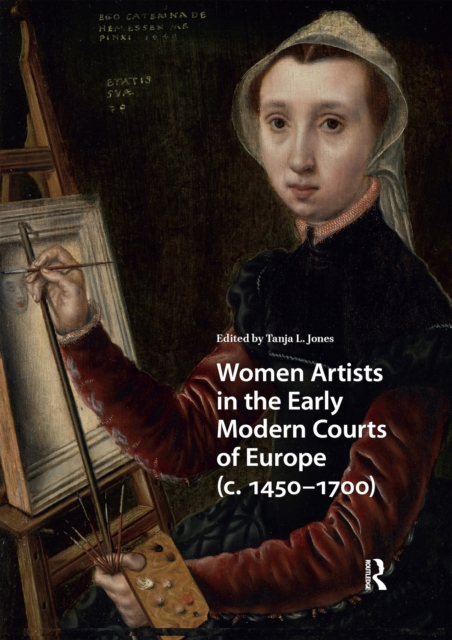
Women Artists in the Early Modern Courts of Europe
Women Artists in the Early Modern Courts of Europe, c. 1450.1700 presents the first collection of essays dedicated to women as producers of visual and material culture in the Early Modern European courts, offering fresh insights into the careers of, among others, Caterina van Hemessen, Sofonisba Anguissola, Luisa Roldán, and Diana Mantuana. Also considered are groups of female makers, such as ladies-in-waiting at the seventeenth-century Medici court. Chapters address works by women who occupied a range of social and economic positions within and around the courts and across media, including paintings, sculpture, prints, and textiles. Both individually and collectively, the texts deepen understanding of the individual artists and courts highlighted and, more broadly, consider the variety of experiences of female makers across traditional geographic and chronological distinctions. The book is also accompanied by the Global Makers: Women Artists in the Early Modern Courts digital humanities project (www.globalmakers.ua.edu), extending and expanding the work begun here.
eBook

Farewell to visual studies
\"A transdisciplinary collection of essays discussing the identity, nature, and future of visual studies as a laboratory for thinking about relations between fields including art history, cultural studies, sociology, visual anthropology, film studies, media studies, postcolonial studies, philosophy of history, the science of vision, and science studies\"--Provided by publisher.
Book

A Delicate Matter
Eighteenth-century France witnessed an unprecedented
proliferation of materially unstable art, from oil paintings that
cracked within years of their creation to enormous pastel portraits
vulnerable to the slightest touch or vibration. In A Delicate
Matter , Oliver Wunsch traces these artistic practices to the
economic and social conditions that enabled them: an ascendant
class of art collectors who embraced fragile objects as a means of
showcasing their disposable wealth.
While studies of Rococo art have traditionally focused on style
and subject matter, this book reveals how the physical construction
of paintings and sculptures was central to the period's
reconceptualization of art. Drawing on sources ranging from
eighteenth-century artists' writings to twenty-first-century
laboratory analyses, Wunsch demonstrates how the technical
practices of eighteenth-century painters and sculptors provoked a
broad transformation in the relationship between art, time, and
money. Delicacy, which began the eighteenth century as a
commodified extension of courtly sociability, was by century's end
reimagined as the irreducible essence of art's autonomous
value.
Innovative and original, A Delicate Matter is an
important intervention in the growing body of scholarship on
durability and conservation in eighteenth-century French art. It
challenges the art historical tendency to see decay as little more
than an impediment to research, instead showing how physical
instability played a critical role in establishing art's meaning
and purpose.
eBook