
Catalogue Search | MBRL


Are you sure you want to remove the book from the shelf?

{{itemTitle}}
3,006
result(s) for
"wah"
Sort by:


Hamas : politics, charity, and terrorism in the service of jihad
How does a group that operates terror cells and espouses violence become a ruling political party? How is the world to understand and respond to Hamas, the militant Islamist organization that Palestinian voters brought to power in the stunning election of January 2006?
This important book provides the most fully researched assessment of Hamas ever written. Matthew Levitt, a counterterrorism expert with extensive field experience in Israel, the West Bank, and Gaza, draws aside the veil of legitimacy behind which Hamas hides. He presents concrete, detailed evidence from an extensive array of international intelligence materials, including recently declassified CIA, FBI, and Department of Homeland Security reports.Levitt demolishes the notion that Hamas' military, political, and social wings are distinct from one another and catalogues the alarming extent to which the organization's political and social welfare leaders support terror. He exposes Hamas as a unitary organization committed to a militant Islamist ideology, urges the international community to take heed, and offers well-considered ideas for countering the significant threat Hamas poses.
eBook

An Analytical Study of the Da'wah Movement of Prophet Muhammad in Relation to Social Movement Theory
This article explores the da’wah activities of Prophet Muhammad through the perspective of social movements to provide new insights. This article explains that the Prophet Muhammad was not only a religious activist who worked to spread Islam but also a statesman who successfully led his followers to establish a new state in Yathrib (Medina). This research focuses on the Prophet's endeavours in political activism through the movement aimed at achieving social and political change. This study will analyse the da’wah movement using social movement perspectives, focusing on structural-functional theory, resource mobilization theory, political opportunity structure, and framing theory. This article argues that the success of the Prophet's da’wah and political initiatives is rooted in the structural conditions of Mecca and the mobilization strategies. The strength of religious narratives and the capacity to exploit narrow political opportunities while generating the new ones have played a vital role to support da’wah activities. This research uses a historical qualitative methodology, leveraging primary and secondary sources to analyse the socio-political landscape of Mecca, the Prophet's resource mobilization techniques, and the framing of his religious messages. This article is an initial investigation into the integration of social movement theories within the context of Islamic social movements, highlighting the importance of overcoming Western secular dominance of social movement studies.
Journal Article

Strategies for the Vocal Jazz Ensemble
When I program music for the next academic year, I'm not only programming jazz standards; I also focus on programming a lot of popular music that contains jazz harmony. Pm fortunate that I always have a solid rhythm section for my ensembles, so I try to have solo features as much as I can (this is why I love having guitar in the combo). For bass solos, I encourage them to play the solo in the upper half of the fret board to show more volume, contour, and versatilely. 4) For guitar: [...]using a wah-wah pedal on the right R&B/Neo-Soul chart could be very intriguing from a color standpoint. 5) For piano:
Journal Article
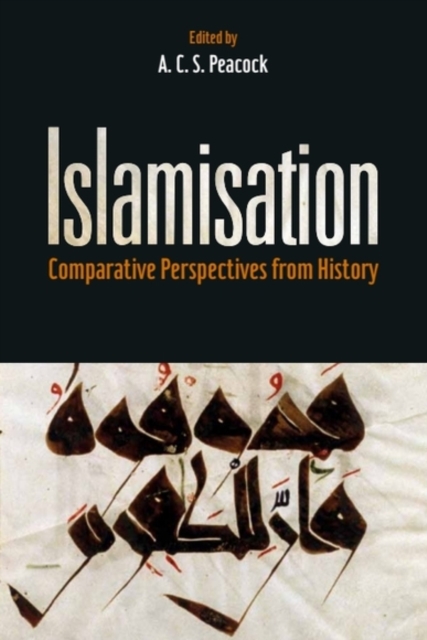
Islamisation
The spread of Islam and the process of Islamisation (meaning both conversion to Islam and the adoption of Muslim culture) is explored in the 25 chapters of this volume.
eBook

“Befo’ de Wah”: Sounding Out Ill-Legibility in Charles W. Chesnutt’s Conjure Stories
In 1969, blues guitarist Earl Hooker released Two Bugs and a Roach, solidifying him as a pioneer of the wah-wah technique. Before the wah-wah pedal, however, there was Charles W. Chesnutt’s Conjure Stories, a collection of frame narratives that recollect plantation life “befo’ de wah”. In this essay, I insist the slide, slip, and compressions of Hooker’s wah-wah voicings find resonance in Chesnutt’s own linguistic play, through which the sonics of Julius’ sociolect texture the text towards speculative spellings, grammars, and meanings that query the logics of white, Enlightenment rationality and its hegemonic conceptions of space, time, value, and subjecthood. In listening to the tales’ resonances with the “wah”, I suggest Chesnutt articulates the “ill-legibility” of plantation existence and its echoes into and out from the present, as evidenced by Hooker’s own disproportionate susceptibility to and lifelong struggle with tuberculosis. In doing so, Julius’ storytelling makes legible modes of survival that attune to how Black bodies persist via the (un)sound logics of illness, slavery, and sonority. Overall, I argue Chesnutt amplifies modes of existence that emerge from the distinct spatio-temporality of the plantation, thus re-forming with and through the ills of slavery and persisting against rational legibility, capital production, and normativity.
Journal Article

Huckleberries and HEPA Filters: Talking Place with Fred Wah
In the late 1950s and early 1960s, he studied music and English at UBC, where he was one of the young writers responsible for the poetry newsletter Tish, which quickly became part of CanLit legend.4 After further studies at the University of New Mexico and SUNY Buffalo, he began his teaching career at Selkirk College in Castlegar, BC, and later taught at the University of Calgary. [...]we've had forest fires up here quite badly, off and on, over the last ten to fifteen years. A couple of years ago I bought a HEPA filter and we put it in the house, so the house has great quality air inside, but going outside you have to wear an N95 mask with the forest fires. No, and as a teenager I worked in the bush in summers, I worked on a fire suppression crew, and I worked as a timber cruiser, so we were around [fires].
Journal Article

From the T-cell receptor to cancer therapy: an interview with Tak W. Mak
This interview is part of a series of articles to mark the 25th anniversary of the launching of Cell Death and Differentiation.
Journal Article
Hybridity in Joshua Whitehead’s Full Metal Indigiqueer
This essay reads Oji-Cree poet Joshua Whitehead’s full metal indigiqueer in relation to hybridity. Whitehead’s poems are both lyrical and experimental, offering a hybrid poetics that resonates with existing critical discussions of hybridity, but he also extends hybrid poetics in new directions through his engagement with posthuman and Indigenous futurism and through his development of Zoa, the hybridized trickster figure who combines the technological and the biological, who features so prominently throughout the collection. Indigiqueerness emerges in these poems as a hybrid identity positioned not only to survive but to thrive in the twenty-first century and beyond.
Journal Article

Writing the Roaming Subject
Engaging current debates within the studies of life writing and of the nation-state,Writing the Roaming Subjectfocuses on a group of Canadian writers who pose questions about cultural difference and national identity while writing about their own lives and their own experiences of displacement. Joanne Saul uses the term 'biotext' to describe the unique form of writing that challenges critical practices regarding both life writing and immigrant and ethnic minority writing by blurring the borders of biography, autobiography, history, fiction and theory, as well as poetry, prose, and visual representation.
In her readings of selected contemporary Canadian biotexts - including Michael Ondaatje'sRunning in the Family, Daphne Marlatt'sGhost Works, Roy Kiyooka'sMothertalk, and Fred Wah'sDiamond Grill- Saul suggests that by crossing generic boundaries, these works illuminate the complex relationships between language, place, and self as they are manifested in textual form.Writing the Roaming Subjectexplores issues of identity formation, representation, and resistance in Canada and suggests that these are particularly crucial questions during a period of Canadian literary history when so many writers are insisting on new, more diverse cultural performances that resist the pull of the national imaginary.
eBook