
Catalogue Search | MBRL


Are you sure you want to remove the book from the shelf?

{{itemTitle}}
68
result(s) for
"weaving pattern"
Sort by:

Innovative Design Algorithm of Huizhou Bamboo Weaving Patterns Based on Deep Learning
In the field of innovative design of Huizhou bamboo weaving patterns, traditional deep learning algorithms cannot fully capture the fine structure and subtle changes of patterns, resulting in distorted or blurred results, and require a lot of computing resources and time during the training process. This paper constructs an improved ViT (Vision Transformer) model to collect diverse Huizhou bamboo weaving pattern data covering different styles and forms. In the data enhancement stage, common enhancement techniques such as rotation, scaling, flipping, and color perturbation are used to increase the diversity of training data. Based on the traditional ViT model, a local self-attention mechanism is applied to replace the traditional global self-attention mechanism. Mixed precision training and distributed training strategies are used to effectively accelerate the training process while maintaining high accuracy. The model automatically generates innovative designs by learning the style and structural characteristics of Huizhou bamboo weaving patterns, and adds a detail repair module in the generation process to enhance the detail expression of the pattern. The experimental results show that the improved ViT model tends to 0.95 after 50 training rounds, indicating that it performs well in detail preservation and structural similarity; with a sample data volume of 5000, the training time of the improved ViT model is 47.4 seconds, and the GPU memory usage is 37.1GB, providing higher computing efficiency. The experimental results prove the effectiveness of this paper’s research on the innovative design algorithm of Huizhou bamboo weaving patterns.
Journal Article

Exploring Gnetum Gnemon L. Fibers In Noken Bag: A Path to Sustainable Material Development Through Mechanical Testing
This research investigates the mechanical properties of Gnetum gnemon L. fibers, a traditional material used in Papua’s UNESCO-recognized Noken bags. The study examined three different weaving patterns (1×1, 2×1, and 2×2) to determine their tensile strength and elongation characteristics. Testing revealed that the 2×2 weave pattern demonstrated the highest tensile strength with a mean breaking force of 678.09 N, while the 1×1 pattern showed the greatest elongation at break at 195.37%. Compared to other natural fibers like pineapple, yucca, coir, cotton, and bamboo, Gnetum gnemon fibers exhibited superior mechanical properties with a tensile strength of 739 N and density of 1.72 g/cm³. These findings suggest significant potential applications in technical textiles, protective clothing, and composite materials. The study highlights the untapped potential of Gnetum gnemon fibers, particularly in Papua where the species is abundant yet underutilized. Further research on durability, environmental resistance, and industrial-scale performance would be valuable for developing practical applications of this promising natural fiber.
Journal Article

Effect of reinforced weave patterns on the mechanical performance and wear resistance of wool-epoxy composites
This work investigates the effects of fabric weave architecture on the mechanical and tribological properties of sheep wool/epoxy composites manufactured using the hand lay-up technique. Four different weave patterns, namely plain, twill, satin, and basket, were fabricated using a manual handloom and reinforced in an epoxy matrix. The mechanical, interfacial, and wear properties were characterized using tensile, flexural, impact, pull-out, and dry sliding wear tests according to ASTM specifications. Among all the architectures, the satin weave architecture showed the maximum tensile strength of 132.6 MPa, flexural strength, and yield strength due to its lower crimp and higher yarn alignment, which favoured better load transfer. On the other hand, twill architecture offered the best tribological characteristics, and the Taguchi L27 analysis evidenced that the sliding distance is the most dominating parameter that controlling the wear rate. The SEM images showed evidence of good fiber-matrix bonding in satin and twill composites, and the plain and basket architectures revealed higher fiber pull-out and brittle fractures. These observations establish that modifications in weaving architecture could help attain significantly improved stiffness, strength, and wear resistance, and thus wool-reinforced epoxy emerges as a bio-sustainable material for light-weight structural and tribological applications.
Journal Article

Modelling the Constitutive Behaviour of Recycled PET for the Manufacture of Woven Fabrics
Recycling polyethylene terephthalate (rPET) from packaging materials consumes a vast amount of energy and incurs significant economic and environmental costs. This study proposes directly recycling rPET into woven fabrics to eliminate reprocessing while still preserving the mechanical performance of the material. The mechanical properties of rPET were tested along two orthogonal directions, and the resulting test data were used to calibrate an elasto-plastic model in order to capture the constitutive behaviour of the material. Additionally, the virtual weaving of rPET fibres into fabrics was modelled using finite element analysis (FEA) to replicate the actual manufacturing process. The results show that rPET that is directly recycled into woven fabrics exhibits superior performance to the same material derived from reprocessing. A strong anisotropy of rPET materials was observed, with distinct elastic and ductile behaviours. The FEA simulation also revealed the critical role of the ductility of rPET fibres when used as warp yarns. The process parameters to achieve a successful weaving operation for different yarn configurations, taking into account the motion and tension of the fibres during manufacture, were also identified. A further sensitivity study highlights the influence of friction between the fibres on the tension force of warp yarns. The virtual manufacture-by-weaving model suggests that utilising rPET with a simplified recycling approach can lead to the sustainable manufacture of fabrics with broad industrial applications.
Journal Article

A Study on the Aesthetic Preference of Bamboo Weaving Patterns Based on Eye Movement Experiments
Bamboo weaving is an intangible cultural heritage in China. Exploring people’s aesthetic preferences for bamboo weaving patterns to better serve the design of bamboo architectural decoration can help promote the upgrading of traditional crafts. This study explored the differences between genders in the oculomotor indicators in different bamboo weaving patterns through an eye-movement experimental study combined with a subjective questionnaire to explore whether different genders have aesthetic preferences for people’s pictures of bamboo weaving patterns. The results showed that both males and females preferred less visually striking and softer corrugated patterns, with males paying more attention to the more ‘angular’ hexagonal and triangular patterns, while females were more interested in the more regular and uniform brickwork and diagonal patterns.
Journal Article

Finite Element Analysis on the Mechanical Properties of Self-lubricating Fabric Liners Based on Periodic Boundary Conditions
A new parameterized finite element model was established for self-lubricating fabric liners in different weaving patterns. This model precisely simulated the spatial configuration of woven yarns with consideration of the cross-section deformation as well as the anisotropic material characteristics of yarns by converting the principal material direction along the yarn-path. Moreover, a set of simple and universal periodic boundary equations was proposed to solve the problem of the overabundance restriction in the boundary surfaces. To verify the validation of the finite element method proposed in this paper, an experimental prediction on elastic constants of self-lubricating fabric liners was carried out. The results indicate that the finite element model can successfully predict the macro mechanical properties of self-lubricating fabric liners with periodical structures. Based on the finite element model, the distributions of stress and strain, as well as the effects of weaving type and weaving density on the elastic modulus of fabric liners were investigated in details.
Journal Article

Weaving and dyeing in highland Ecuador
Although less well known than its much-admired counterparts in Peru and Bolivia, highland Ecuadorian weaving is an Andean tradition that has relationships with these more southern areas. A world away from the industrialized textile manufacturing of Euro-American society, these handmade pieces reflect the history and artistry of an ancient culture.
This comprehensive study, edited by Ann Pollard Rowe, is unrivaled in its detail and includes not only descriptions of the indigenous weaving and dyeing technology, but also an interpretation of its historical significance, as well as hundreds of photographs, drawings, and maps that inform the understanding of the process.
The principal focus is on backstrap-loom weaving, a major pre-Hispanic technology. Ecuadorian backstrap looms, which differ in various ways from those found elsewhere in the Andes, have previously only been treated in general terms. Here, the basic operation of this style of loom is covered, as are a variety of patterning techniques including warp-resist (ikat) dyeing, weaving belts with twill, and supplementary- and complementary-warp patterning. Spanish colonial treadle-loom weaving is also covered. The weaving techniques are explained in detail, so the reader can replicate them if desired.
Textiles have been an important art form among Andean peoples from remote prehistory up to the present. A greater understanding of their creation process can yield a more meaningful appreciation of the art itself.
eBook
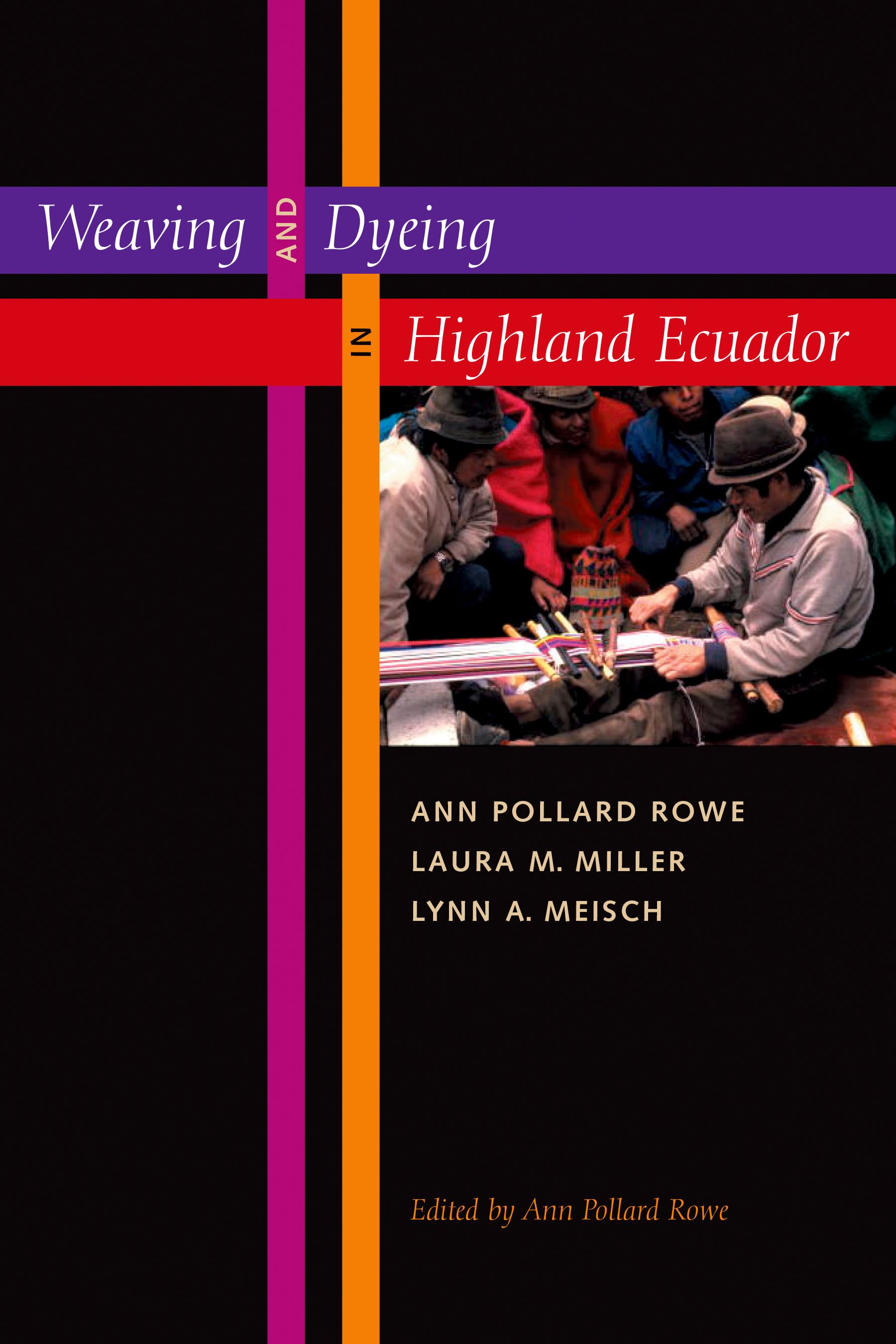
Weaving and Dyeing in Highland Ecuador
Although less well known than its much-admired counterparts in Peru and Bolivia, highland Ecuadorian weaving is an Andean tradition that has relationships with these more southern areas. A world away from the industrialized textile manufacturing of Euro-American society, these handmade pieces reflect the history and artistry of an ancient culture. This comprehensive study, edited by Ann Pollard Rowe, is unrivaled in its detail and includes not only descriptions of the indigenous weaving and dyeing technology, but also an interpretation of its historical significance, as well as hundreds of photographs, drawings, and maps that inform the understanding of the process. The principal focus is on backstrap-loom weaving, a major pre-Hispanic technology. Ecuadorian backstrap looms, which differ in various ways from those found elsewhere in the Andes, have previously only been treated in general terms. Here, the basic operation of this style of loom is covered, as are a variety of patterning techniques including warp-resist (ikat) dyeing, weaving belts with twill, and supplementary- and complementary-warp patterning. Spanish colonial treadle-loom weaving is also covered. The weaving techniques are explained in detail, so the reader can replicate them if desired. Textiles have been an important art form among Andean peoples from remote prehistory up to the present. A greater understanding of their creation process can yield a more meaningful appreciation of the art itself.
eBook

Material Relationships: The Textile and the Garment, the Maker and the Machine: Developing a Composite Pattern Weaving System
This research brings together the disciplines of woven textile design, zero waste pattern cutting and fashion design to form the Composite Pattern Weaving system; an innovative approach to woven garment design and construction which assimilates textile and garment lay-plan design and construction to produce engineered zero waste and integrally shaped woven garments, containing multiple fabric qualities, from a single length of woven textile. The approach challenges conventional textile and fashion design processes and systems by adopting a holistic and simultaneous approach to the design and production of textile and garment components; facilitating the integration of functional and sustainable design strategies to enhance garment durability and longevity through the implementation of a multi-method lifecycle approach to design. This research adopts the Transitional Design Methodology; an alternative approach of working between traditional and advanced technologies which challenges the constraints of the two modes of production whilst capitalising on their advantages. This cyclical iterative approach emphasises the importance of the relationship between the maker, materials and the machine(s), whilst recognising the potential for a transitional dialogue and knowledge transfer between all aspects of hand and digital production. Employing both modes of production in parallel, the Transitional Design Methodology facilitates a reciprocal relationship whereby concepts, designs and ways of working evolve as the maker moves between modes. Through the production of zero waste woven garment prototypes using hand and digital weaving technologies, the research establishes new integral shaping techniques and woven garment construction methods to minimise material production, consumption and waste, and identifies some of the limitations of fully-fashioned and composite garment weaving. The garment prototypes embody the learning and knowledge derived through the application of the Transitional Design Methodology. They demonstrate the advantages of working iteratively between hand and digital modes of design and construction to produce innovative (and interconnected) design outcomes, to advance skills and processes, and enhance personal practice.
Dissertation

The Historical Relationship between the Shawls of Gürün and Iran
About a thousand years ago, Turks settled in Anatolia. Along the way, while migrating from Central Asia, they established a common concept of culture and arts in every country they claimed to be under Turkish sovereignty. For this reason it is possible to find the same motifs in the arts of Anatolia and Central Asia. When Turkmen (Oguz-lar) who had once settled in Turkestan (Horasan and Kirman areas) moved westward, they formed the foundation of the relationship between Iran and Anatolia. This is why much artwork found along this migration route has common Turkish and Iranian features. An example in point are the shawls woven in Sivas-Gürün in Turkey in the nineteenth century that share common features with shawls made in the Kesan and Kirman regions of Iran from the same period.
Journal Article