
Catalogue Search | MBRL


Are you sure you want to remove the book from the shelf?

{{itemTitle}}
1,008
result(s) for
"web comics"
Sort by:

Perfect Copies
Analyzing the way that recent works of graphic narrative use the
comics form to engage with the \"problem\" of reproduction, Shiamin
Kwa's Perfect Copies reminds us that the mode of
production and the manner in which we perceive comics are often
quite similar to the stories they tell. Perfect Copies
considers the dual notions of reproduction, mechanical as well as
biological, and explores how comics are works of reproduction that
embed questions about the nature of reproduction itself. Through
close readings of the comics My Favorite Thing Is Monsters
by Emil Ferris, The Black Project by Gareth Brookes,
The Generous Bosom series by Conor Stechschulte,
Sabrina by Nick Drnaso, and Panther by Brecht
Evens, Perfect Copies shows how these comics makers push
the limits of different ideas of \"reproduction\" in strikingly
different ways. Kwa suggests that reading and thinking about books
like these, that push us to engage with these complicated
questions, teaches us how to become better readers.
eBook

Between Pen and Pixel
2019 Will Eisner Comic Industry Award Nominee, Best
Academic/Scholarly Work In Between Pen and Pixel: Comics,
Materiality, and the Book of the Future , Aaron Kashtan argues
that paying attention to comics helps us understand the future of
the book. Debates over the future of the book tend to focus on
text-based literature, particularly fiction. However, because
comics make the effects of materiality visible, they offer a
clearer demonstration than prose fiction of how the rise of digital
reading platforms transforms the reading experience. Comics help us
see the effects of alterations in features such as publication
design and typography, whereas in print literature, such
transformations often go unnoticed. With case studies of the work
of Alison Bechdel, Matt Kindt, Lynda Barry, Carla Speed McNeil,
Chris Ware, and Randall Munroe, Kashtan examines print comics that
critique digital technology, comics that are remediated from print
to digital and vice versa, and comics that combine print and
digital functionality. Kashtan argues that comics are adapting to
the rise of digital reading technologies more effectively than
print literature has yet done. Therefore, looking at comics gives
us a preview of what the future of the book looks like. Ultimately,
Between Pen and Pixel argues that as print literature
becomes more sensitive to issues of materiality and mediacy, print
books will increasingly start to resemble to comic books.
eBook
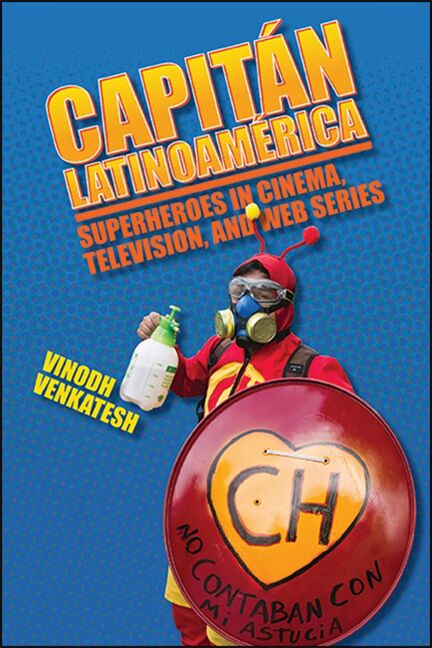
Capitán Latinoamérica
Capitán Latinoamérica is the first study to examine the
unique contribution of Latin American cinema, television, and web
series to the global superhero boom. Through an analysis of
superhero-themed media from Mexico to Argentina, Vinodh Venkatesh
argues that contemporary Latin American superheroes are a hybrid of
regional tropes and figures such as the famed luchador , El
Chapulín Colorado, and North American blockbuster characters from
the DC and Marvel universes. These superheroes channel anxieties
specific to their respective national contexts. In Chile, for
example, Mirageman rehashes and works through the Pinochet
dictatorship and its traumatic aftermath; in Honduras, Chinche Man
confronts neoliberalism and gang violence. In Colombia's El
Man , in turn, rapid urbanization and drug cartels are the
central concerns, whereas corruption and the political machinations
of the state feature most prominently in the television and web
series Capitán Centroamérica . While the Latin American
superhero genre may be superficially characterized by low budgets
and kitsch aesthetics, it also poses profound challenges to the
social, political, and economic status quo. Covering a wide variety
of media bookended by wrestling films from the early 1960s and
multimedia productions from the 2010s, Capitán
Latinoamérica offers a comprehensive introduction to, and
assessment of, the state of the superhero in Latin America.
eBook

Document Parsing Tool for Language Translation and Web Crawling using Django REST Framework
There are 7.5 billion inhabitants and over 7,117 languages existing around the world, but only 20% of the people speak English. To understand the wisdom and knowledge of other cultures language translation becomes a basic need. In this paper, a computer-assisted document parsing tool is investigated. The proposed approach uses a language translator that performs translation from images eliminating the need of a human translator for images avoiding the scope for misinterpretation and misunderstanding among people of different ethnic groups. The proposed tool is also capable of performing web crawling using Django Representational State Transfer framework. Further, the proposed approach employs Python packages such as pytesseract, textblob and beautifulsoup to perform Optical Character Recognition, Translation and Extraction of Hypertext Markup Language data respectively. Experimental results of translation on four different categories of images such as Maps, Comics, Newspapers and Magazines, Scientific Publications demonstrate an accuracy of 97.2%, 93.3%, 95.82% and 98.27% respectively. By considering websites like E-commerce, Magazines, Blogs, Social Media, News and Educational sites average precision of 5.4, recall of 7.45 and F-score of 6.24 is achieved. The results reveal that the proposed system can be used as an improvement over a human translator and a data entry operator.
Journal Article

Blog spotlight
When opening this site by school librarian Matt Imrie, @mattlibrarian on Twitter, the author immediately liked how clean and uncluttered the page is and loved the fact that the newest post was a review about The Territory Book 2 as she has been waiting to read this. There are several ways of navigating this site. It can be searched through recent posts, archives dated monthly like most blog posts or by a substantial list of categories which include titles such as comics, competitions, book lists or displays.
Journal Article

A Linked Open Data model for describing comic book sequences: Exploring semantic enrichment opportunities with graphic medicine
Applying a Linked Open Data (LOD) approach to modeling the visual structure and content of comic books and graphic novels enables the description of these works to be enhanced through the process of semantic enrichment. This strategy may be particularly impactful for graphic medicine, a non-exclusive genre of comics that communicate medical and healthcare information, including personal stories of illness. However, the metadata for these works may lack references to healthcare-related vocabulary, thesauri or ontology that would more precisely describe their contents. This material may include pages and panels that illustrate specific medical topics, such as symptoms, side-effects or treatments — subjects that often overlap with other healthcare challenges, including mental health and illness. Exploring an LOD approach for describing comics content may potentially enhance the discoverability of this material and its ability to be remixed and reused, and better connected to other information resources.
Journal Article

The Platformization of Culture: Webtoon Platforms and Media Ecology in Korea and Beyond
This article examines the webtoon (wept'un)—a term coined in Korea to refer to webcomics—which is arguably the most pervasive and powerful form of digital serial production in twenty-first-century Korea. Webtoons have developed by utilizing various potentials that the digital platform offers, such as open solicitation, (partial) free web/mobile distribution, profit from advertisement and page viewing, and transmedia production. As a new cultural medium, the webtoon is thus inseparable from its platform and organically tied to its distinctive platform ecology, which is different from the ecosystems that other (global) mega-platforms create. Engaging with the insights from recent studies of platforms and utilizing empirical media analysis, I argue that Korean webtoon platforms demonstrate the continuing and intensifying dependency of art on platforms—a process that I call “the platformization of culture”—and that this specific type of platformization is reinforced by what I call “the artist incubating system.” The case of webtoon platforms reveals a number of telling aspects of media ecosystems for art production in the digital age—aspects that are spreading and expanding to various fields of art.
Journal Article

Spreadable Media
Spreadable Media maps fundamental changes taking place in our contemporary media environment, a space where corporations no longer tightly control media distribution and many of us are directly involved in the circulation of content. It contrasts stickiness - aggregating attention in centralized places - with spreadability - dispersing content widely through both formal and informal networks,some approved, many unauthorized. Stickiness has been the measure of success in the broadcast era (and has been carried over to the online world), but spreadability describes the ways content travels through social media.Following up on the hugely influential Convergence Culture: Where Old and New Media Collide, this book challenges some of the prevailing metaphors and frameworks used to describe contemporary media, from biological metaphors like memes and viral to the concept of Web 2.0 and the popular notion of influencers. Spreadable Media examines the nature of audience engagement,the environment of participation, the way appraisal creates value,and the transnational flows at the heart of these phenomena. It delineates the elements that make content more spreadable and highlights emerging media business models built for a world of participatory circulation. The book also explores the internal tensions companies face as they adapt to the new communication reality and argues for the need to shift from hearing to listening in corporate culture.Drawing on examples from film, music, games, comics, television,transmedia storytelling, advertising, and public relations industries,among others - from both the U.S. and around the world - the authors illustrate the contours of our current media environment.They highlight the vexing questions content creators must tackle and the responsibilities we all face as citizens in a world where many of us regularly circulate media content. Written for any and all of us who actively create and share media content, Spreadable Media provides a clear understanding of how people are spreading ideas and the implications these activities have for business, politics, and everyday life.
eBook
Mastering Manga Studio 5
Key benefitsMake Manga Studio 5 your own personalized software by creating your own workspace, tools, page layouts, and materialsExplore using 3D models, actions, ruler tools, and creating projects to save you timeFull of examples, illustrations, and tips with a lighthearted and fun style to make comic creation fun and easyDescriptionTime is something that almost every artist doesn't have enough of. If you're an illustrator or comic creator you know just how much time and effort it can take to produce one great page. But the features in Manga Studio 5 can make this process a lot more streamlined and give you more time to create! \"Mastering Manga Studio 5\" will teach you how to create more comics and illustrations in less time than you ever thought possible. By using the features of Manga Studio 5 like the Story Editor, Custom brushes, actions, materials, and 3D models, you'll learn how to make Manga Studio work for your style and workflow. Go from being a novice Manga Studio user to an expert using the tricks, techniques, and projects in this guide. Learn how to make and share custom tools, set up left- and right-handed workspaces, make custom materials, alter 3D models, and create custom actions. By putting together a custom story project and making your own tools, automating redundant processes, and converting an inked art into a traditional comic art, you'll learn all about the advanced features of Manga Studio 5. \"Mastering Manga Studio 5\" will teach you what you need to know to produce more work in less time.Who is this book for?This book is for those who already have some Manga Studio and graphics program experience. It is not a beginner's guide, but if you are a novice Manga Studio 5 user it will help you to master the time-saving features of the software.What you will learnSet up and save custom page templates to use in your comicsLearn how to use the story editor features efficientlyCreate custom workspaces for drawing, coloring, and moreMake custom sets of colors and use them to speed up your coloring processSearch, use, navigate, edit, and make materialsLearn how to insert, pose, and edit 3D modelsAutomate actions for redundant processesIntegrate everything learned to create a finished, colored comic page
eBook

Drawing everyday sexism in academia: observations and analysis of a community-based initiative
Sexist behaviour in the workplace contributes to create a hostile environment, hindering the chance of women and gender non-conforming individuals to pursue an academic career, but also reinforcing gender stereotypes that are harmful to their progress and recognition. The Did this really happen?! project aims at publishing real-life, everyday sexism in the form of comic strips. Its major goal is to raise awareness about unconscious biases that transpire in everyday interactions in academia and increase the visibility of sexist situations that arise within the scientific community, especially to those who might not notice it. Through the website didthisreallyhappen.net, we collect testimonies about everyday sexism occurring in the professional academic environment (universities, research institutes, scientific conferences…). We translate these stories into comics and publish them anonymously without any judgement or comments on the website. By now, we have collected over 100 testimonies. From this collection, we identified six recurrent patterns: (1) behaviours that aim at maintaining women in stereotypical feminine roles, (2) behaviours that aim at maintaining men in stereotypical masculine roles, (3) the questioning of the scientific skills of female researchers, (4) situations where women have the position of an outsider, especially in informal networking contexts, (5) the objectification of women, and (6) the expression of neosexist views. We first present a detailed analysis of these categories, then we report on the different ways we interact and engage with the Earth science community, the scientific community at large and the public in this project.
Journal Article