
Catalogue Search | MBRL


Are you sure you want to remove the book from the shelf?

{{itemTitle}}
46
result(s) for
"witch hunts"
Sort by:

The Devil
\"Although the Devil still 'lives' in modern popular culture, for the past 250 years he has become marginal to the dominant concerns of Western intellectual thought. That life could not be thought or imagined without him, that he was a part of the everyday, continually present in nature and history, and active at the depths of our selves, has been all but forgotten. It is the aim of this work to bring modern readers to a deeper appreciation of how, from the early centuries of the Christian period through to the recent beginnings of the modern world, the human story could not be told and human life could not be lived apart from the 'life' of the Devil. With that comes the deeper recognition that, for the better part of the last two thousand years, the battle between good and evil in the hearts and minds of men and women was but the reflection of a cosmic battle between God and Satan, the divine and the diabolic, that was at the heart of history itself.\"-fromThe Devil
Lucifer, Mephistopheles, Beelzebub; Ha-Satan or the Adversary; Iblis or Shaitan: no matter what name he travels under, the Devil has throughout the ages and across civilizations been a compelling and charismatic presence. In Christianity, Judaism, and Islam, the supposed reign of God has long been challenged by the fiery malice of his opponent, as contending forces of good and evil have between them weighed human souls in the balance.
InThe Devil, Philip C. Almond explores the figure of evil incarnate from the first centuries of the Christian era. Along the way, he describes the rise of demonology as an intellectual and theological pursuit, the persecution as witches of women believed to consort with the Devil and his minions, and the decline in the belief in Hell and in angels and demons as corporeal beings as a result of the Enlightenment. Almond shows that the Prince of Darkness remains an irresistible subject in history, religion, art, literature, and culture.
Almond brilliantly locates the \"life\" of the Devil within the broader Christian story of which it is inextricably a part; the \"demonic paradox\" of the Devil as both God's enforcer and his enemy is at the heart of Christianity. Woven throughout the account of the Christian history of the Devil is another complex and complicated history: that of the idea of the Devil in Western thought. Sorcery, witchcraft, possession, even melancholy, have all been laid at the Devil's doorstep. Until the Enlightenment enforced a \"disenchantment\" with the old archetypes, even rational figures such as Thomas Aquinas were obsessed with the nature of the Devil and the specific characteristics of the orders of demons and angels. It was a significant moment both in the history of demonology and in theology when Benedict de Spinoza (1632-1677) denied the Devil's existence; almost four hundred years later, popular fascination with the idea of the Devil has not yet dimmed.
eBook

Scholarship Suppression: Theoretical Perspectives and Emerging Trends
This paper explores the suppression of ideas within an academic scholarship by academics, either by self-suppression or because of the efforts of other academics. Legal, moral, and social issues distinguishing freedom of speech, freedom of inquiry, and academic freedom are reviewed. How these freedoms and protections can come into tension is then explored by an analysis of denunciation mobs that exercise their legal free speech rights to call for punishing scholars who express ideas they disapprove of and condemn. When successful, these efforts, which constitute legally protected speech, will suppress certain ideas. Real-world examples over the past five years of academics that have been sanctioned or terminated for scholarship targeted by a denunciation mob are then explored.
Journal Article

Sages and Hail: An Inquiry into Hail Interpretation in Ming China
Between the 15th and 17th centuries, as the Northern Hemisphere entered the Little Ice Age, the scale and frequency of hailstorms increased. In Ming Dynasty China, following the Han Dynasty’s “Interaction Between Heaven and Mankind” doctrine and the pre-Qin Confucian classic Zuo Zhuan’s interpretation that “when a sage rules, there is no hail,” linked these disasters to the moral conduct of the emperor. Others took a more agnostic, naturalistic approach, but in both cases, scapegoating was largely avoided. Building on existing Western scholarship on the link between witch hunts and hail, this paper will use Chinese classical interpretations, historical records of hail events from the Ming Dynasty, and the reactions of emperors and Confucian scholars as a point of reference. It aims to compare and contrast the different understandings and responses to hail disasters in Ming China and Europe.
Journal Article

Witch-hunting: A Human Rights Perspective in South Africa and Zimbabwe
This article underscored the human rights implications of witch-hunts in selected areas of South Africa and Zimbabwe. The thorny issue at the focus of this article is that, despite good harvests, technological developments and other economic progress worldwide, witch-killings are still a serious problem. The article argued that, in cases where people suspect foul play or do not understand what transpires in life, cultural and modern ordeals are resorted to in order to identify a ‘witch.’ These witch-hunts result in gross human rights violations. A synthesis of qualitative data collection methods and legal research methods were used to collect data. Participants in Zimbabwe and South Africa were selected through purposive and snowball sampling. The study employed a human-rights based approach. The study revealed that self-styled witch-finders’ practices are unethical, unlawful and a direct gross human rights violation. The study showed that the accusers often stand to gain in some way and exploit the vulnerability of those they accuse. The study recommended that peace officers and the judicial system should take stern measures to ensure that an urgent and holistic approach is adopted.
Journal Article

Origins of the Witches’ Sabbath
While the perception of magic as harmful is age-old, the notion
of witches gathering together in large numbers, overtly worshiping
demons, and receiving instruction in how to work harmful magic as
part of a conspiratorial plot against Christian society was an
innovation of the early fifteenth century. The sources collected in
this book reveal this concept in its formative stages.
The idea that witches were members of organized heretical sects
or part of a vast diabolical conspiracy crystalized most clearly in
a handful of texts written in the 1430s and clustered
geographically around the arc of the western Alps. Michael D.
Bailey presents accessible English translations of the five oldest
surviving texts describing the witches' sabbath and of two witch
trials from the period. These sources, some of which were
previously unavailable in English or available only in incomplete
or out-of-date translations, show how perceptions of witchcraft
shifted from a general belief in harmful magic practiced by
individuals to a conspiratorial and organized threat that led to
the witch hunts that shook northern Europe and went on to influence
conceptions of diabolical witchcraft for centuries to come.
Origins of the Witches' Sabbath makes freshly available
a profoundly important group of texts that are key to understanding
the cultural context of this dark chapter in Europe's history. It
will be especially valuable to those studying the history of
witchcraft, medieval and early modern legal history, religion and
theology, magic, and esotericism.
eBook
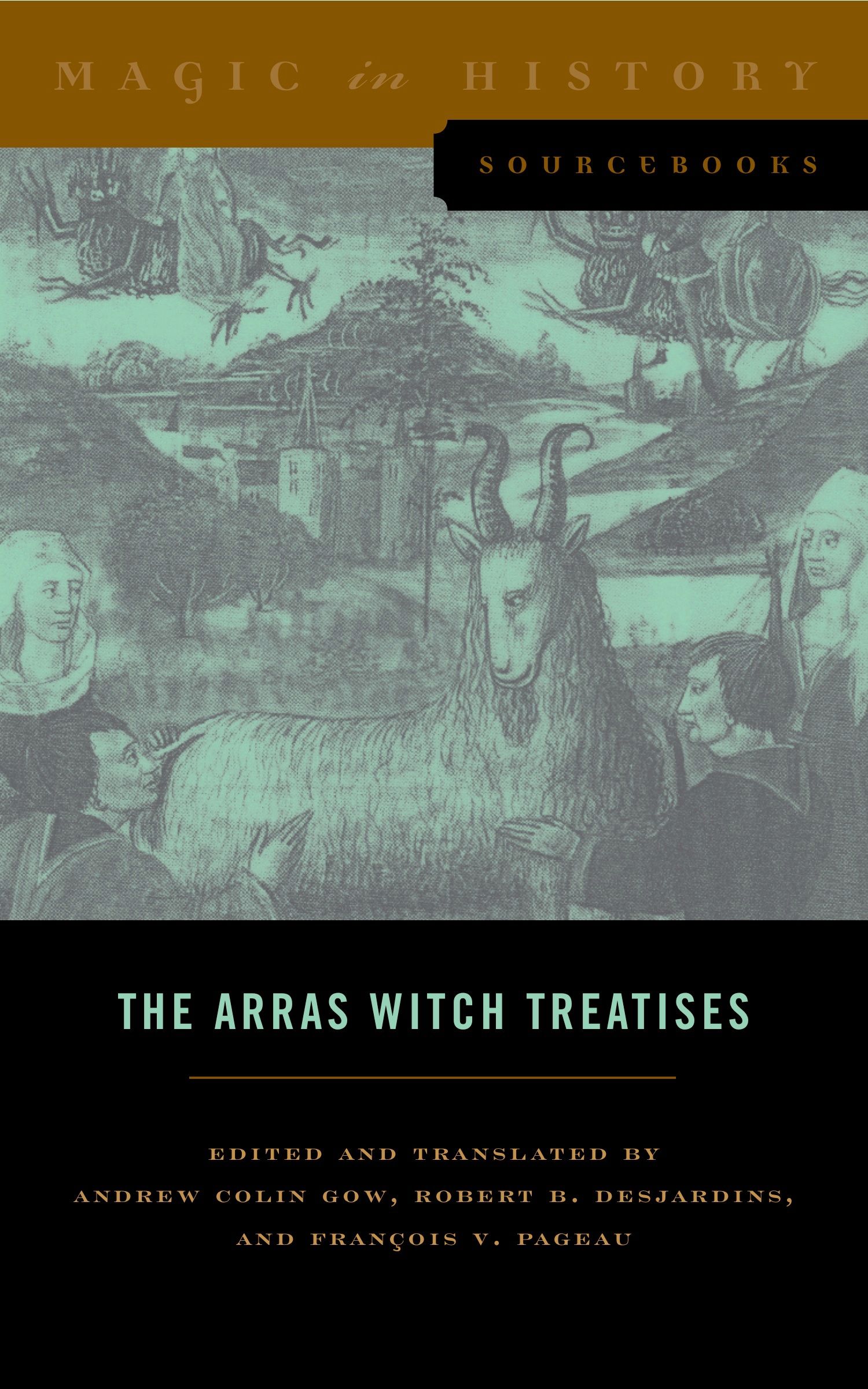
The Arras Witch Treatises
This is the first complete and accessible English translation of two major source texts—Tinctor's Invectives and the anonymous Recollectio—that arose from the notorious Arras witch hunts and trials in the mid-fifteenth century in France. These writings, by the \"Anonymous of Arras\" (believed to be the trial judge Jacques du Bois) and the intellectual Johannes Tinctor, offer valuable eyewitness perspectives on one of the very first mass trials and persecutions of alleged witches in European history. More importantly, they provide a window onto the early development of witchcraft theory and demonology in western Europe during the late medieval period—an entire generation before the infamous Witches' Hammer appeared.
Perfect for the classroom, The Arras Witch Treatises includes a reader-friendly introduction situating the treatises and trials in their historical and intellectual contexts. Scholars, students, and others interested in the occult will find these translations invaluable.
eBook

‘Viral’ Hunts? A Cultural Darwinian Analysis of Witch Persecutions
The theory of Darwinian cultural evolution is gaining currency in many parts of the socio-cultural sciences, but it remains contentious. Critics claim that the theory is either fundamentally mistaken or boils down to a fancy re-description of things we knew all along. We will argue that cultural Darwinism can indeed resolve long-standing socio-cultural puzzles; this is demonstrated through a cultural Darwinian analysis of the European witch persecutions. Two central and unresolved questions concerning witch-hunts will be addressed. From the fifteenth to the seventeenth centuries, a remarkable and highly specific concept of witchcraft was taking shape in Europe. The first question is: who constructed it? With hindsight, we can see that the concept contains many elements that appear to be intelligently designed to ensure the continuation of witch persecutions, such as the witches’ sabbat, the diabolical pact, nightly flight, and torture as a means of interrogation. The second question is: why did beliefs in witchcraft and witch-hunts persist and disseminate, despite the fact that, as many historians have concluded, no one appears to have substantially benefited from them? Historians have convincingly argued that witch-hunts were not inspired by some hidden agenda; persecutors genuinely believed in the threat of witchcraft to their communities. We propose that the apparent ‘design’ exhibited by concepts of witchcraft resulted from a Darwinian process of evolution, in which cultural variants that accidentally enhanced the reproduction of the witch-hunts were selected and accumulated. We argue that witch persecutions form a prime example of a ‘viral’ socio-cultural phenomenon that reproduces ‘selfishly’, even harming the interests of its human hosts.
Journal Article
Debating the Devil’s Clergy. Demonology and the Media in Dialogue with Trials (14th to 17th Century)
In comparison with the estimated number of about 60,000 executed so-called witches (women and men), the number of executed and punished witch-priests seems to be rather irrelevant. This statement, however, overlooks the fact that it was only during medieval and early modern times that the crime of heresy and witchcraft cost the life of friars, monks, and ordained priests at the stake. Clerics were the largest group of men accused of practicing magic, necromancy, and witchcraft. Demonology and the media (in constant dialogue with trials) reveal the omnipresence of the devil’s cleric with his figure possessing the quality of a ‘super-witch’, labelled as patronus sagarum. In Western Europe, the persecution of Catholic priests played at least two significant roles. First, in confessional debates, it proved to Catholics that Satan was assaulting post-Tridentine Catholicism, the only remaining bulwark of Christianity; for Protestants on the other hand, the news about the devil’s clergy proved that Satan ruled popedom. Second, in the Old Reich and from the start of the 17th century, the prosecution of clerics as the devil’s minions fueled the general debates about the legitimacy of witchcraft trials. In sketching these over-lapping discourses, we meet the devil’s clergy in Catholic political demonology, in the media and in confessional debates, including polemics about Jesuits being witches and sorcerers. Friedrich Spee used the narratives about executed Catholic priests as vital argument to end trials and torture. Inter alia, battling the devil’s clergy played a vital role in campaigns of internal Catholic church reform and clerical infighting. Studying the debates about the devil’s clergy thus provides a better understanding of how the dynamics of the Reformation, counter-Reformation, Catholic Reform, and confessionalization had an impact on European witchcraft trials.
Journal Article

Hexenhaus
A powerful novel about three young women caught in the hysteria of their own times. In 1628, Veronica and her brother flee for their lives into the German woods after their father is burned at the stake. At the dawn of the eighteenth century, Scottish maid Katherine is lured into political dissent after her parents are butchered for their beliefs. In present-day Australia, Paisley navigates her way through the burning torches of small-town gossip after her mother's new-age shop comes under scrutiny.
eBook

The logic of hatred and its social and historical expressions: From the great witch-hunt to terror and present-day djihadism
In two important books, the French philosopher Jacob Rogozinski analyses the logic of hatred underlying the great witch-hunt at the beginning of modern times, the period of terror following the French and the Russian Revolution and present-day djihadism. According to his analysis, the same logic of hatred is at work in these historical phenomena. The confrontation with the martyrs-murderers of djihadism, challenges the self-understanding of the defenders of democracy. Just as, on the level of religion, one must give up the dream of a reformation that would make Islam more « moderate », and help the Islamic believers become more radical, but otherwise than more fanatical, by rediscovering their forgotten treasures, on a political level, democracy too needs to be radicalized.
Journal Article