Asset Details
Do you wish to reserve the book?

Those barren leaves : a novel

Hey, we have placed the reservation for you!
By the way, why not check out events that you can attend while you pick your title.

Oops! Something went wrong.
Looks like we were not able to place the reservation. Kindly try again later.
Are you sure you want to remove the book from the shelf?
Those barren leaves : a novel

Do you wish to request the book?
Those barren leaves : a novel
Please be aware that the book you have requested cannot be checked out. If you would like to checkout this book, you can reserve another copy

We have requested the book for you!
Your request is successful and it will be processed during the Library working hours. Please check the status of your request in My Requests.
Oops! Something went wrong.
Looks like we were not able to place your request. Kindly try again later.
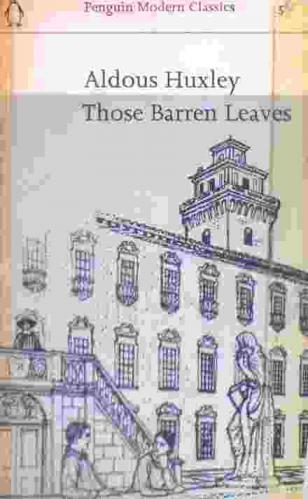
Those barren leaves : a novel
Available to read in the library!
Overview
\"Those Barren Leaves,\" shows how people who might be expected to be more enlightened are as self-centered as the mass of humanity. The setting of the novel, which deals with a circle of British intellectuals in Italy, immediately and powerfully reinforces the fact of the characters' social isolation. Mrs. Lilian Aldwinkle, a patroness of the arts and a votary of love, wants to believe that the whole world revolves around her. As usual, she is possessive of her guests, who have assembled at her newly bought palace of Cybo Malaspina in the village of Vezza in Italy, and she wants them to do as she commands. She is unable, however, to hold them completely under her control. In spite of all her efforts, she fails to win the love of Calamy, and later of Francis Chelifer; Chelifer remains unmoved even when she goes down on her knees and begs for his love. She sinks into real despair when her niece escapes her smothering possessiveness and falls in love with Lord Hovenden. Well past her youth, Mrs. Aldwinkle finds herself left alone with nobody to blame but herself for her plight. Miss Mary Thriplow and Francis Chelifer are both egocentric writers who are cut off from the world of real human beings. Miss Thriplow is obsessed with her suffering and pain, which are mostly self-induced. Her mind is constantly busy, spinning stories on gossamer passions she experiences while moving, talking, and loving. Conscious of the unreality of the life of upper-class society, Chelifer gives up poetry and also the opportunity of receiving a fellowship at Oxford in favor of a job as editor of The Rabbit Fanciers' Gazette in London. The squalor, the repulsiveness, and the stupidity of modern life constitute, in Chelifer's opinion, reality. Because it is the artist's duty to live amid reality, he lives among an assorted group of eccentrics in a boardinghouse in Gog's court, which he describes as \"the navel of reality.\" If Miss Thriplow is lost in her world of imagination and art, Chelifer is lost in \"the navel of reality\" -- equidistant from the heart of reality. Through the character of Calamy, Huxley suggests a way to overcome the perverse modern world. Rich, handsome, and hedonistic, Calamy was once a part of that world, but he no longer enjoys running after women, wasting his time in futile intercourse, and pursuing pleasure. Rather, he spends his time reading, satisfying his curiosity about things, and thinking. He withdraws to a mountain retreat, hoping that his meditation will ultimately lead him into the mysteries of existence, the relationship between human beings, and that between humanity and the external world. Calamy's withdrawal to a mountain retreat is, no doubt, an unsatisfactory solution, particularly in view of the problem of egocentricity and isolation of the individual from society raised in \"Those Barren Leaves\" and Huxley's two preceding novels. It may be noted, however, that Calamy's isolation is not a result of his egocentricity: He recognizes that there are spheres of reality beyond the self.
Publisher
Penguin Books,Cox and Wyman Ltd
Item info:
1
item available
1
item total in all locations
| Call Number | Copies | Material | Location |
|---|---|---|---|
| PR 6015 .U9 T4 1964 | 1 | BOOK | AUTOSTORE |