Asset Details
Do you wish to reserve the book?

A Tale of Two Transformations

Hey, we have placed the reservation for you!
By the way, why not check out events that you can attend while you pick your title.

Oops! Something went wrong.
Looks like we were not able to place the reservation. Kindly try again later.
Are you sure you want to remove the book from the shelf?
A Tale of Two Transformations

Do you wish to request the book?
A Tale of Two Transformations
Please be aware that the book you have requested cannot be checked out. If you would like to checkout this book, you can reserve another copy

We have requested the book for you!
Your request is successful and it will be processed during the Library working hours. Please check the status of your request in My Requests.
Oops! Something went wrong.
Looks like we were not able to place your request. Kindly try again later.
eBook
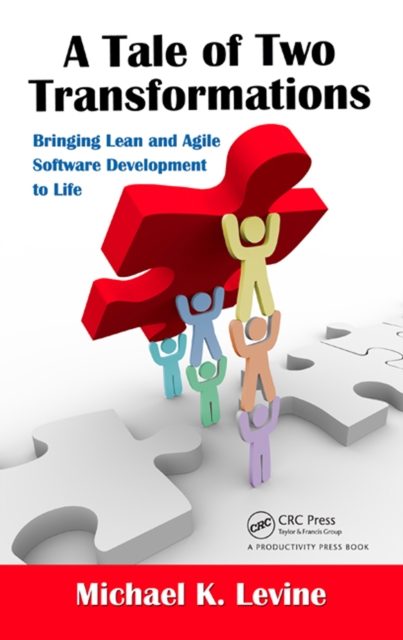
A Tale of Two Transformations
2012,2016,2011
Overview
There are many books that seek to explain Lean and Agile software that offer theory, techniques, and examples. Michael Levine’s first book, A Tale of Two Systems , is one of the best, synthesizing Lean manufacturing and product development with agile software concepts in an engaging business novel. However, there has been precious little practical guidance for those seeking to change existing organizations to become Lean and Agile, until now. Mr. Levine has followed the successful approach of A Tale of Two Systems , telling two simultaneous intertwined and contrasting stories, to bring organizational transformation to life.
Mary O’Connell and James \"Wes\" Wesleyan, recently engaged to be married, share a commitment to Lean and Agile Software. They have recently become leaders in two very different companies – one, stuck in a slow-moving, unresponsive, process-driven quagmire of a software culture; the other, struggling through the chaos of a sales-driven, process-less swirl. Together with their wise mentor, Neville Roberts, they identify two approaches to making needed changes: Drive People (a top-down approach focused on processes and tools), and People Driven (an enablement approach focused on people and organizations). Mary and Wes evaluate their situations and choose approaches that best fit for them, and the transformations commence.
A Tale of Two Transformations differs from many information technology books by grappling with all the complexities of our organizations: the people, the politics, the financials, the processes – in short, the culture from which our Lean and Agile journeys must begin. The change model presented in the flow of the stories is generally applicable, and can help anyone thinking about how to improve their organization.
The story-telling approach, with a summary of the lessons and insights at the end of each chapter, is an engaging way to learn…. My hat is off to Mr. Levine for writing a book that both entertains and teaches. Not an easy task, but masterfully done in this case. —John G. Schmidt, Vice President for Enterprise Initiatives, Informatica & author of Lean Integration
Finally! A book about Lean and Agile software development for the executives who want to make the transition - from someone who has been there … deals with a broad array of leadership problems, from discovering chief engineers, to dealing with demanding sales managers to pulling back from outsourcing. — Mary Poppendieck, Author of Lean Software Development , Implementing Lean Software Development , and Leading Lean Software Development
Michael K. Levine has led a 26-year career primarily focused on how to profit through the application of information technology. He was educated in international relations and economics at Carleton College and Princeton University and began his career in international trade negotiation in Washington, D.C. He moved on to commercial lending and financial product management at First Bank System in Minneapolis. In each of his early jobs, he saw the promise of applying information technology to solve business problems; eventually, he moved his career more formally in that direction by joining Norwest Corporation as strategic technology planner and large-scale software project manager.
Michael continued his immersion in technology leadership when he became chief technology officer of Moore Data/Vista Information Solutions, a leading provider of information technology solutions to the real estate field. For the last 6 years, Michael has been at Wells FargoHome Mortgage, leading Operations and Technology Groups. One of the constant elements in Michael’s work has been the innovative, business-driven application of information technology. The accomplishments of his teams range from the first system to calculate duties on unfair trade, to cross-business line customer information systems in two large banks, to an early Internet-based real estate search engine, to an image-based, straight-through/exception-based loan processing system.
His continuing search for better ways to build complex business software drew him to the operations and product development approaches coming out of Toyota (Lean) and the Agile software development movement. Michael and his teams have used many of the Lean and Agile approaches over the last several years. This practical application experience, in addition to his extensive, successful career at the junction of business operations and software technology, gives Michael a unique, practical perspective on how business leaders can improve their results through better technology leadership.
SETTING THE STAGE FOR CHANGE: FEBRUARY
Wes’s Challenge at MCCA: February Narrator: Wes MCCA’s Past (in Microfilm) versus Its Future (in Information Management) MCCA’s Transformation Goal: Fix Operations and Build New Technology Products Wes’s New Role: New Product Development, Including Technology Wes’s New Organization and People Endnotes Mary’s Challenge at FinServia: February Narrator: Mary FinServia’s Troubles: Glacial, Unresponsive Product Development FinServia’s Transformation Goal: Faster and Cheaper
Setting Initial Approaches for Both Companies: February Narrator: Wes Building a Lean and Agile Change Model Comparing the Two Opportunities, and Selecting an Approach Wes and Mary Make Their Initial Plans Endnotes
UNDERSTANDING THE LANDSCAPE: MARCH
Getting to Know the MCCA Team and Culture: March Narrator: Wes Meeting My Development Team Transforming Operations, Including the Relationship with Sales Wes Visits San Diego National Insurance Preparing to Meet SDNI Listening for Customer Value Understanding the Customer’s Needs Endnotes
Reorienting FinServia’s Relationship with GRI: March Narrator: Mary GRI’s Death Grip on Finservia’s Technology Meeting with GRI: Being Clear about What FinServia Needs GRI Goals and the Win–Win Endnotes
Solving the Chief Engineer Puzzle at MCCA: March Narrator: Wes Finding a Project Manager to Handle Part of the Chief Engineer Role Finding a Product Manager to Handle Part of the Chief Engineer Role Exploring Alternative Development Models: Powerful Individual Chief Engineers versus Development Teams of Peers Endnotes
BEGINNING THE TRANSFORMATIONS: APRIL–MAY
Six Weeks to Change the FinServia Organization: April Narrator: Mary Early Week One: Planning the FinServia Development Organization Option 1: A Functional Organization Option 2: A Divisional Organization Option 3: A Matrix Organization Option 4: Chief Engineers with Shared Support Later in Week One: Planning the Transition with GRI Week Four: Selecting the People Week Six: Announcement Day Endnotes
Six Weeks to Start the MCCA Transformation: May Narrator: Wes Week One: Preparing for the Management Scrum Week Two: Assembling and Training the Team The Team Assembles: Overview Training MCCA Value Defined by Owners, Customers Lean Product Development Introduced Agile Software Development: An Implementation of Lean Product Development Agile Introduced Scrum Explained Next Steps Week Four: Creating the Management Backlog and the Release Plan Week Six: Lean Team Scrum Meeting Endnotes
TRANSFORMATIONS TAKE HOLD: MAY–SEPTEMBER
Making Delivery Commitments at FinServiea: May Narrator: Mary The Classic Struggle: Setting Dates and Costs The Date/Cost Commitment Struggle at FinServia Configuring Agile Releases: Distributing to and Managing Multiple Backlogs Endnotes
MCCA Engages with Its Sales Force and Customers at DocWorld: Late July Narrator: Wes Wes’s Six-Month Retrospective User Conference Preparation: The Product Roadmap and Customer Engagement Planning Connie and Wes Agree on Sales Guidance Partnering with Customers and Prospects: Demos and Backlogs Endnotes
Sprint 1 Demo at FinServia—Dealing with Disappointment: July Narrator: Mary Mary’s Six-Month Retrospective Tools Can Help, Tools Can Hurt Results of Sprint 1 Disappointing: The Sprint Demo Discord during the Sprint Ready or Not, Sprint and Demo Reviewing the Plan for Sprint 1 (Lack of) Accomplishments of Sprint 1 Code Demo for Sprint 1 Sprint 1 Retrospective Margaret Plans and Facilitates the Retrospective Endnotes
Jack’s Gambit at MCCA Narrator: Wes Phillip Spills the Beans Getting Advice from Connie Jack’s Proposal Mary and Wes Consider Lynn’s Options Lynn Hollander Makes Her Choice LOOKING BACK AND LOOKING AHEAD: DECEMBER
Sustaining Lean and Agile: December Narrator: Wes Comparing the MCCA and FinServia Experiences Sustaining a Lean and Agile Software Culture Building Towering Technical Competence Building and Sustaining Cultural Values Strategic Planning and Study Customer-Focused, Hands-On Leaders Lightweight Processes Endnotes
SUMMARY AND CONCLUSIONS
Transforming to Become Lean and Agile Summary of the People Driven Approach Summary of the Drive People Approach Vision and Leadership Set a Simple and Compelling Vision Build a Supporting Coalition Make a Plan, Specific to Your Reality Use Integrating Events Accelerate Delivery Find Outside Wisdom Encourage Engagement and Debate, within Limits Understand Your Boundaries It’s (Almost) Always about the Money People Give Existing Leaders a Chance Let Obstructionists Continue Their Careers Elsewhere Stir Up the Pot by Adding Some New Blood Get Them to Do It Themselves Build Chief Engineers, but Adapt to the Situation at Hand Teach to Lead, and Lead by Teaching Spreading Knowledge—Institutionalize Knowledge and Learning \"You Go to War with the Army You Have\" 2 or Build Your Capability before You Build Your Software Organization Customer Focus Demolish the Barriers: We Are All \"The Business\" Small Intact Teams Process Process Can Drive Lean/Agile Change, but It’s Not Enough by Itself Start Slow and Simple PDCA Yourself! Methods—Don’t Overprescribe But Do Insist on Some Basic Practices Tools Tools Can Help, but Be Careful! Vendor Partnerships Final Words Endnotes Index
Publisher
Productivity Press,Taylor and Francis,CRC Press
Subject
ISBN
9781439879757, 1439879753, 9781283596176, 9781439879788, 1439879788, 1283596172