Asset Details
Do you wish to reserve the book?

Information Status and Noncanonical Word Order in English

Hey, we have placed the reservation for you!
By the way, why not check out events that you can attend while you pick your title.

Oops! Something went wrong.
Looks like we were not able to place the reservation. Kindly try again later.
Are you sure you want to remove the book from the shelf?
Information Status and Noncanonical Word Order in English

Do you wish to request the book?
Information Status and Noncanonical Word Order in English
Please be aware that the book you have requested cannot be checked out. If you would like to checkout this book, you can reserve another copy

We have requested the book for you!
Your request is successful and it will be processed during the Library working hours. Please check the status of your request in My Requests.
Oops! Something went wrong.
Looks like we were not able to place your request. Kindly try again later.
eBook
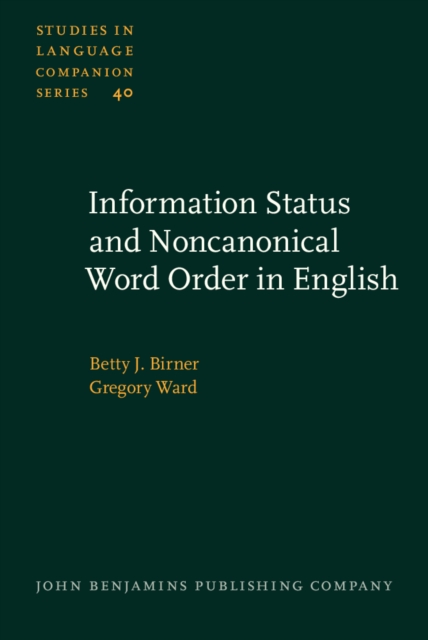
Information Status and Noncanonical Word Order in English
1998
Overview
This work provides a comprehensive discourse-functional account of three classes of noncanonical constituent placement in English - preposing, postposing, and argument reversal - and shows how their interaction is accounted for in a principled and predictive way. In doing so, it details the variety of ways in which information can be 'given' or 'new' and shows how an understanding of this variety allows us to account for the distribution of these constructions in discourse. Moreover, the authors show that there exist broad and empirically verifiable functional correspondences within classes of syntactically similar constructions.Relying heavily on corpus data, the authors identify three interacting dimensions along which individual constructions may vary with respect to the pragmatic constraints to which they are sensitive: old vs. new information, relative vs. absolute familiarity, and discourse- vs. hearer-familiarity. They show that preposed position is reserved for information that is linked to the prior discourse by means of a contextually licensed partially-ordered set relationship; postposed position is reserved for information that is 'new' in one of a small number of distinct senses; and argument-reversing constructions require that the information represented by the preverbal constituent be at least as familiar within the discourse as that represented by the postverbal constituent. Within each of the three classes of constructions, individual constructions vary with respect to whether they are sensitive to familiarity within the discourse or (assumed) familiarity within the hearer's knowledge store. Thus, although the individual constructions in question are subject to distinct constraints, this work provides empirical evidence for the existence of strong correlations between sentence position and information status. The final chapter
presents crosslinguistic data showing that these correlations are not limited to English.
Publisher
John Benjamins B.V,J. Benjamins,John Benjamins Publishing Company,John Benjamins
Subject
ISBN
9027281904, 9789027281906, 1556199260, 9789027230430, 9027230439, 9781556199264