
Catalogue Search | MBRL


Are you sure you want to remove the book from the shelf?

{{itemTitle}}
131
result(s) for
"Barón, Júlia"
Sort by:

Exploring the effects of audiovisual material and age in pragmatic learning
The present study aims at analyzing the effects of pragmatic instruction through captioned audiovisual input on pragmatic performance by learners of different ages. The participants were 40 intermediate English as a Foreign Language (EFL) learners, 20 children and 20 adults, who were distributed into intervention and control groups. All participants received pragmatic-focused instruction (on greetings and requests), and were engaged in class discussions to raise pragmatic awareness. In the intervention group, pragmatic instruction was supported by captioned audiovisual material, whereas in the control group no audiovisual material was used to support pragmatic instruction. To examine pragmatic performance, an Oral Discourse Completion Test (ODCT) was administered at the beginning and at the end of the treatment period. Moreover, classroom observations were carried out during class discussions. The findings suggest a benefit of captioned audiovisual input on pragmatic performance when teaching pragmatics in the EFL classroom as well as differences in terms of pragmatic performance between child and adult learners.
Journal Article

The Development of Pragmatic Markers in English as a Second Language: Do Age and Learning Context Matter?
The present study explores the development of pragmatic marker (PM) use by children and adult L2 English learners in two learning contexts: study abroad (SA) and at home (AH). The study involved a group of 35 Catalan/Spanish girls (aged 11 to 13) learning English AH (n = 16) and abroad in Ireland (n = 19), and a group of 16 adult students aged 19–31 learning English in the UK and Ireland (n = 10) and at their home university in Barcelona (n = 6). To test their pragmatic development, the use of PMs was prompted through pre-test and post-test semi-structured interviews. The results indicated an effect of both age and context on PM development. Children in the SA context increased their use of some PMs, whereas their peers who remained at home did not show any development. Regarding the adults, both SA and AH participants increased their use of specific PMs. These findings shed some light on a topic that has not received scholarly attention in the field of L2 pragmatics: the development of PM use by children. Additionally, they contribute to the very small body of longitudinal studies on the development of PM use during SA.
Journal Article

Manipulating cognitive complexity across task types and its impact on learners' interaction during oral performance
The goal of the reported study is to investigate the impact of manipulating the cognitive complexity of three different types of oral tasks on interaction. The study first considers the concepts of task complexity and interaction and then examines the specific studies that have looked at the effects of increasing task complexity on conversational interaction. In the experiment, learners of English as a foreign language organized into 27 dyads carry out three different types of tasks: a narrative reconstruction task, an instruction-giving map task, and a decision-making task. Two different versions of each task, one simple and one complex, are presented to learners in different sequences. Task complexity is manipulated along the degree of displaced, past time reference, the number of elements, and the reasoning demands. Audio recordings are transcribed and coded for interactional feedback, which is measured in terms of negotiation of meaning (i.e., confirmation checks, clarification requests, and comprehension checks), recasts, language-related episodes (LREs), and repairs, all of which have been described in the literature as being conducive to acquisition. Both parametric and non-parametric statistical tests are used. Results are discussed in the light of previous studies that have looked at the specific relationship between task complexity and interaction, attention models (Robinson, Applied Linguistics 22: 27-57, 2001a, Second Language Studies 21: 45-105, 2003, International Review of Applied Linguistics 55: 1-32, 2005, International Review of Applied Linguistics 45: 193-213, 2007b; Skehan and Foster, Cognition and tasks, Cambridge University Press, 2001), and how different task types may variously affect the way interaction proceeds during task performance. (Verlag, adapt.).
Journal Article
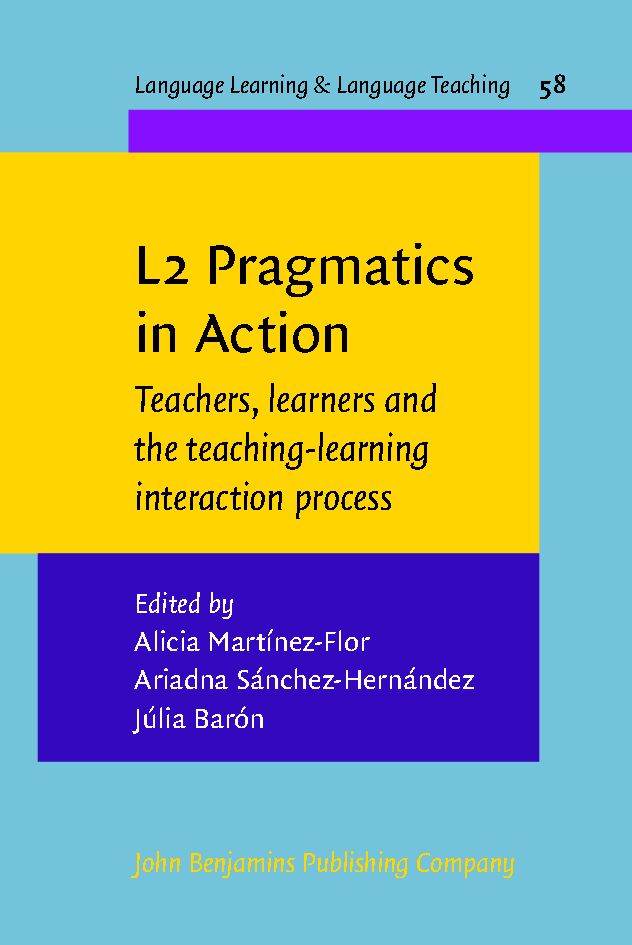
L2 pragmatics in action : teachers, learners and the teaching-learning interaction process
This is the first edited volume dedicated to both teachers and learners of second/foreign language (L2) pragmatics. It comprises a collection of studies that explore how teachers background and practices, and individual learners differences contribute to the teaching and learning of L2 pragmatics. Also included are chapters that present pedagogical approaches that bring teachers and learners together in action in the classroom setting. Written by an international team of experts, the volume examines the most relevant topics on instructional pragmatics in a variety of language contexts, including Brazil, China, Germany, Japan, Spain, the United States, and Vietnam. This global perspective represents a key contribution in the current increasingly multilingual and multicultural society. Taken together, the findings presented have diverse research and pedagogical implications, and provide new directions to explore L2 pragmatic competence. This innovative book will be a valuable resource for researchers and graduate students, as well as for language teachers and course developers.
eBook

The interface between grammar and pragmatics in EFL measurement and development
The aim of the present study is to analyze how learners of English as a foreign language with no instruction on pragmatics develop their grammatical and pragmatic competence from beginner to more advanced levels. The participants (N = 144) carried out an open role-play where requests and responses to such requests were required. A seven-point scale was used to assess grammatical competence in a different way to previous studies, which generally equate grammar with proficiency levels. The study describes the interface between the acquisition of grammar items and the development of pragmatic competence. The results show that as the learners become more grammatically competent, they tend to use more elaborate requests and responses and more pragmatically appropriate utterances. Further evidence is, therefore, provided to the parallel development of grammar and pragmatics in a context that has received little attention so far. The findings will also be discussed in relation to the EFL classroom.
Journal Article


L2 Pragmatics in Action: Teachers, Learners and the Teaching-Learning Interaction Process. Language Learning & Language Teaching. Volume 58
This is the first edited volume dedicated to both teachers and learners of second/foreign language (L2) pragmatics. It comprises a collection of studies that explore how teachers background and practices, and individual learners differences contribute to the teaching and learning of L2 pragmatics. Also included are chapters that present pedagogical approaches that bring teachers and learners together in action in the classroom setting. Written by an international team of experts, the volume examines the most relevant topics on instructional pragmatics in a variety of language contexts, including Brazil, China, Germany, Japan, Spain, the United States, and Vietnam. This global perspective represents a key contribution in the current increasingly multilingual and multicultural society. Taken together, the findings presented have diverse research and pedagogical implications, and provide new directions to explore L2 pragmatic competence. This innovative book will be a valuable resource for researchers and graduate students, as well as for language teachers and course developers. [Foreword written by Marta González-Lloret.]
Book

\Can I Make a Party, Mum?\ The Development of Requests from Childhood to Adolescence / “Mamá, ¿puedo hacer una fiesta?” El desarrollo del acto de habla de pedir permiso desde la niñez hasta la adolescencia
This study presents how requests are acquired and developed over an eight-year period by an EFL learner in a foreign language setting, where target language pragmatics is not an issue dealt with in the classroom. In order to assess pragmatic development, a role-play requiring requests was used. This study has been triggered by the fact that longitudinal studies have commonly been considered very valuable, since development of the same participants can be traced over a long period of time. The development of requests has been followed by, first, examining what types of requests were produced by the learner at the different stages of pragmatic development; second, by analyzing the use of request modification; and, finally, by placing the learner's requests at different stages of development. The results seem to show that little development can be traced at very early stages of acquisition, and that it is not until Grade II that a development toward more pragmatically appropriate productions can be found. Este estudio presenta cómo se adquieren los actos de habla de petición de permiso mediante el seguimiento de un mismo aprendiz de inglés como lengua extranjera durante ocho años, en cuyo contexto de aprendizaje —la clase de lengua extranjera— los aspectos pragmáticos no parecen ser relevantes. Para medir el desarrollo de este componente pragmático se utilizó una tarea de role-play en la que se requería el uso del acto de habla de pedir permiso. La motivación para realizar este estudio deriva de la consideración de los estudios longitudinales como muy valiosos, en tanto en cuanto se puede trazar un proceso de aprendizaje en los mismos participantes durante un largo periodo de tiempo. El desarrollo de este acto de habla se analizó, primero, examinando las diferentes modalidades de petición de permiso en distintos estadios de desarrollo pragmático; segundo, mediante el análisis de la modificación de este mismo acto de habla; y finalmente, clasificando las producciones del aprendiz en distintos estadios de desarrollo. Los resultados parecen mostrar poca evolución pragmática en las primeras etapas de adquisición, y no es hasta primero de bachillerato cuando aparece una producción pragmática más apropiada.
Journal Article

Coronary Artery Perforation: Insights and Outcomes From a 13‐Year Experience at a District General Hospital
Introduction and Objectives: Coronary artery perforation (CAP) is a rare but potentially fatal complication of percutaneous coronary intervention (PCI). Although its management is well‐studied in tertiary care settings, little is known about the incidence and treatment patterns at district general hospitals (DGHs), which this study explored. Materials and Methods: A single‐centre analysis of all PCI procedures in a DGH between January 2011 and December 2023 was performed. Patients’ records were examined for procedure details and endpoints, which included pericardiocentesis, emergency cardiac surgery and secondary coronary artery bypass grafting. The endpoints also included in‐hospital and one‐year mortalities. Results: During the study period, there were 13,480 PCIs, of which 31 (0.23%) were complicated by CAP. Males composed 65%, and the mean age was 69.9 ± 10 years. The most common perforation type was Ellis II in 45% of patients, and the left anterior ascending artery (LAD) was most affected in 55% of patients. An echocardiogram was done in all patients and showed tamponade physiology in 16%, in all of whom pericardiocentesis was performed. Other CAP treatments included balloon tamponade in 65%, covered stent in 42%, fat embolisation in 10% and emergency surgery and coiling in 6% each. Inpatient mortality occurred in three patients (10%), with no one‐year mortalities. Long‐term complications were not observed in the study. Conclusion: CAP remains a rare, potentially lethal complication of PCI in a DGH setting, with an incidence, pattern and treatments similar to those of high‐volume PCI teaching centres. Early recognition and proper management are crucial.
Journal Article