
Catalogue Search | MBRL


Are you sure you want to remove the book from the shelf?

{{itemTitle}}
44
result(s) for
"Boustan, Raʿanan S."
Sort by:

Violence, Scripture, and Textual Practice in Early Judaism and Christianity
This volume analyzes the emergence of Jewish and Christian discourses of \"religious violence\" within their Roman imperial context with an emphasis on the shared textual practices through which authoritative scriptural traditions were redeployed to represent, legitimate, and indeed sacralize violence.
eBook
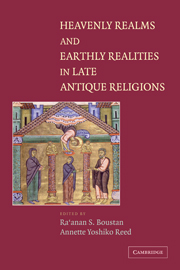
Heavenly Realms and Earthly Realities in Late Antique Religions
The idea of heaven held a special place in the late antique imagination, which was marked by a poignant sense of the relevance of otherworldly realities for earthly life. Such concerns can be found not only in Judaism and Christianity but also in the Greco-Roman religious, philosophical, scientific, and 'magical' traditions. Transcending social, regional and creedal boundaries, the preocupation with heaven in Late Antiquity serves as a focus for an interdisciplinary approach to understanding this formative era in Western culture and history. Drawing upon the expertise of scholars of Classics, Ancient History, Jewish Studies and Patristics, this volume explores the different functions of heavenly imagery in different texts and traditions in order to map the patterns of unity and diversity within the religious landscape of Late Antiquity.
eBook

Jewish Studies at the Crossroads of Anthropology and History
Over the past several decades, the field of Jewish studies has expanded to encompass an unprecedented range of research topics, historical periods, geographic regions, and analytical approaches. Yet there have been few systematic efforts to trace these developments, to consider their implications, and to generate new concepts appropriate to a more inclusive view of Jewish culture and society.Jewish Studies at the Crossroads of Anthropology and Historybrings together scholars in anthropology, history, religious studies, comparative literature, and other fields to chart new directions in Jewish studies across the disciplines. This groundbreaking volume explores forms of Jewish experience that span the period from antiquity to the present and encompass a wide range of textual, ritual, spatial, and visual materials. The essays give full consideration to non-written expressions of ritual performance, artistic production, spoken narrative, and social experience through which Jewish life emerges. More than simply contributing to an appreciation of Jewish diversity, the contributors devote their attention to three key concepts-authority, diaspora, and tradition-that have long been central to the study of Jews and Judaism. Moving beyond inherited approaches and conventional academic boundaries, the volume reconsiders these core concepts, reorienting our understanding of the dynamic relationships between text and practice, and continuity and change in Jewish contexts. More broadly, this volume furthers conversation across the disciplines by using Judaic studies to provoke inquiry into theoretical problems in a range of other areas.
eBook
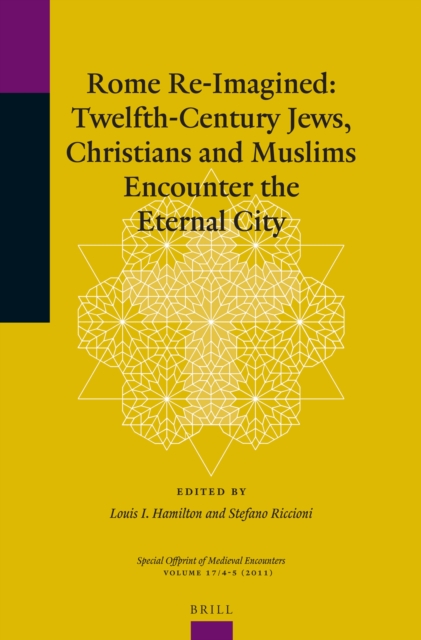
Rome re-imagined : twelfth-century Jews, Christians and Muslims encounter the Eternal City
This collection examines the image of Rome through Arabic, Greek, Hebrew, Latin, and Persian descriptions of the eternal city. Placing the twelfth-century renaissance into a Mediterranean context. The city of Rome is revealed as a multi-vocal object of desire and a contested ideal.
eBook

The Emergence of Pseudonymous Attribution in Heikhalot Literature: Empirical Evidence from the Jewish \Magical\ Corpora
»Vielmehr bietet [der Kommentar] auf höchstem Niveau eine substantielle Auseinandersetzung mit den Hintergründen, den Zusammenhängen, der Theorie und der Praxis des Grundgesetzes. Besseres lässt sich von einem Verfassungskommentar nicht sagen.“ Herbert Günther Staaatsanzeiger für das Land Hessen 2018 (50), 1494–1495 The 4th edition of the first volume of this work provides an update of the commentary on the preamble and articles 1 to 19 in case law and literature. The structure of the book has been retained and its content supplemented by more recent developments, such as the implications of Europeanisation and digitalisation as well as the Corona pandemic. As of the 4th edition, Frauke Brosius-Gersdorf has taken over the editorship of the commentary. Die 4. Auflage bringt zunächst die Kommentierung der Präambel und der Art. 1 bis 19 auf den aktuellen Stand von Judikatur und Literatur. Die grundlegende Struktur des Kommentares wurde beibehalten und um neuere Entwicklungen wie die Implikationen der Europäisierung und Digitalisierung sowie der Corona-Pandemie ergänzt.Die Herausgeberschaft des Kommentares hat ab der 4. Auflage Frauke Brosius-Gersdorf übernommen. Auch im Autorenkreis sind personelle Veränderungen zu verzeichnen: Mit Ausnahme von Frauke Brosius-Gersdorf, Alexander Thiele und Ferdinand Wollenschläger, die bereits an der 3. Auflage mitgewirkt haben, liegen die Kommentierungen in den Händen neuer Autorinnen und Autoren.Der Kommentar erscheint in drei Bänden und wird nur geschlossen abgegeben.Der Grundgesetz-Kommentar ist Bestandteil des Moduls Verfassungsrecht PREMIUM, das bei beck-online.de erhältlich ist.
Journal Article

Christian Magicians, Jewish Magical Idioms, and the Shared Magical Culture of Late Antiquity
Some time in the late-fifth or early-sixth century CE, a ritual practitioner—operating in the environs of Oxyrhynchus, Egypt—created a protective amulet that reads, “Hôr, Hôr, Phôr, Elôei, Adônai, Iaô, Sabaôth, Michaêl, Jesus Christ. Help us and this house. Amen” (Ὡρ, Ὡρ, Φωρ, Ἐλωεί, Ἀδωναί, Ἰάω, Σαβαώθ, Μιχαήλ, Ἰεσοῦ Χριστέ· Βοήθι ἡμῖν καὶ τούτῳ οἴκῳ. ἀμήν). Each of the names used in the first part of this amulet, known as P.Oxy. VIII 1152 (=PGM P6a), is familiar from other ritual objects from late antiquity (approx. fourth to seventh centuries CE). But the juxtaposition of these divine names on a single amulet presents us with a puzzle: did the ritual expert who created this artifact or his client perceive there to be a difference, tension, or even contradiction between Jesus Christ and the other names listed? Or, alternatively, would they have conceptualized all of these names as belonging equally within what they would have thought of as the “Christian tradition” or some other tradition?
Journal Article

The Dislocation of the Temple Vessels
Over the past two decades, a growing chorus of scholars and intellectuals, both within and beyond the field of Jewish studies, has advanced the claim that the notions of exile and diaspora, despite their apparent affinities, stand in profound tension with each other.¹ While “exile” is configured, in historical sources as well as contemporary scholarship, as an abnormal and unsustainable state of crisis governed by a narrative of sin, punishment, and longing for restoration, “diaspora” has come to signify a dynamic and even generative politico-spatial condition that is characterized by porous social boundaries and cultural vitality.² This revisionist interpretation of
Book Chapter

Rabbinization and the Making of Early Jewish Mysticism
Hekhalot literature testifies to the heterogeneous nature of Jewish religious practice and authority at and across the boundaries of rabbinic Judaism. Yet, Hekhalot and rabbinic literatures do not reflect clear-cut social, cultural, and institutional divisions within Jewish society, nor are they complementary facets of a single, coherent religious system. Both of these options oversimplify the complex relationship between these rapidly evolving sites of Jewish literary culture. Rather, Hekhalot literature and the social groups that produced it were subject to the same institutional, technological, linguistic, and demographic transformations that reshaped Jewish society and culture more broadly toward the end of Late Antiquity (500–800 C.E.). The relationship between Hekhalot and rabbinic literatures can thus shed light on the dialectical process by which rabbinic authority was gradually extended into new areas of Jewish life, while itself being transformed in the process.
Journal Article
Augustine as Revolutionary? Reflections on Continuity and Rupture in Jewish—Christian Relations in Paula Fredriksen's Augustine and the Jews
Levine seeks to strike a careful balance between continuity and change. [...]on the one hand, he affirms both the heuristic utility and historical accuracy of delineating a significant shift in Jewish society and culture from the world of the high empire to what he himself labels the \"Byzantine-period\" of Jewish history.
Book Review