
Catalogue Search | MBRL


Are you sure you want to remove the book from the shelf?

{{itemTitle}}
1,525
result(s) for
"Cameron, Kim S"
Sort by:


Exploring the Relationships between Organizational Virtuousness and Performance
The importance of virtuousness in organizations has recently been acknowledged in the organizational sciences, but research remains scarce. This article defines virtuousness and connects it to scholarly literature in organizational science. An empirical study is described in which the relationships between virtuousness and performance in 18 organizations are empirically examined. Significant relationships between virtuousness and both perceived and objective measures of organizational performance were found. The findings are explained in terms of the two major functions played by virtuousness in organizations: an amplifying function that creates self-reinforcing positive spirals, and a buffering function that strengthens and protects organizations from traumas such as downsizing.
Journal Article

Competing values leadership
\"This book serves as the key source for understanding the Competing Values Framework, one of the most widely used and highly cited frameworks in the world. The authors, who have been at the foundation of developing, applying and studying this framework for over three decades, explain how it helps foster successful leadership, improve organizational effectiveness and promote value creation.\"-- Publisher's description.
Book

The Amplifying and Buffering Effects of Virtuousness in Downsized Organizations
Virtuousness refers to the pursuit of the highest aspirations in the human condition. It is characterized by human impact, moral goodness, and unconditional societal betterment. Several writers have recently argued that corporations, in addition to being concerned with ethics, should also emphasize an ethos of virtuousness in corporate action. Virtuousness emphasizes actions that go beyond the \"do no harm\" assumption embedded in most ethical codes of conduct. Instead, it emphasizes the highest and best of the human condition. This research empirically examines the buffering and amplifying effects of virtuousness in organizations. The study hypothesizes that virtuousness has a positive effect on organizations because amplifying dynamics make subsequent virtuous action more likely, and buffering dynamics reduce the harmful effects of downsizing. The study reveals that two types of virtuousness - tonic and phasic - are associated with these effects.
Journal Article

Ethics and Ethos: The Buffering and Amplifying Effects of Ethical Behavior and Virtuousness
Logical and moral arguments have been made for the organizational importance of ethos or virtuousness, in addition to ethics and responsibility. Research evidence is beginning to provide, empirical support for such normative claims. This paper considers the relationship between ethics and ethos in contemporary organizations by summarizing emerging findings that link virtuousness and performance. The effect of virtue in organizations derives from its buffering and amplifying effects, both of which are described.
Journal Article

Diagnosing and Changing Organizational Culture : Based on the Competing Values Framework
\"The Third Edition of this key resource provides a means of understanding and changing organizational culture in order to make organizations more effective. It provides validated instruments for diagnosing organizational culture and management competency; a theoretical framework (competing values) for understanding organizational culture; and a systematic strategy and methodology for changing organizational culture and personal behavior. New edition includes online versions of the MSAI and OCAI assessments and new discussions of the implications of national cultural profiles\"-- Provided by publisher.
Book
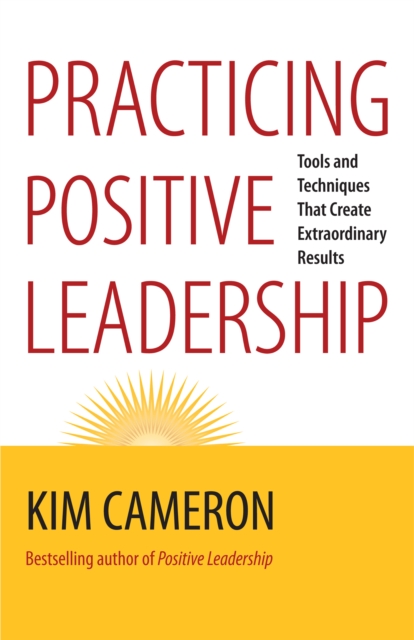
Practicing positive leadership : tools and techniques that create extraordinary results
This book makes the latest scholarship on creating extraordinarily successful organizations available in a concise, how-to format. Makes the latest scholarship on creating extraordinarily successful organizations available in a concise, how-to format; Features a wealth of specific tools and techniques for implementing positive leadership in five different areas; Written by one of the founders of the field of positive organizational scholarship and the coauthor of Developing Management Skills (more than 250,000 copies sold over eight editions). Over a decade ago, Author and some colleagues decided that rather than analyze what went terribly wrong with organizations and how to prevent it, they would look at what went extraordinarily right and how to replicate it. This was the birth of positive organizational scholarship, a new field that focused on what they called \"positive deviance\"-outcomes that far exceeded normal success.In his previous book Positive Leadership, Cameron outlined four leadership strategies-Positive Climate, Positive Relationships, Positive Communications, and Positive Meaning-that characterize exceptionally high-performing organizations.
eBook
Contributions to the discipline of positive organizational scholarship
Positive organizational scholarship is the study of that which is positive, flourishing, and life-giving in organizations. Positive refers to the elevating processes and outcomes in organizations. Organizational refers to the interpersonal and structural dynamics activated in and through organizations, specifically taking into account the context in which positive phenomena occur. Scholarship refers to the scientific, theoretically derived, and rigorous investigation of that which is positive in organizational settings. This article introduces this new field of study and identifies some of its key contributions. Reprinted by permission of Sage Publications, Inc.
Journal Article

Strategies for successful organizational downsizing
This article reports the results of a study of 30 organizations that engaged in downsizing over a four‐year period. Three questions were investigated: (1) What general strategies are used by organizations to downsize? (2) What are the effects of downsizing on organizational performance? (3) What are downsizing's “best practices?” or, What are the differences between organizations that effectively downsize and those that do not? Three main strategies for downsizing are explained, the managerial actions to overcome the negative effects of downsizing are enumerated, and the best practices of successful downsizing firms are presented.
Journal Article