
Catalogue Search | MBRL


Are you sure you want to remove the book from the shelf?

{{itemTitle}}
87
result(s) for
"Comber, Barbara"
Sort by:

Poverty, place and pedagogy in education : research stories from front-line workers
This article considers what it means to teach and learn in places of poverty through the narratives of front-line workers-particularly students and teachers. What is the work of teaching and learning in places of poverty in current times? How has this changed? What can be learned from both the haunting and hopeful narratives of front-line workers? Is it possible to continue to educate in these times and in ways that allow for critique, imagination and optimism? These questions are addressed by drawing from studies conducted over three decades in schools located in high-poverty neighbourhoods. Literacy education is considered as a particular case. Educational researchers need to remain on the front line with teachers and students in places of poverty because that is where some of the hardest work gets done. Reinvigorated democratic research communities would include teachers, school leaders, policy workers and young people. [Author abstract]
Journal Article

Critical Literacy and Social Justice
Given the global escalation of gaps between rich and poor, contemporary work in critical literacy needs to overtly question the politics of poverty. How and where is poverty produced, by what means, by whom and for whom and how are educational systems stratified to provide different kinds of education to the rich and the poor? Yet rather than critical literacy, international educational reform movements stress performative standards on basic literacy. In this context literacy researchers need to ask policy‐makers hard questions about taken‐for‐granted rhetoric that surrounds poverty, literacy and education. At school, regional and state levels, educational leaders need to argue for fair resourcing and decision‐making for their communities and students. In classrooms teachers need to weave critical questioning and inclusive learning interactions into the fabric of everyday life.
Journal Article

Learners, environments and differences – insights from literacy research
PurposeThe purpose of this article is to introduce qualitative research in literacy that has been significant in educators understanding difference in young people’s literacy learning.Design/methodology/approachThe approach has been to select influential investigations that have impacted over time and to summarise the insights provided.FindingsThis article foregrounds research that helps educators understand learner difference as positive resources and that contests approaches which perpetuate deficit discourses.Originality/valueThe article offers a distinctive and selective reading of literacy studies to highlight and remind readers of what is known about language and literacy learning that should not be ignored in designing further research nor in interpreting existing studies.
Journal Article
Critical reading comprehension in an era of accountability
This article argues for the need for critical reading comprehension in an era of accountability that often promotes reading comprehension as readily assessable through students answering multiple choice questions of unseen texts. Based upon a 1 year study investigating literacy in Years 4-9 the ways strong performing primary schools develop serious and in-depth reading for learning are explored. School and teacher features which allow for the development of sophisticated pedagogical repertoires and space for critical reading comprehension, without losing the complexity of curriculum offerings, are outlined. How one experienced middle primary teacher operates strategically, ethically and critically in supporting her ESL students to learn to read is illustrated. The teacher's work is situated within the complex accountability demands faced by classroom teachers. This was accomplished by a teacher whose pedagogical repertoire has been assembled across a career teaching in low-SES high ESL communities in a school with a balanced literacy program and high level of collegial support. Risks for schools and teachers whose circumstances work against their capacities for prioritisation and strategic decision-making are identified and discussed. [Author abstract]
Journal Article

Educative encounters of a different kind: Pedagogies of everyday life
Lately I have been thinking and writing about the idea of a teacher's oeuvre - the notion that over time teachers create a significant body or work that might be compared to that of an artist or composer. I have argued that too often the contributions that teachers make remain invisible, under-valued and unknown in the field of education. This is true certainly when compared to the impact of educational theorists and researchers. Classroom teachers are rarely remembered beyond the local networks in which they have practised. In taking up this opportunity to honor the contribution of Allan Luke as an educational scholar, researcher and theorist, I will argue that, along with his publications, his oeuvre also necessarily includes his work as a teacher and teacher educator in institutional and everyday situations; hence I will refer to my experiences as a student, colleague, collaborator and friend. Being a researcher necessarily involves personal, professional and political dimensions because scholarly personae and milieu extend beyond the university into everyday life.
Journal Article
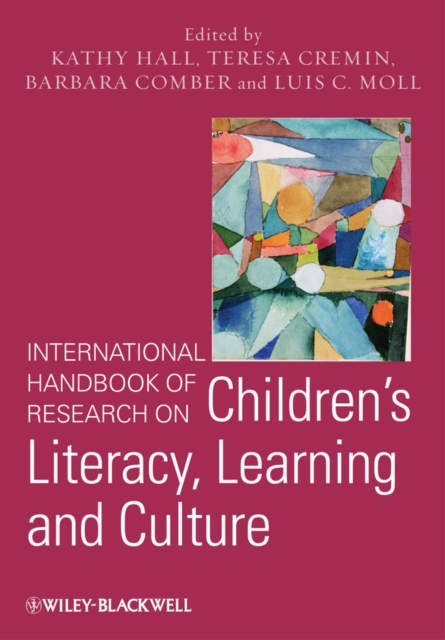
International Handbook of Research on Children's Literacy, Learning and Culture
The International Handbook of Research in Children's Literacy, Learning and Culture presents an authoritative distillation of current global knowledge related to the field of primary years literacy studies. Features chapters that conceptualize, interpret, and synthesize relevant research Critically reviews past and current research in order to influence future directions in the field of literacy Offers literacy scholars an international perspective that recognizes and anticipates increasing diversity in literacy practices and cultures
eBook

How Homework Shapes Family Literacy Practices
The authors explore the possibility that school literacy practices sent home as homework are changing family reading interactions by adding to the tasks that teachers expect parents to undertake. The authors consider how reading, formerly an elective leisure practice between parents and their children, has been reorganized and how this positions parents differently. The authors also examine teachers’ views on the importance of parents reading to their children and teachers’ expectations of parents to support school literacy practices in the form of homework. Evidence that teachers now depend on parents to support school‐based literacy practices and how this serves to change the nature of literacy practices in the home is discussed.
Journal Article
Texts, Identities, and Ethics: Critical Literacy in a Post-Truth World
This department explores critical perspectives on issues at the intersection of policy and practice in order to generate fresh questions about enduring dilemmas, new challenges, and debates.
Journal Article
Critical Literacy and the Importance of Reading With and Against a Text
This department explores critical perspectives on issues at the intersection of policy and practice in order to generate fresh questions about enduring dilemmas, new challenges, and debates.
Journal Article

Civic Literacies: Civic Engagement through Supporting Young Learners to Think More Critically
As the fifth piece of our year-long inquiry asks, “What does it mean to prepare students for civic engagement?,” Vivian Vasquez, Carolyn Clarke, and Barbara Comber speak to the importance of developing learning experiences that center our students’ experiences, questions, and tensions when helping them develop critical literacies.
Journal Article