
Catalogue Search | MBRL


Are you sure you want to remove the book from the shelf?

{{itemTitle}}
123
result(s) for
"Copeland, Rita"
Sort by:


Ambiguity and Intention in Ancient and Medieval Rhetorical Thought
Ancient and medieval rhetorical theorists gave much attention to discovering an author's intent ( voluntas ) from the letter of a document ( scriptum ). By contrast, resolving ambiguity ( ambiguitas ) was supposedly easy. But in fact, ambiguity proves the more slippery problem because it functions somewhere between argumentation (a controversy to be disputed) and stylistic embellishment. Legal discourse often tried to impose limits on ambiguity, but at the same time ambiguitas could be quietly weaponized — in both law and poetry — to transform legal and even theological meaning. Where rhetorical theorists such as Cicero, Quintilian, Augustine, William of Champeaux (c. 1100), Geoffrey of Vinsauf (c. 1210), and Boncompagno da Signa (c. 1235), as well as legal theorists such as Henry de Bracton, try to pin down how ambiguity works, poets such as William Langland seem to revel in the slippages that it affords.
Journal Article
The Cambridge Companion to Allegory
Allegory is a vast subject, and its knotty history is daunting to students and even advanced scholars venturing outside their own historical specializations. This Companion will present, lucidly, systematically, and expertly, the various threads that comprise the allegorical tradition over its entire chronological range. Beginning with Greek antiquity, the volume shows how the earliest systems of allegory developed in poetry dealing with philosophy, mystical religion, and hermeneutics. Once the earliest histories and themes of the allegorical tradition have been presented, the volume turns to literary, intellectual, and cultural manifestations of allegory through the Middle Ages and Renaissance. The essays in the last section address literary and theoretical approaches to allegory in the modern era, from reactions to allegory in the eighteenth and nineteenth centuries to reevaluations of its power in the thought of the twentieth century and beyond.
eBook


Pathos and Pastoralism: Aristotle's Rhetoric in Medieval England
In 1927 Heidegger claimed that there was hardly a better analysis of the emotions than Aristotle's account in book 2 of his Rhetoric. Here I will consider how this pronouncement might have rung true for a fifteenth-century English preacher. My study concerns an unexpected junction of two textual worlds, one ancient and one medieval, all the more surprising because the connection occurs in the mind of a fifteenth-century annotator of a manuscript of Aristotle. The significance of this intersection lies in that vast field that we now call the “history of the emotions.” My argument here will take its departure from a poignant and powerful piece of manuscript evidence that links Aristotle's Rhetoric with the poetic effects of Piers Plowman. This evidence opens a window onto what the Rhetoric meant to readers in medieval England and how it was appreciated for its systematic, rhetorical approach to the passions. The Rhetoric could serve as a catalyst acting upon two already familiar discourses, poetry and preaching, to tap their common potential as the key repositories of knowledge about audience emotions.
Journal Article
Pedagogy, Intellectuals, and Dissent in the Later Middle Ages
This book is about the place of pedagogy and the role of intellectuals in medieval dissent. Focusing on the medieval English heresy known as Lollardy, Rita Copeland places heretical and orthodox attitudes to learning in a long historical perspective that reaches back to antiquity. She shows how educational ideologies of ancient lineage left their imprint on the most sharply politicized categories of late medieval culture, and how radical teachers transformed inherited ideas about classrooms and pedagogy as they brought their teaching to adult learners. The pedagogical imperatives of Lollard dissent were also embodied in the work of certain public figures, intellectuals whose dissident careers transformed the social category of the medieval intellectual. Looking closely at the prison narratives of two Lollard preachers, Copeland shows how their writings could serve as examples for their fellow dissidents and forge a new rapport between academic and non-academic communities.
eBook
Pedagogy, intellectuals, and dissent in the later Middle Ages: Lollardy and ideas of learning
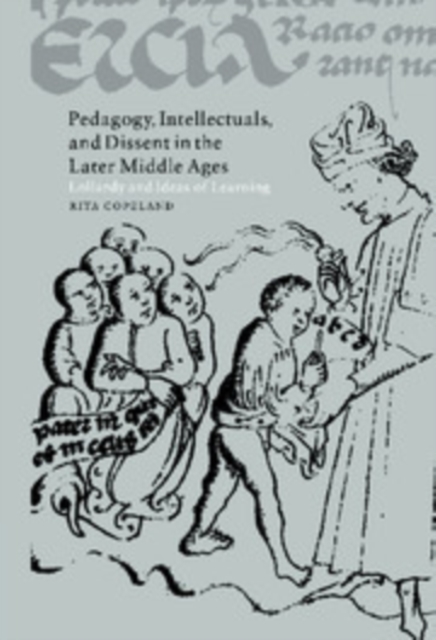
This book is about the place of pedagogy and the role of intellectuals in medieval dissent. Focusing on the medieval English heresy known as Lollardy, Rita Copeland places heretical and orthodox attitudes to learning in a long historical perspective that reaches back to antiquity. She shows how educational ideologies of ancient lineage left their imprint on the most sharply politicized categories of late medieval culture, and how radical teachers transformed inherited ideas about classrooms and pedagogy as they brought their teaching to adult learners. The pedagogical imperatives of Lollard dissent were also embodied in the work of certain public figures, intellectuals whose dissident careers transformed the social category of the medieval intellectual. Looking closely at the prison narratives of two Lollard preachers, Copeland shows how their writings could serve as examples for their fellow dissidents and forge a new rapport between academic and non-academic communities.
eBook


ESSAYS FROM THE ENGLISH INSTITUTE 2012: TEXT
Literary scholars have long taken text to be the object of study.1 Yet with the conceptual breadth that has come to characterize notions of text and textuality, literary criticism has found itself at a confluence of disciplines, including linguistics, anthropology, history, politics, and law. [...]notions of cultural text and social text have placed literary study in productive dialogue with fields in the social sciences. [...]text has come to stand for different and often contradictory things: linguistic data for philology; the unfolding \"real time\" of interaction for sociolinguistics; the problems of copy-text and markup in editorial theory; the objectified written work (\"verbal icon\") for New Criticism; in some versions of poststructuralism the horizons of language that overcome the closure of the work; in theater studies the other of performance, ambiguously artifact and event.
Journal Article