
Catalogue Search | MBRL


Are you sure you want to remove the book from the shelf?

{{itemTitle}}
189
result(s) for
"Curtis, Rebecca C"
Sort by:

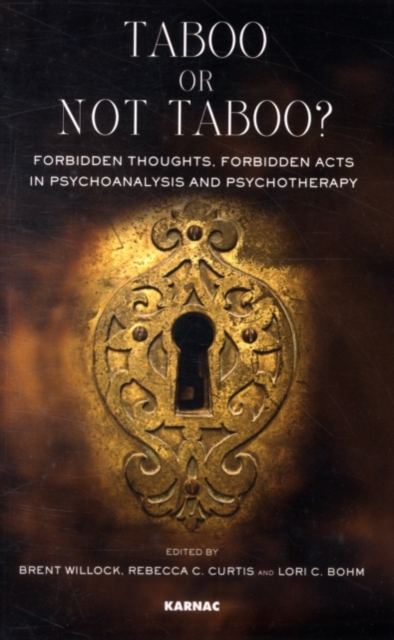
Taboo or not taboo?
This book challenges this idea by examining a sampling of the taboos that are rife in the field. It is not intended to offer a complete summary of all of the forbidden ideas, clinical procedures, behaviors and institutional practices in psychoanalysis, but rather to raise consciousness about the fact that even within a field which encourages freedom of expression, many issues remain difficult to fully discuss both in the consulting room and in professional discourse.
eBook


What is taboo and not taboo in psychoanalysis?
James Grotstein deals with the issues of acceptable theory in psychoanalysis, among other matters. He comments on the threat of suspension issued to the Los Angeles Psychoanalytic Society/Institute by the American Psychoanalytic Association over inclusion of Kleinians and the democratization of promotion to training analyst. Morris Eagle is concerned about the reliance upon transference and countertransference in contemporary psychoanalysis. This concern, also expressed by Schachter and Curtis, is part of the broader issue of the distinctiveness of psychoanalytic technique raised by Grotstein. Psychoanalysis as a discipline, like cultures and religions, suggests that certain behaviours usually have harmful consequences and should remain taboo. Unlike religion, however, psychoanalysis has proposed that all topics are open to discussion. Psychoanalysts could present and publish more interventions that do not turn out well and more failed treatments. Such a change in what is made public would probably require requests from conference organizers and journal editors.
Book Chapter


Suffering to Improve Outcomes Determined by Both Chance and Skill
Subjects were recruited for two studies regarding physiological responses to chance outcomes. In the first experiment, subjects were told that five rolls of dice would determine how many unpleasant foods they would have to taste. They were told that in order to get baseline information about their autonomic responding, the experimenter wanted to obtain galvanic skin resistance (GSR) data while they either shocked themselves, exerted effort at a vowel-cancellation task, or relaxed, depending upon the experimental condition. In the shock condition, subjects' expectations regarding the number of unpleasant foods they would have to taste improved, whereas in other conditions they did not. In the second experiment, subjects who were asked to shock themselves expected to improve on an anagram task, compared to subjects instructed to relax. The results demonstrated that suffering improved expectations regarding future outcomes.
Journal Article


Children's Attributions to Self and Situation
Thirty-two nursery school boys and girls were presented questions about themselves and another and asked to attribute the cause of an event to the actor's personality or the situation. They were also asked to answer 10 questions from the Stanford Preschool Internal-External Scale about themselves and another. They made more personality attributions to others than to themselves for both positive and negative outcomes, when situational attributions did not imply a lack of control over the environment. Differences in attributions to self and other did not occur on the I-E scale where situational attributions represent external control. Most children saw themselves and others as externally controlled.
Journal Article
