
Catalogue Search | MBRL


Are you sure you want to remove the book from the shelf?

{{itemTitle}}
447
result(s) for
"Dick, Alexander"
Sort by:

Excel 2019 bible
Whether you are just starting out or an Excel novice, the Excel 2019 Bible is your comprehensive, go-to guide for all your Excel 2019 needs. Whether you use Excel at work or at home, you will be guided through the powerful new features and capabilities to take full advantage of what the updated version offers. Learn to incorporate templates, implement formulas, create pivot tables, analyze data, and much more. -- Publisher's description.
Book

Spheres of Action
With contributions from leading Romanticist scholars who draw on literary history, performance studies, philosophy, linguistics, and anthropology, Spheres of Action examines the significant intersections between language and performance during the Romantic period. These essays consider cultural phenomena such as elocution and political oratory, newspaper journalism, public mourning, the function of gesture and clothing in theatre - even a long-distance walking contest. They examine the problematic relationships among action, agency, and language in a variety of cultural institutions and media from the era.
Exploring aspects of public speaking and body language, these essays propose that understanding the culture and institutions of the Romantic period requires nuanced approaches to performance and agency. The collection also studies the ways in which the Romantics discovered both the potency and limitations of performativity.
Presenting a boldly multifaceted portrait of Romantic culture, Spheres of Action is essential reading for Romanticists, historians, and scholars with interests in language and performance.
eBook

101 ready-to-use Excel formulas
Excel formulas can make your work easier and more productive, but it takes time to grasp the ins and outs of formulas. This book arms you with the 101 most commonly used Excel formulas that will solve your problems now!
Book

Point-of-care genetic testing for personalisation of antiplatelet treatment (RAPID GENE): a prospective, randomised, proof-of-concept trial
Prospective assessment of pharmacogenetic strategies has been limited by an inability to undertake bedside genetic testing. The CYP2C19*2 allele is a common genetic variant associated with increased rates of major adverse events in individuals given clopidogrel after percutaneous coronary intervention (PCI). We used a novel point-of-care genetic test to identify carriers of the CYP2C19*2 allele and aimed to assess a pharmacogenetic approach to dual antiplatelet treatment after PCI.
Between Aug 26, 2010, and July 7, 2011, 200 patients were enrolled into our prospective, randomised, proof-of-concept study. Patients undergoing PCI for acute coronary syndrome or stable angina were randomly assigned to rapid point-of-care genotyping or to standard treatment. Individuals in the rapid genotyping group were screened for the CYP2C19*2 allele. Carriers were given 10 mg prasugrel daily, and non-carriers and patients in the standard treatment group were given 75 mg clopidogrel daily. The primary endpoint was the proportion of CYP2C19*2 carriers with high on-treatment platelet reactivity (P2Y12 reactivity unit [PRU] value of more than 234) after 1 week of dual antiplatelet treatment, which is a marker associated with increased adverse cardiovascular events. Interventional cardiologists and data analysts were masked to genetic status and treatment. Patients were not masked to treatment allocation. All analyses were by intention to treat. This study is registered with ClinicalTrials.gov, NCT01184300.
After randomisation, 187 patients completed follow-up (91 rapid genotyping group, 96 standard treatment). 23 individuals in each group carried at least one CYP2C19*2 allele. None of the 23 carriers in the rapid genotyping group had a PRU value of more than 234 at day 7, compared with seven (30%) given standard treatment (p=0·0092). The point-of-care genetic test had a sensitivity of 100% (95% CI 92·3–100) and a specificity of 99·3% (96·3–100).
Point-of-care genetic testing after PCI can be done effectively at the bedside and treatment of identified CYP2C19*2 carriers with prasugrel can reduce high on-treatment platelet reactivity.
Spartan Biosciences.
Journal Article

Excel 2016 formulas
\"Excel 2016 Formulas is fully updated to cover all of the tips, tricks, and techniques you need to maximize the power of Excel 2016 through the use of formulas. This comprehensive book explains how to create financial formulas, release the power of array formulas, develop custom worksheet functions with VBA, debug formulas, and much more. Whether you're a beginner, a power user, or somewhere in between this is your essential go-to for the latest on Excel formulas. When conducting simple math or building highly complicated spreadsheets that require formulas up to the task, leveraging the right formula can heighten the accuracy and efficiency of your work, and can improve the speed with which you compile and analyze data. Understanding which formulas to use and knowing how to create a formula when you need to are essential. Access tips, tricks, and techniques that have been fully updated to reflect the latest capabilities of Microsoft Excel; Create and use formulas that have the power to transform your Excel experience; Leverage supplemental material online, including sample files, templates, and worksheets from the book.\"--Www.amazon.com.
Book

Impact of baseline beta-blocker use on inotrope response and clinical outcomes in cardiogenic shock: a subgroup analysis of the DOREMI trial
Background
Cardiogenic shock (CS) is associated with significant morbidity and mortality. The impact of beta-blocker (BB) use on patients who develop CS remains unknown. We sought to evaluate the clinical outcomes and hemodynamic response profiles in patients treated with BB in the 24 h prior to the development of CS.
Methods
Patients with CS enrolled in the DObutamine compaREd to MIlrinone trial were analyzed. The primary outcome was a composite of all-cause mortality, resuscitated cardiac arrest, need for cardiac transplant or mechanical circulatory support, non-fatal myocardial infarction, transient ischemic attack or stroke, or initiation of renal replacement therapy. Secondary outcomes included the individual components of the primary composite and hemodynamic response profiles derived from pulmonary artery catheters.
Results
Among 192 participants, 93 patients (48%) had received BB therapy. The primary outcome occurred in 47 patients (51%) in the BB group and in 52 (53%) in the no BB group (RR 0.96; 95% CI 0.73–1.27;
P
= 0.78) throughout the in-hospital period. There were fewer early deaths in the BB group (RR 0.41; 95% CI 0.18–0.95;
P
= 0.03). There were no differences in other individual components of the primary outcome or in hemodynamic response between the two groups throughout the remainder of the hospitalization.
Conclusions
BB therapy in the 24 h preceding the development of CS did not negatively influence clinical outcomes or hemodynamic parameters. On the contrary, BB use was associated with fewer deaths in the early resuscitation period, suggesting a paradoxically protective effect in patients with CS.
Trial registration
ClinicalTrials.gov Identifier: NCT03207165
Journal Article

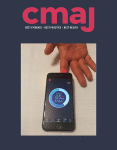
Photoplethysmography using a smartphone application for assessment of ulnar artery patency: a randomized clinical trial
Radial artery access is commonly performed for coronary angiography and invasive hemodynamic monitoring. Despite limitations in diagnostic accuracy, the modified Allen test (manual occlusion of radial and ulnar arteries followed by release of the latter and assessment of palmar blush) is used routinely to evaluate the collateral circulation to the hand and, therefore, to determine patient eligibility for radial artery access. We sought to evaluate whether a smartphone application may provide a superior alternative to the modified Allen test.
We compared the modified Allen test with a smartphone heart rate–monitoring application (photoplethysmography readings detected using a smartphone camera lens placed on the patient’s index finger) in patients undergoing a planned cardiac catheterization. Test order was randomly assigned in a 1:1 fashion. All patients then underwent conventional plethysmography of the index finger, followed by Doppler ultrasonography of the radial and ulnar arteries (the diagnostic standard). The primary outcome was diagnostic accuracy of the heart rate–monitoring application.
Among 438 patients who were included in the study, we found that the heart rate–monitoring application had a superior diagnostic accuracy compared with the modified Allen test (91.8% v. 81.7%, p = 0.002), attributable to its greater specificity (93.0% v. 82.8%, p = 0.001). We also found that this application had greater diagnostic accuracy for assessment of radial or ulnar artery patency in the ipsilateral and contralateral wrist (94.0% v. 84.0%, p < 0.001).
A smartphone application used at the bedside was diagnostically superior to traditional physical examination for confirming ulnar patency before radial artery access. This study highlights the potential for smartphone-based diagnostics to aid in clinical decision-making at the patient’s bedside. Trial registration: Clinicaltrials.gov, no. NCT02519491.
Journal Article

Rationale and design of Enhanced Angiogenic Cell Therapy in Acute Myocardial Infarction (ENACT-AMI): The first randomized placebo-controlled trial of enhanced progenitor cell therapy for acute myocardial infarction
Despite the widespread use of pharmacological and/or interventional reperfusion therapies, recovery of cardiac function in myocardial infarction (MI) patients is often modest or even absent. Unlike classical pharmacological treatments, the use of progenitor cells could potentially restore functional tissue in regions that otherwise would form only scar. However, a major limitation of autologous cell therapy is the deleterious influence of age and cardiac risk factors on progenitor cell activity.
The ENACT-AMI trial is a phase IIb, double-blind, randomized placebo-controlled trial, using transplantation of autologous early endothelial progenitor cells (EPCs) for patients who have suffered large MI. Circulating mononuclear cells (MNCs) are obtained by apheresis and subjected to differential culture for 3 days to select a population of highly regenerative, endothelial-like, culture modified MNCs (E-CMMs), often referred to as “early EPCs.” A total of 99 patients will be randomized to placebo (Plasma-Lyte A), autologous E-CMMs, or E-CMMs transfected with human endothelial nitric oxide synthase delivered by coronary injection into the infarct-related artery. The primary efficacy end point is change from baseline to 6 months in global left ventricular ejection fraction by cardiac MRI; secondary endpoints include regional wall motion, wall thickening, infarct volume, time to clinical worsening, and quality of life.
This will be the first clinical trial to include a strategy designed to enhance the function of autologous progenitor cells by overexpressing endothelial nitric oxide synthase, and the first to use combination gene and cell therapy for the treatment of cardiac disease.
Journal Article

Comparison of the Frequencies of Myocardial Edema Determined by Cardiac Magnetic Resonance in Diabetic Versus Nondiabetic Patients Having Percutaneous Coronary Intervention for ST Elevation Myocardial Infarction
The specific mechanisms by which diabetes may affect the myocardial tissue response to ischemia are unclear. Our objective was to prospectively quantify the degree of myocardial edema in diabetics versus nondiabetics with ST elevation myocardial infarction using cardiac magnetic resonance. Fifty-two patients (16 diabetics and 36 nondiabetics) were enrolled after primary percutaneous coronary intervention and underwent cardiac magnetic resonance on a 1.5-T scanner at 48 hours and 6 months. Myocardial edema was quantified using a T2 mapping technique, and infarct size and microvascular obstruction size were assessed by way of a contrast-enhanced T1-weighted inversion recovery gradient-echo sequence. The infarct segment T2 was elevated in diabetics compared with nondiabetics (59.0 ± 8.0 vs 50.8 ± 3.1 ms, p <0.001) at 48 hours. Multivariate analysis demonstrated that diabetes (p <0.001) and symptom-to-balloon time (p = 0.04) were independent predictors of the degree of acute myocardial edema. Infarct size was nonsignificantly higher in the diabetic group at 48 hours (26.9 ± 9.4% vs 20.1 ± 10.1% of myocardium, p = 0.07) and 6 months (17.1 ± 6.3% vs 13.4 ± 6.1% of myocardium, p = 0.09). Microvascular obstruction size was equivalent in both groups, and there was a trend toward lower myocardial salvage index in diabetics (34.2 ± 11.8 vs 49.6 ± 13.4, p = 0.08). In conclusion, diabetes is associated with increased myocardial edema in the acute phase after primary percutaneous coronary intervention. Our results offer insight into the complex processes that characterize myocardial tissue response to injury in diabetic patients.
Journal Article