
Catalogue Search | MBRL


Are you sure you want to remove the book from the shelf?

{{itemTitle}}
184
result(s) for
"Dillon, Justin"
Sort by:


Plant awareness is linked to plant relevance: A review of educational and ethnobiological literature (1998–2020)
Societal Impact Statement This research attempts to provide novel insights into plant awareness disparity (plant blindness), through a systematic and critical examination of the educational and ethnobiological literature. The low interest and awareness for plants is well documented in urban societies and has serious implications for biodiversity conservation and sustainable land‐use. This study is significant because it provides a comprehensive analysis of the characteristics of human‐plant relations in different societies, which does not currently exist in the academic literature. The findings suggest that people's plant awareness develops where they have frequent interactions with plants that have direct relevance to their lives. Summary The inattention to plants, known as ‘plant blindness’ or ‘plant awareness disparity’, is an established concern amongst biologists, but there has been no comprehensive and critical examination of the investigative literature to date. This study aims to address this, with a narrative review of experimental studies published in indexed journals from 1998 to 2020. Data were extracted using a suite of relevant search terms, characterised using key words and subjected to a thematic content analysis; 326 studies were shortlisted for review, with the majority in the subject areas of biological education, ethnobiology and biological conservation. The prevalent research methods were interviews and free‐listing exercises (ethnobiology) and questionnaires and tests (education). The most common characteristics of plant awareness disparity were a deficit of knowledge or identification skills, followed by an attention or memory advantage for animals compared to plants, preference for animals and low interest in plants. There was no concrete evidence of innate plant awareness disparity; instead, diminished experience of nature in urbanised societies appeared to be the cause. Virtually, all the 87 studies that found evidence of plant awareness disparity were undertaken in urban populations in high‐income countries. By contrast, there were 109 studies of extensive botanical knowledge based on rural communities dependent on biological resources, where individual expertise was found to be proportionate to the extent of wild plant collecting. We conclude that a decline in relevant experience with plants leads to a cyclical process of inattention that could be addressed through first‐hand experiences of edible and useful plants in local environments. This research attempts to provide novel insights into plant awareness disparity (plant blindness), through a systematic and critical examination of the educational and ethnobiological literature. The low interest and awareness for plants is well documented in urban societies and has serious implications for biodiversity conservation and sustainable land‐use. This study is significant because it provides a comprehensive analysis of the characteristics of plant awareness disparity in society, which does not currently exist in the academic literature. The findings suggest that people's plant awareness develops where they have frequent interactions with plants that have direct relevance to their lives.
Journal Article


Convergence Between Science and Environmental Education
Citizen science and concerns about sustainability can catalyze much-needed synergy between environmental education and science education. Urgent issues such as climate change, food scarcity, malnutrition, and loss of biodiversity are highly complex and contested in both science and society ( 1 ). To address them, environmental educators and science educators seek to engage people in what are commonly referred to as sustainability challenges. Regrettably, science education (SE), which focuses primarily on teaching knowledge and skills, and environmental education (EE), which also stresses the incorporation of values and changing behaviors, have become increasingly distant. The relationship between SE and EE has been characterized as “distant, competitive, predatorprey and host-parasite” ( 2 ). We examine the potential for a convergence of EE and SE that might engage people in addressing fundamental socioecological challenges.
Journal Article


Learning from the past; thinking for the future: reflections on STEM and its integration in formal and informal settings
We discuss opportunities to integrate STEM across both formal and informal settings. Our reflections begin with looking back to
Making Science Matter: Collaborations Between Informal Science Education Organizations and Schools
, an influential report published by the Center for Advancement of Informal Science Education (CAISE) in 2010. We expand the arguments in that report to address integrating STEM education in formal and informal education particularly in the light of the growth of interest in teaching about ‘wicked problems’. We discuss several issues that we believe need to be taken into account in developing closer formal/informal collaboration, and trace how they have emerged since the term STEM was first used in the 1960s. We conclude that a significant challenge, that is often overlooked, is that the term STEM has several different meanings and that institutions in formal and informal settings may have different outcomes in mind when collaborating with each other. The implications are that discussing the meaning and purpose of STEM are an essential first step in any collaboration between formal and informal institutions.
Journal Article
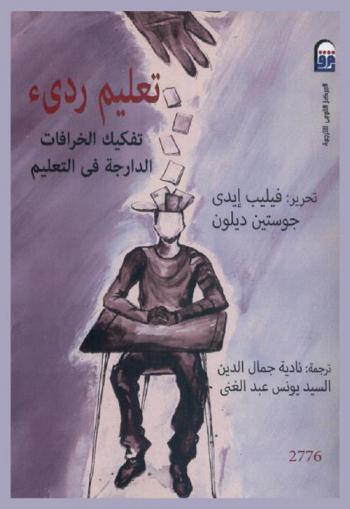
تعليم ردئ : تفكيك الخرافات الدارجة في التعليم
يتناول الكتاب حيث يقوم بدور محطم الخرافات الذي يسعى لتفكيك ومن ثم إسقاط المفاهيم والتصورات الشائعة ووضع الحقائق الثابتة في مكانها إن الكتاب بمثابة دليل صادم من الناحية السياسية لما يزخر به من البراهين التي من شأنها أن تمثل تحديا لصناع السياسات والصحافة وأولياء الأمور على حد سواء \"دايل باسيت : مدير السياسة العامة ائتلاف التقييم والمؤهلات العلمية AQA ينبغي أن يضحى هذا الكتاب دليلا للتغيير لكل المنخرطين في العملية التعليمية الذين ينافحون من أجل ضمان ألا يتلقى أطفالنا تعليما سيئا فعلى كل مدير مدرسة أن يشتري نسخه من هذا الكتاب لكل معلم\" \"جاري فيليبس : مدير مدرسة ليليان بابليس التكنولوجية كلنا يعلم أن الفصول الصغيرة أفضل من الفصول الأكبر حجما وأن الأفضل للأطفال أن يتم تعلمهم في مجموعات تأسيسا على قدراتهم وأن بعض المدارس أفضل كثيرا من غيرها\"
Book

Improving the Welfare of Companion Dogs—Is Owner Education the Solution?
Vets, animal welfare charities, and researchers have frequently cited educating owners as a necessity for improving the welfare of companion dogs. The assumption that improving an owner’s knowledge through an education intervention subsequently results in improvements in the welfare of the dog appears reasonable. However, the complexity of dog welfare and dog ownership and the context in which these relationships occur is rapidly changing. Psychology has demonstrated that humans are complex, with values, attitudes, and beliefs influencing our behaviours as much as knowledge and understanding. Equally, the context in which we individuals and our dogs live is rapidly changing and responding to evolving societal and cultural norms. Therefore, we seek to understand education’s effectiveness as an approach to improving welfare through exploring and understanding these complexities, in conjunction with the relevant research from the disciplines of science education and communication. We argue that well designed and rigorously evaluated education interventions can play a part in the challenge of improving welfare, but that these may have limited scope, and welfare scientists could further consider extending cross-disciplinary, cross-boundary working, and research in order to improve the welfare of companion dogs.
Journal Article
Science|Environment|Health – the emergence of a new pedagogy of complex living systems
Science|Environment|Health (S|E|H) is an emerging science pedagogy for complex living systems. The name highlights a situation of mutual benefit between science education, environmental education and health education. The paper discusses a range of topics from the curriculum-focused origin of the S|E|H movement to the issues that concern S|E|H researchers today. These include, among others, the role of scientific knowledge in S|E|H decision making, medicine education as a paradigmatic example of S|E|H, complexity in S|E|H issues, the role of empathy in S|E|H, and the tension between societal and individual responsibility. In conclusion, it is argued that two insights are essential for current S|E|H work. First, living systems can be understood both in causal and empathetic terms, which makes S|E|H a powerful ‘science for all’ approach. Second, in living systems, there is always a trade-off between predictability and homeostasis. This brings S|E|H in a natural antagonism – but not in opposition – to STEM approaches.
Journal Article
Do Animal Welfare Education Campaigns Really Work? An Evaluation of the RSPCA’s #DogKind Campaign in Raising Awareness of Separation-Related Behaviours in UK Dog Owners
One of the main aims of companion animal welfare charities is to educate the public about the needs of animals. This is frequently performed through campaigns focusing on specific aspects of welfare. The Royal Society for the Prevention of Cruelty to Animals (RSPCA), Britain’s biggest animal welfare charity, launched the nationwide #DogKind campaign in March 2019. Targeted mainly at 25–34-year-olds, the campaign aimed to increase awareness of separation-related behaviour (SRB) among dog owners and encourage them to seek help for SRB from reliable sources. This research involved a quasi-experimental, non-equivalent control group design evaluating the campaign’s effectiveness. It was conducted through a series of online surveys at three different time points: before the launch of the campaign (n = 2002), six months after (n = 2423), and, again, two months later (n = 269), during which we asked the same questions regarding knowledge of SRB. An experimental trial of 269 participants tested whether accessing a video alongside the campaign web pages increased the effectiveness of the campaign objectives. Overall, the campaign appeared to be effective in reaching its target audience but not at raising awareness of SRB or increasing the number of owners intending to seek help. The inclusion of a video in the campaign made no difference to its effectiveness. This study shows that this campaign had limited success in achieving its targets and highlights the importance of thorough evaluations of education interventions that aim to improve the welfare of companion animals.
Journal Article