
Catalogue Search | MBRL


Are you sure you want to remove the book from the shelf?

{{itemTitle}}
41
result(s) for
"Dwan, David"
Sort by:

The Cambridge companion to Edmund Burke
\"This comprehensive and accessible Companion examines the life and writings of Edmund Burke, one of the eighteenth-century's most influential thinkers\"-- Provided by publisher.
Book

Unlucky Jim
Conrad’s fiction often focuses on luck, particularly on moral luck—those happenings that exceed our control but affect our standing in the world nonetheless. Such luck has a key bearing on the moral intelligibility of plot and character in Lord Jim. This is a novel that supports two sides of a paradox: morality should and should not be influenced by the vagaries of luck. There is no obvious resolution to this double vision in Conrad and it leads him to question the coherence of morality as a general system. He also doubts—however paradoxically—its basic fairness. If luck is all-pervasive, then justice itself is unjust.
Journal Article

Important Nonsense
This essay shows how the practice of symbolism needs to be interpreted within a broader intellectual history. The metaphysical content of this history might encourage us to abandon it, but it provides the conditions of intelligibility, nonetheless, for key literary concepts–at least if one assumes that the historical operation of these concepts have some bearing on their current use. I make the case with Yeats. His symbolic practice, I argue, is unintelligible without reference to two metaphysical traditions in which he was deeply invested 1) an idealism that is pledged to a super-reality that exceeds time and space 2) a radical subjectivism in which the private ego is the source and ground of meaning in the world. The friction between these two outlooks partly explains why the symbol becomes such a \"troubled mirror\" in Yeats's writing.
Journal Article

ROMANTIC NATIONALISM: HISTORY AND ILLUSION IN IRELAND
Intellectual historians often invoke “romanticism” to account for the origins and conceptual shape of nationalism. In an Irish context, however, this approach has yielded false genealogies of influence and an impaired political understanding. Cast through a “romantic” prism, nationalism is divorced from its conditions of intelligibility, becoming unhelpfully isolated from questions about sovereignty, democratic legitimacy and the nature of modern citizenship. Thus all too often the irrationality that is made part of the definition of “romantic nationalism” is a function of the way that it is interpreted.
Journal Article

Edmund Burke and the Emotions
The emphasis Burke placed on the role of feeling in moral and political life is an obvious feature of his thought. Less obvious is what Burke understood by a feeling and it is a question that has been largely overlooked in modern scholarship. This article suggests that Burke entertained different and incompatible theories of emotion. In early works, he often endorsed a non-cognitive theory of affect: here emotions were essentially non-reasoning states. But he later rejected this position and insisted upon the intrinsic rationality of feeling. This article examines the philosophical content and political significance of these rival outlooks.
Journal Article
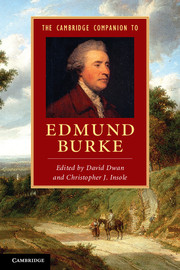
The Cambridge Companion to Edmund Burke
Edmund Burke prided himself on being a practical statesman, not an armchair philosopher. Yet his responses to specific problems - rebellion in America, the abuse of power in India and Ireland, or revolution in France - incorporated theoretical debates within jurisprudence, economics, religion, moral philosophy and political science. Moreover, the extraordinary rhetorical force of Burke's speeches and writings quickly secured his reputation as a gifted orator and literary stylist. This Companion provides a comprehensive assessment of Burke's thought, exploring all his major writings from his early treatise on aesthetics to his famous polemic, Reflections on the Revolution in France. It also examines the vexed question of Burke's Irishness and seeks to determine how his cultural origins may have influenced his political views. Finally, it aims both to explain and to challenge interpretations of Burke as a romantic, a utilitarian, a natural law thinker and founding father of modern conservatism.
eBook

ORWELL'S PARADOX: EQUALITY IN \ANIMAL FARM\
Animal Farm presents itself as a simple fable, but it raises profound questions about one of our most cherished political concepts, namely, equality. Initially viewed as a solution to the problem of injustice on Animal Farm, equality soon presents itself as part of the problem. It is a radically open-ended ideal that lends itself to different and contradictory interpretations. This article shows how George Orwell's \"fairy story\" puts equality on trial and forces readers to reexamine some of their most fundamental moral and political commitments.
Journal Article

Truth and Freedom in Orwell's Nineteen Eighty-Four
Did Orwell regard truth as a political virtue? Yes, and the case Orwell makes for truth is a subtle one. Truth, he suggests, can never be adequately theorized - hence the different and rival descriptions of truth provided in Nineteen Eighty-Four are either empty or mistaken. For Orwell, truth will always elude our theories, but it must serve as the ground and even the goal of our freedom nonetheless.
Journal Article

Abstract Hatred: Yeats and the Counter-Revolutionary Paradigm
Marat, 'talentless, possessing no critical acumen and of mediocre intelligence,' according to Taine, joined Robespierre 'with his mediocre education and average intellect' in undermining the historical foundations and established government of France, replacing them with abstract principles gleaned largely from Rousseau.4 Yeats shared Taine's distrust of abstract method. [...]he also chose to relate the abstractions of a decadent classicism to revolution. [...]Yeats's opinion that Burke was a Whig who hated Whiggery or that the latter was reducible to a 'levelling rancorous, rational sort of mind' (VP 486) was not a view Burke himself would have shared. [...]in 1925 Yeats enlists Burke as a precursor of the anti-democratic tradition now culminating in the writings of Péguy, Claudel, and Maurras, and in the actions of Mussolini. [...]he is careful to insist that the 'French and Irish democracies follow . . . a logical deduction to its end, no matter what suffering it caused,' not because of some inherent racial attribute or because of their fortunate proximity to some Platonic ideal, but rather because of their fatal severance from history (M 206). Like his compatriot, W. E. H. Lecky, Yeats deemed democratic equality to be fundamentally despotic. Since equality can never be found in the empirical world it must be continually enforced, in what amounts to the ruthless suppression of individual differences.
Journal Article
