
Catalogue Search | MBRL


Are you sure you want to remove the book from the shelf?

{{itemTitle}}
244
result(s) for
"Feuchtwang, Stephan"
Sort by:


The Anthropology of Religion, Charisma and Ghosts
It has been said that Chinese government was, until the republican period, government through li. Li is the untranslatable word covering appropriate conduct toward others, from the guest rituals of imperial diplomacy to the hospitality offered to guests in the homes of ordinary people. It also covers the centring of self in relation to the flows and objects in a landscape or a built environment, including the world beyond the spans of human and other lives. It is prevalent under the republican regimes of China and Taiwan in the forming and maintaining of personal relations, in the respect for ancestors, and especially in the continuing rituals of address to gods, of command to demons, and of charity to neglected souls. The concept of religion does not grasp this, neither does the concept of ritual, yet li undoubtedly refers to a figuration of a universe and of place in the world as encompassing as any body of rite and magic or of any religion. Through studies of Chinese gods and ghosts this book challenges theories of religion based on a supreme god and that gods prophets, as well as those like Hinduism based on mythical figures from epics, and offers another conception of humanity and the world, distinct from that conveyed by the rituals of other classical anthropological theories.
eBook


Care as Critique of Care: Public Services, Social Security and Ritual Responsiveness
Socialist governance and popular sovereignty require state administration of care. In the People's Republic of China (PRC) today, such state care is provided in the form of public services and in the guarantee of social security. Ideally, different levels of government should foster relations of care in local communities and remain responsive to “the people.” Local self-government, relations of mutual support and ritual communities, however, reveal the deficits of state care. Much like general philosophies of care, such local ethics of care propose universal benchmarks against which social practice can be measured. This article outlines the main contours of state care in the post-Mao Zedong PRC, and contrasts its findings with empirical research on public services, social security and ritual responsiveness. Mutual help, neighbourhood communities and ritual practice, in particular, provide alternative models of care. As such, they can be extended and universalized, and offer possibilities for a critique of care.
Journal Article


Stocks of Images
Abstract What kind of knowledge is created through systems of divination? I will contend that the form of such knowledge is a type of pattern recognition—patterns that emerge in reference to a cosmology and by means of a stock of images. Divination creates knowledge of a moment and its circumstances. Reference to a sense of the encompassing world raises the issue of how any one means of divination and its outcomes is bound historically to a civilization. That will be my secondary topic of reflection. I will conclude with a discussion of worlds, recent history, speculation, and the ontology of divination in relation to the experience of uncertainty in which the object of knowledge is the momentary and its circumstances.
Journal Article

Welcoming Dangerous Benefactors: Incense, Gods and Hospitality in North-Eastern Taiwan
Chinese festival ritual offers an extreme case of hospitality to outsider benefactors, to gods. They are invited outsiders. Their host is a territorial community of households represented by their divinely selected master of the god's incense burner. Mediation to communicate with and separate from powerful guests is a courting of great power and avoiding its danger. Their welcome poses the danger of offence. To these points I add other sides and counterparts to rites of hospitality, such as rites of charitable feeding. I begin by arguing that the dangers of hospitality suggested by others in this volume are applicable in this case. Finally, I suggest how the terms in which I analyse these Chinese rites are applicable to other orders of hospitality.
Journal Article
Welcoming Dangerous Benefactors
Chinese festival ritual offers an extreme case of hospitality to outsider benefactors, to gods. They are invited outsiders. Their host is a territorial community of households represented by their divinely selected master of the god’s incense burner. Mediation to communicate with and separate from powerful guests is a courting of great power and avoiding its danger. Their welcome poses the danger of offence. To these points I add other sides and counterparts to rites of hospitality, such as rites of charitable feeding. I begin by arguing that the dangers of hospitality suggested by others in this volume are applicable in this case. Finally, I suggest how the terms in which I analyse these Chinese rites are applicable to other orders of hospitality.
Journal Article
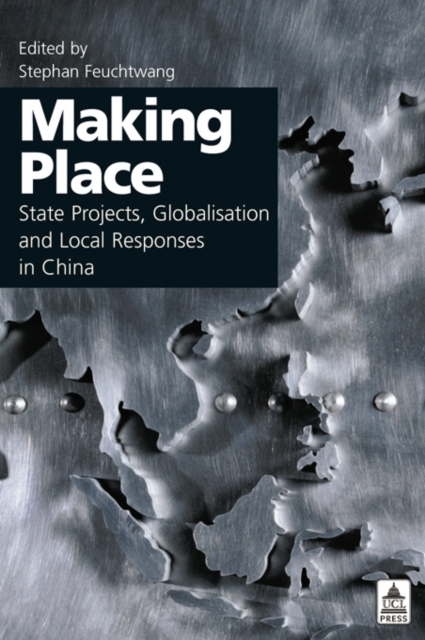
Making Place
To make a place is to create a location where its creators can feel they belong. Processes of place-making are still very much ongoing today. Geographers, sociologists, political scientists and philosophers of advanced capitalism have said that place is a localisation of the global. However, the creation of a place is not legible from such grand perspectives. It is also much more creative than can be predicted by translating large-scale processes into local cultures.
Anthropologists have been sensitive to the intimate, tragic and lyrical senses of local place. But their theorising has been too much bound up with cosmology and insufficiently with the intermediate scales of state and local state.
In this book, Stephan Feuchtwang and his contributors offer a set of historical, anthropological and scale-mediated studies from China - a country that includes a subcontinental variety of cultures and landscapes. In the twentieth century it experienced collapse in civil war and was then reasserted as a particularly strong state. Now it is managing the fastest growing capitalist economy in the world. These intriguing Chinese studies contribute to the anthropology of place and space, providing an historical perspective on processes of change and of accommodation to disruption.
The stories they tell are fascinating in their own right, but in addition, the result is a critical reformulation of previous theories of place that geographers, philosophers, historians, and anthropologists will find of great interest.
eBook
Civilization, Hierarchy, and Political-Economic Inequality
Abstract This article puts Dumont’s ‘hierarchy’ into the context of Marcel Mauss’s conception of civilization as a correction to Dumont’s ahistorical and structuralist approach. First, it introduces and elaborates Mauss’s ‘civilization’ into a descriptive and analytic concept. It then proposes a loosened conception of different hierarchies of encompassment and ideology. What follows as extended examples is a selection of long processes of transformation of the hierarchical structure of civilization in China. The article concludes by broaching the big historical questions that anthropology should be asking about hierarchies, that is, how they are formed and transformed.
Journal Article