
Catalogue Search | MBRL


Are you sure you want to remove the book from the shelf?

{{itemTitle}}
23
result(s) for
"Gabel, Susan L."
Sort by:


Shatter Not the Branches of the Tree of Anger: Mothering, Affect, and Disability
Using the social interpretation of disability, Foucault's theory of disciplinary power, literary devices, and feminist literature, I write an affective narrative of mothering disabled children. In doing so I illustrate the ways in which the materiality of normalcy, surveillance, and embodiment can produce emotions that create docile mothers ashamed of their contribution to the world, conflicted mothers struggling with dissonant affects, and unruly, angry mothers battling against the architectures of their children's oppression.
Journal Article

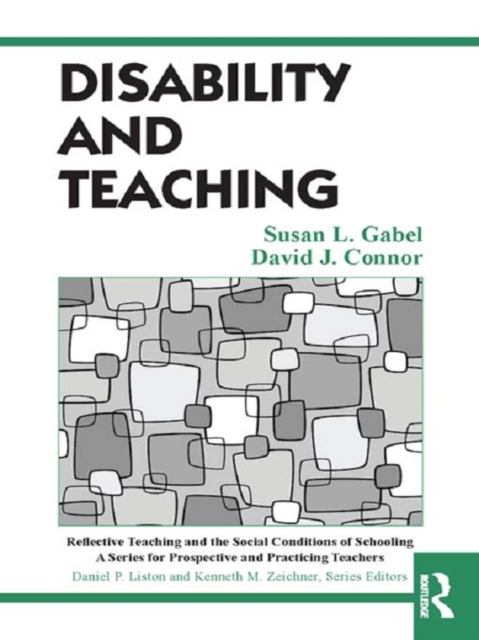
Disability and Teaching
Disability and Teaching highlights issues of disability in K-12 schooling faced by teachers, whoare increasingly accountable for the achievement of all students regardless of the labelsassigned to them. It is designed to engage prospective and practicing teachers in examining theirpersonal theories and beliefs about disability and education.
Part I offers four case studies dealing with issues such as inclusion, over-representation inspecial education, teacher assumptions and biases, and the struggles of novice teachers. Thesecases illustrate the need to understand disability and teaching within the contexts of school,community, and the broader society and in relation to other contemporary issues facing teachers.Each is followed by space for readers to write their own reactions and reflections, educators'dialogue about the case, space for readers' reactions to the educators' dialogue, a summary, andadditional questions. Part II presents public arguments representing different views about thetopic: conservative, liberal-progressive, and disability centered. Part III situates the authors'personal views within the growing field of Disability Studies in education and provides exercisesfor further reflection and a list of resources.
Disability and Teaching is the 8th volume in the Reflective Teaching and the Social Conditions ofSchooling Series, edited by Daniel P. Liston and Kenneth M. Zeichner. This series of small,accessible, interactive texts introduces the notion of teacher reflection and develops it in relationto the social conditions of schooling. Each text focuses on a specific issue or content area inrelation to teaching and follows the same format. Books in this series are appropriate for teachereducation courses across the curriculum.
eBook

Exploring Involvement Expectations for Culturally and Linguistically Diverse Parents: What We Need to Know in Teacher Education
In the United States parental involvement is an important part of a child’s education, and teachers often rely on parents to boost student achievement. This qualitative analysis employs a two-step process, first examining the data with regards to parental involvement and then using critical theories in education to examine the intersections between parental involvement findings and subtractive schooling practices in order to highlight how educational praxis, teacher perspectives, and school climate impact both parental involvement and school achievement for culturally and linguistically diverse (CLD) students.
Journal Article

Intellectual Disability and Space: Critical Narratives of Exclusion
The language of intellectual disability is rife with spatial terms. Students labeled with intellectual disability are “placed in” special education where they may be “self-contained,” “segregated,” “excluded,” or “included.” Conversations ensue about where to seat them, next to whom, and at what distance from the teacher and other students. In this article, critical spatial studies and critical narratives are used to illustrate the ways in which power and exclusion constitute intellectual disability.
Journal Article
Resistance and Resilience in a Life Full of Professionals and Labels: Narrative Snapshots of Chris
In this article, the authors relate the life of Chris through narrative snapshots. Chris asked the authors to tell her story. They decided that it could be used to provide an insight into the different ways people with labels are confronted with professional practices and rituals. Although Chris lived a “tough life,” her story is full of resilience and resistance. Chris will be kept in the authors' memory as a strong woman, a teacher, and a friend.
Journal Article

Reimagining Critical Care and Problematizing Sense of School Belonging as a Response to Inequality for Immigrants and Children of Immigrants
This chapter examines the factors that contribute to a sense of school belonging for immigrant and immigrant-origin youth. Through a review of the education research on critical care, the authors propose a framework informed by cariño conscientizado— critically conscious and authentic care—as central to reconceptualizing notions of school belonging. Research studies on teacher-student andpeer relationships, student agency, and organizing are reviewed to identify how they function to disrupt structural factors that maintain educational inequities. Belonging as a concept is problematized through a reenvisioning of curriculum, pedagogy, and school-community relationships as a means to reduce inequality for immigrant and immigrant-origin youth and children.
Journal Article
Critical Care and Problematizing Sense of School Belonging as a Response to Inequality for Immigrants and Children of Immigrants
This chapter examines the factors that contribute to a sense of school belonging for immigrant and immigrant-origin youth. Through a review of the education research on critical care, the authors propose a framework informed by \"cariño conscientizado\"--critically conscious and authentic care--as central to reconceptualizing notions of school belonging. Research studies on teacher-student and peer relationships, student agency, and organizing are reviewed to identify how they function to disrupt structural factors that maintain educational inequities. Belonging as a concept is problematized through a re-envisioning of curriculum, pedagogy, and school-community relationships as a means to reduce inequality for immigrant and immigrant-origin youth and children.
Journal Article

When numbers don’t add up and words can’t explain: Challenges in defining disability in higher education
This paper follows the discursive loops we have been attempting to untangle as a result of our work on a federally sponsored 3-year mixed methods research project at a private, not-for-profit university, which we will call Midwestern Regional University (MRU), in the mid-western United States. Grounded in the social model of disability, the project aimed to improve MRU's ability to provide a quality education for disabled students. We explore two sets of tensions: methodological ones that emanate from different epistemological assumptions of qualitative and quantitative inquiry that we combined, and theoretical ones stemming from different ideological underpinnings that position the medical and social model of disability as incongruent. These methodological and theoretical tensions also reverberated to the ethical and political aspects of our research. [PUBLICATION ABSTRACT]
Journal Article