
Catalogue Search | MBRL


Are you sure you want to remove the book from the shelf?

{{itemTitle}}
87
result(s) for
"Greene, Kenneth F."
Sort by:

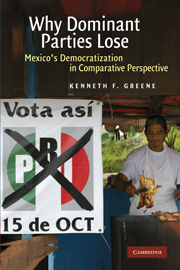
Why Dominant Parties Lose
Why have dominant parties persisted in power for decades in countries spread across the globe? Why did most eventually lose? Why Dominant Parties Lose develops a theory of single-party dominance, its durability, and its breakdown into fully competitive democracy. Greene shows that dominant parties turn public resources into patronage goods to bias electoral competition in their favor and virtually win elections before election day without resorting to electoral fraud or bone-crushing repression. Opposition parties fail because their resource disadvantages force them to form as niche parties with appeals that are out of step with the average voter. When the political economy of dominance erodes, the partisan playing field becomes fairer and opposition parties can expand into catchall competitors that threaten the dominant party at the polls. Greene uses this argument to show why Mexico transformed from a dominant party authoritarian regime under PRI rule to a fully competitive democracy.
eBook

The Machine Works: Why Turnout Buying is More Effective Than it Appears
Turnout buying is a mainstay of machine politics. Despite strong theory that selective incentives should spur turnout, meta-analyses of empirical studies show no effect, thus making machine politics seem irrational and unsustainable. I argue that the apparent failure of turnout buying is an artefact of common measurement decisions in experimental and observational research that lump together turnout buying, abstention buying, and vote-choice buying. Data generated using these compound measures include countervailing and null effects that drive estimates of the effects of each strategy toward zero. I show that machines have incentives to diversify their strategies enough to make compound measures substantially underestimate the impact of turnout buying. I propose simple alternative measurement approaches and show how they perform using new survey data and a constituency-level analysis of machine strategy in Mexico. Findings close the gap between theory and facts and reaffirm the rationality of machine politics.
Journal Article

Is Mexico Falling into the Authoritarian Trap?
Mexico’s 2021 midterm elections occurred amid concerns about the erosion of democratic institutions. Supporters of President López Obrador (AMLO) view his centralization of power in the executive as necessary to make government work for a marginalized majority. But the same state weaknesses that helped to propel AMLO to power constrain his responses to complex governance problems, including poverty and violent crime. This limits AMLO’s ability to consolidate a populist supermajority that can overwhelm constitutional checks and balances. State weakness and his increased reliance on the military thus pose a greater threat to Mexico’s democracy than a new electoral hegemon.
Journal Article

Making Clientelism Work: How Norms of Reciprocity Increase Voter Compliance
Recent research on clientelism focuses on mercenary exchanges between voters and brokers. In this \"instrumentalist\" view, machine politics is only sustainable where patrons can punish clients for defection-a situation that does not apply in many places known for clientelism.
We build a different theory of clientelism around the norm of reciprocity. If exchanges rely on clients' feelings of obligation to return favors to their patrons, then clientelism can be sustained even where the ballot is genuinely secret. To support this argument, we draw on a range of research,
including a series of split-sample experiments embedded in two surveys on Mexico specifically focused on reciprocity. Our findings have implications for voting behavior, party organization, and the types of public policies that may prevent clientelism.
Journal Article

Dominant Party Strategy and Democratization
How do incumbent parties strategize against challengers when a new partisan cleavage cuts across the incumbent's electoral coalition? This article argues that a two-dimensional extension of Riker's anticoordination thesis conflicts with Downsian extensions. It shows that when voters coordinate on a single challenger based on their shared preference on a cross-cutting cleavage, a vote-maximizing incumbent party should move away from the challenger on the primary dimension of competition, even at the risk of abandoning the center. The article develops this hypothesis with reference to dominant parties in competitive authoritarian regimes where challenger parties constantly attempt \"heresthetical\" moves by mobilizing regime issues into the partisan debate, and it tests the predictions with an original sample survey of national leaders of Mexico's Revolutionary Institutional Party (PRI). It also spells out the implications of the findings for dominant party survivability in democratic transitions and, more broadly, for incumbents' spatial strategies in the face of new partisan cleavages.
Journal Article
Campaign Persuasion and Nascent Partisanship in Mexico's New Democracy
Despite ample evidence of preelection volatility in vote intentions in new democracies, scholars of comparative politics remain skeptical that campaigns affect election outcomes. Research on the United States provides a theoretical rationale for campaign effects, but shows little of it in practice in presidential elections because candidates' media investments are about equal and voters' accumulated political knowledge and partisan attachments make them resistant to persuasive messages. I vary these parameters by examining a new democracy where voters' weaker partisan attachments and lower levels of political information magnify the effects of candidates' asymmetric media investments to create large persuasion effects. The findings have implications for the generalizability of campaign effects theory to new democracies, the development of mass partisanship, candidate advertising strategies, and the specific outcome of Mexico's hotly contested 2006 presidential election. Data come primarily from the Mexico 2006 Panel Study.
Journal Article

Using the Predicted Responses from List Experiments as Explanatory Variables in Regression Models
The list experiment, also known as the item count technique, is becoming increasingly popular as a survey methodology for eliciting truthful responses to sensitive questions. Recently, multivariate regression techniques have been developed to predict the unobserved response to sensitive questions using respondent characteristics. Nevertheless, no method exists for using this predicted response as an explanatory variable in another regression model. We address this gap by first improving the performance of a naive two-step estimator. Despite its simplicity, this improved two-step estimator can only be applied to linear models and is statistically inefficient. We therefore develop a maximum likelihood estimator that is fully efficient and applicable to a wide range of models. We use a simulation study to evaluate the empirical performance of the proposed methods. We also apply them to the Mexico 2012 Panel Study and examine whether vote-buying is associated with increased turnout and candidate approval. The proposed methods are implemented in open-source software.
Journal Article

The Latin American Left's Mandate: Free-Market Policies and Issue Voting in New Democracies
The rise of the left across Latin America is one of the most striking electoral events to occur in new democracies during the last decade. Current work argues either that the left's electoral success stems from a thoroughgoing rejection of free-market policies by voters or that electorates have sought to punish poorly performing right-wing incumbents. Whether the new left has a policy or performance mandate has implications for the type of policies it may pursue in power and the voting behavior of Latin American electorates. Using a new measure of voter ideology called vote-revealed leftism (VRL) and a time-series cross-sectional analysis of aggregate public opinion indicators generated from mass surveys of eighteen countries over thirteen years, the authors show that the left has a clear economic policy mandate but that this mandate is much more moderate than many observers might expect. In contrast to the generalized view that new democracies are of low quality, the authors reach the more optimistic conclusion that wellreasoned voting on economic policy issues and electoral mandates are now relevant features of politics in Latin America.
Journal Article

Interacting as equals reduces partisan polarization in Mexico
In many contemporary democracies, political polarization increasingly involves deep-seated intolerance of opposing partisans. The decades-old contact hypothesis suggests that cross-partisan interactions might reduce intolerance if individuals interact with equal social status. Here we test this idea by implementing collaborative contact between 1,227 pairs of citizens (2,454 individuals) with opposing partisan sympathies in Mexico, using the online medium to credibly randomize participants’ relative social status within the interaction. Interacting under both equal and unequal status enhanced tolerant behaviour immediately after contact; however, 3 weeks later, only the salutary effects of equal contact endured. These results demonstrate that a simple, scalable intervention that puts people on equal footing can reduce partisan polarization and make online contact into a prosocial force.
Greene et al. find that collaborative contact that equalizes the social status of opposing partisans can reduce political polarization.
Journal Article