
Catalogue Search | MBRL


Are you sure you want to remove the book from the shelf?

{{itemTitle}}
49
result(s) for
"Houser, Heather"
Sort by:


Shimmering Description and Descriptive Criticism
What can studying novelistic description teach us about the allure of modes of reading falling within the descriptive turn, specifically, surface reading, new materialist ecocriticism, and computational analysis? This article's analysis of the paradoxes of description—specifically, its ability to evoke while revoking—in McCarthy's Blood Meridian (1985), Sinha's Animal's People (2007), and Smith's White Teeth (2000) explains an apparent tension between data and materiality in these trending literary critical approaches. It details the evoke-revoke paradox of description and offers it as an analytic for understanding the ontological status of the reader and more-than-human things in methods captured by the descriptive turn. Ultimately, it shows how literary form and critical practices together give us traction on the demands fiction makes on readers and how the ascendancy of Web 2.0 mirrors those demands through its pull between materiality and data.
Journal Article

Abundance Against Scarcity
Edible ecologies stuff Ross Gay's poetic Catalog of Unabashed Gratitude (2015). A fig tree sprawls rich in fruit over a street in Philadelphia, so abundant it almost threatens. A woman \"works hard/rinsing and scrubbing/the walk/lest some poor sod/slip on the/silk of a fig/and break his hip.\" Lusciousness minimizes the possible damage as the speaker imagines the sod might \"reach over to gobble up/the perpetrator.\" The speaker's presence serendipitously prevents this injury as the woman offers him figs and \"says take/as much as/you can/help me/so I load my/pockets and mouth.\" An old woman \"loosed one/from a low slung/branch and its eye/wept like hers.\"
Journal Article

KNOWLEDGE WORK AND THE COMMONS IN BARBARA KINGSOLVER’S AND ANN PANCAKE’S APPALACHIA
[...]instead of production leading to loss, as under extraction, loss generates shared space and experiential knowledge that serve environmentalist goals. Flight Behavior and Strange outline three phases of the commons: a longstanding history of working to gain sustenance from the woods and accruing knowledge about ecological processes that depended on open access to the land, a moment in the near past when residues of these practices endured even under increasing enclosure, and a twenty-first-century moment when enclosed land became common through activism and research as a response to its threat and extinction.2 As women challenge domesticity and resist privatization and surplus extraction, they make the land ripe for knowledge work that melds scientific and experiential epistemologies.
Journal Article

Data Anticipations
Climate change is an ongoing catastrophe, but its diffuse temporal and spatial locations make it one of the hardest to fit into traditionally apocalyptic models of a single event followed by a regenerative aftermath. Ashgate, 2014); Cutcha Risling Baldy, \"On telling Native people to just 'get over it' or why I teach about the Walking Dead in my Native Studies classes … *Spoiler Alert!*,\" Sometimes Writer-Blogger Cutcha Risling Baldy, December 11, 2013, http://www.cutcharislingbaldy.com/blog/on-telling-native-people-to-just-get-over-it-or-why-i-teach-about-the-walking-dead-in-my-native-studies-classes-spoiler-alert; and Kyle Whyte, \"Is it Colonial Déj× Vu? See Sheila Watt-Cloutier, The Right to Be Cold: One Woman's Fight to Protect the Arctic and Save the Planet from Climate Change (Minneapolis: University of Minnesota Press, 2018).
Journal Article

\A Presence Almost Everywhere\: Responsibility at Risk in Don DeLillo's The Names
On March 12, 2002, the newly created United States Department of Homeland Security (DHS) inaugurated its Homeland Security Advisory System. The system was designed to disseminate emergency information smoothly from the DHS to residents and governmental agencies by translating the national threat into one of five colors. Each easy-to-decode color--from red (severe) to green (low)--communicates a threat status that impels government entities as well as the public to modify their preparedness for an emergency. The implementation of this alert system made clear that the nation at large was now, if not at greater risk, more aware of the risks it faced. While federal emergency communication initiatives had been in place for over fifty years, the Homeland Security Advisory System was the first to communicate a perceived threat rather than an actually occurring military offensive or other catastrophic event. Sociologist Ulrich Beck offers the paradigm of the \"world risk society,\" whose emergence the Advisory System confirms, to describe the current advanced stage of modernity. Here, Houser examines how Don DeLillo's The Names, first published in 1982, presents its own vision of the world risk society, one complementary to Beck's.
Journal Article
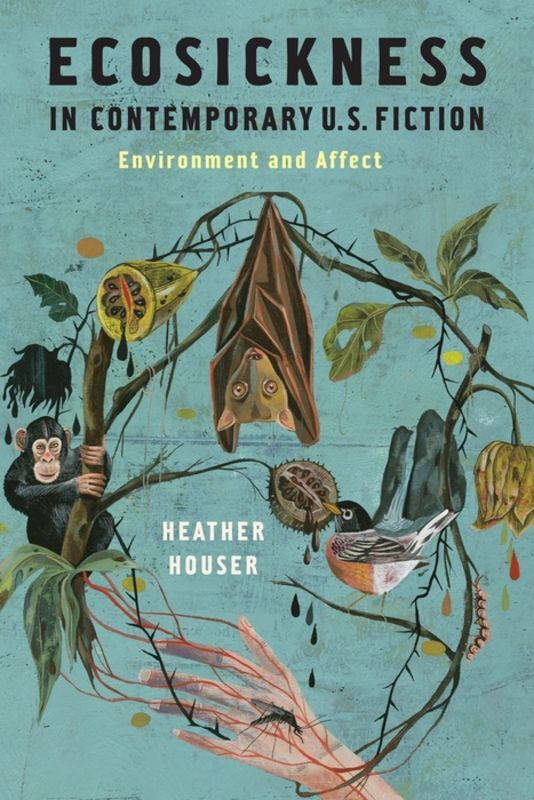
Ecosickness in contemporary U.S. fiction
The 1970s brought a new understanding of the biological and intellectual impact of environmental crises on human beings. As efforts to prevent ecological and bodily injury aligned, a new literature of sickness emerged. \"Ecosickness fiction\" imaginatively rethinks the link between these forms of threat and the sick body to bring readers to environmental consciousness. Tracing the development of ecosickness through a compelling archive of contemporary U.S. novels and memoirs, Ecosickness in Contemporary U.S. Fiction establishes that we cannot comprehend environmental and medical dilemmas through data alone and must call on the sometimes surprising emotions that literary metaphors, tropes, and narratives deploy. In chapters on David Foster Wallace, Richard Powers, Leslie Marmon Silko, Marge Piercy, Jan Zita Grover, and David Wojnarowicz, Heather Houser shows how narrative affects such as wonder and disgust organize perception of an endangered world and orient us ethically toward it. The study builds the connective tissue between contemporary literature, ecocriticism, affect studies, and the medical humanities. It also positions ecosickness fiction relative to emergent forms of environmentalism and technoscientific innovations such as regenerative medicine and alternative ecosystems. Houser models an approach to contemporary fiction as a laboratory for affective changes that spark or squelch ethical projects.
eBook
