
Catalogue Search | MBRL


Are you sure you want to remove the book from the shelf?

{{itemTitle}}
547
result(s) for
"Marcus, Bruce"
Sort by:
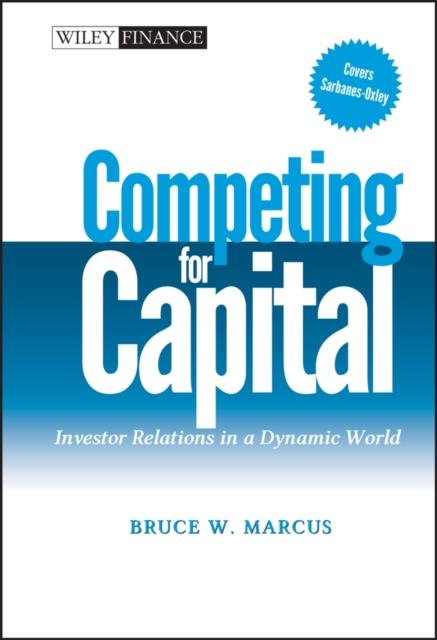
Competing for capital
An updated edition to one of the most detailed guides to investor relations The rapidly changing nature of the economic environment, technology, and the regulatory response to the scandals of the early part of the new century require a new look at traditional investor relation practices.
eBook

A priceless contribution
Experts rarely concern themselves with why it happened. Unless libel is involved, it doesn't really matter. The reporter could have functioned out of ignorance or laziness. Reporters are people, and are not immune to preconceived notions that can subvert the professionalism of even the most experienced journalist. There may have been an adverse chemical reaction to somebody in your firm or a family fight at the journalist's home that morning.
Journal Article

Preferential CTL targeting of Gag is associated with relative viral control in long-term surviving HIV-1 infected former plasma donors from China
It is generally believed that CD8+ cytotoxic T lymphocytes (CTLs) play a critical role in limiting the replication of human immunodeficiency virus type 1 (HIV-1) and in determining the outcome of the infection, and this effect may partly depend on which HIV product is preferentially targeted. To address the correlation between HIV-l-specific CTL responses and virus replication in a cohort of former plasma donors (FPDs), 143 antiretroviral therapy naive FPDs infected with HIV-1 clade B' strains were assessed for HIV-l-specific CTL responses with an IFN-γ Elispot as- say at single peptide level by using overlapping peptides (OLPs) covering the whole consensus clade B proteome. By using a Spearman's rank correlation analysis, we found that the proportion of Gag-specific CTL responses among the total virus-specific CTL activity was inversely correlated with viral loads while being positively correlated to CD4 counts, as opposed to Pol- and Env-speeific responses that were associated with increased viral loads and decreased CD4 counts. In addition, Vpr-specifc CTL responses showed a similar protective effect with Gag responses, but with a much lower frequency of recognition. Significantly, we also observed an association between HLA-A*30/B*13/ Cw*06 haplotype and lower viral loads that was probably due to restricted Gag-specific CTL responses. Thus, our data demonstrate the prominent role of Gag-specific CTL responses in disease control. The advantage of HLA-A*30/ B*13/Cw*06 haplotype in viral control may be associated with the contribution of Gag-specific CTL responses in the studied individuals.
Journal Article

Controlling Cost Growth of NASA Earth and Space Science Missions
Cost and schedule growth is a problem experienced by many types of projects in many fields of endeavor.Based on prior studies of cost growth in NASA and Department of Defense projects, this book identifies specific causes of cost growth associated with NASA Earth and space science missions and provides guidance on how NASA can overcome these.
eBook

Straining at the shackles of partnership. (Practice Management).(accounting and financial services industry standards)
Andersen partners who were far removed from the Enron debacle will probably lose thousands of dollars each in equity investment in the firm, at least as a result of lawsuits, and possibly more as a result of indictments. The arguments for reconsidering the partnership structure are now more compelling than ever. The structure is simply not responsive to the needs of the emerging marketplace for today's professional services and is, in fact, becoming downright dangerous. The firm that resides in the expertise of its partners alone now finds itself inflexible, unable to summon up the many skills that are needed to serve clients. A professional partnership is a structure that is described to convert capital to the profits of the partners. While the corporate sources of capital are drawn from the public, the sources of capital for the partnership are limited to the partners. However, this is clearly not enough today. For tomorrow's needs, no partnership has sufficient reserves of capital.
Journal Article
Impediments to marketing in the 21st century
In so many quarters, bright and well-educated people like accountants and lawyers still treat marketing like a poor relative, to be relegated to a dark attic room. Possible reasons for so many pockets of anachronistic attitudes include: 1. an antiquated billing structure, 2. an antiquated structure of governance, 3. failure to see the future, 4. success inhibiting success, 5. failure to understand both the value and the techniques of competitive intelligence, 6. willingness to give up control of a firm's destiny to the competitive environment, rather than taking steps to control one's own destiny, 7. failure to understanding marketing and its craft, 8. the professional posture, and 9. accountant's and lawyers' traditional inhospitability to non-accountants and non-lawyers.
Journal Article
A manifesto for a new era in firm-client relations
Three things temper the client-professional relationship: 1. the complexity of business and business practices in today's economic environment, 2. the wide array of service providers available, and 3. the changing public perceptions of accountants. Today's client needs and wants is not only greater sophistication and skills, and more imaginative applications of those skills, but a more meticulous understanding by professionals of what each client needs and wants, and how best to meet those needs. Defining a practice begins with understanding the needs of the clients in your markets, and then structuring your firm to meet those needs. It means learning to learn more about a client's business and industry. Where once marketing was thought to be using the mechanics and tools of the process to get clients, we know now that clients are won, and practices are built, by keeping a firm relevant to the clients' needs by becoming an integral part of a client's business, and not ancillary to it. This is accomplished by keeping the client, not the profession, at the core of the practice.
Journal Article
The dawn of a new era in firm-client relations
In Bates v. State Bar of Arizona, the court struck down the Canons of Ethics that prohibited lawyers from advertising. No force has been more significant than the rapidly evolving nature of the client now served by the profession. The newfound ability to use the tools of marketing to compete, while at first uncomfortable for accountants, gradually became familiar and acceptable. But the discovery that the best practices of marketing - the best competitive devices - were those that were most responsive to the needs of the client was slow in coming. Where once the firm and the profession were at the core of the practice, the successful professional was now the one who recognized that for the firm of the future, the client was now at the core of the practice. As the focus changed to the needs of the clients and away from the cult of the professional, the nature of the client-professional relationship changed.
Journal Article