
Catalogue Search | MBRL


Are you sure you want to remove the book from the shelf?

{{itemTitle}}
20
result(s) for
"Moddelmog, William E"
Sort by:

Reconstituting Authority
InReconstituting Authority,William Moddelmog explores the ways in which American law and literature converged in the late nineteenth and early twentieth centuries. Through close readings of significant texts from the era, he reveals not only how novelists invoked specific legal principles and ideals in their fictions but also how they sought to reconceptualize the boundaries of law and literature in ways that transformed previous versions of both legal and literary authority.
Moddelmog does not assume a sharp distinction between literary and legal institutions and practices but shows how writers imagined the two fields as engaged in the same cultural process. He argues that because the law was instrumental in setting the terms by which concepts such as race, gender, nationhood, ownership, and citizenship were defined in the nineteenth century, authors challenging those definitions had to engage the law on its own terrain: to place their work in a dialogue with the law by telling stories that were already authorized (though perhaps suppressed) by legal institutions.
The first half of the book is devoted in separate chapters to William Dean Howells, Helen Hunt Jackson, and Pauline Hopkins. The focus shifts from large theoretical concerns to questions of contract and native sovereignty, to issues of African American citizenship and racial entitlement. In each case the discussion is rooted in a larger consideration of the rule (or misrule) of law.The second half of the book turns from the rule of law to the issue of property, specifically the Lockean version of the self that tied identity to legal conceptions of property and economic value. In separate discussions of Charles Chesnutt, Edith Wharton, and Theodore Dreiser,Reconstituting Authorityreveals authors as closely engaged with those changing perspectives on property and identity, in ways that challenged the racial, gendered, and economic consequences of America's possessive individualism.
eBook
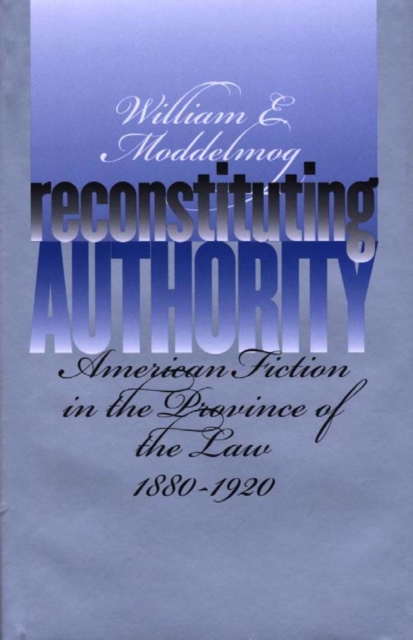
Reconstituting authority: American fiction in the province of the law, 1880-1920
In Reconstituting Authority, William Moddelmog explores the ways in which American law and literature converged in the late nineteenth and early twentieth centuries. Through close readings of significant texts from the era, he reveals not only how novelists invoked specific legal principles and ideals in their fictions but also how they sought to reconceptualize the boundaries of law and literature in ways that transformed previous versions of both legal and literary authority.Moddelmog does not assume a sharp distinction between literary and legal institutions and practices but shows how writers imagined the two fields as engaged in the same cultural process. He argues that because the law was instrumental in setting the terms by which concepts such as race, gender, nationhood, ownership, and citizenship were defined in the nineteenth century, authors challenging those definitions had to engage the law on its own terrain: to place their work in a dialogue with the law by telling stories that were already authorized (though perhaps suppressed) by legal institutions.The first half of the book is devoted in separate chapters to William Dean Howells, Helen Hunt Jackson, and Pauline Hopkins. The focus shifts from large theoretical concerns to questions of contract and native sovereignty, to issues of African American citizenship and racial entitlement. In each case the discussion is rooted in a larger consideration of the rule (or misrule) of law.The second half of the book turns from the rule of law to the issue of property, specifically the Lockean version of the self that tied identity to legal conceptions of property and economic value. In separate discussions of Charles Chesnutt, Edith Wharton, and Theodore Dreiser, Reconstituting Authority reveals authors as closely engaged with those changing perspectives on property and identity, in ways that challenged the racial, gendered, and economic consequences of America's possessive individualism.
eBook

Disowning \Personality\: Privacy and Subjectivity in The House of Mirth
Edith Wharton's \"The House of Mirth\" is discussed. The novel's central conflicts center around home, marriage and legal rights of privacy.
Journal Article

Lawful Entitlements: Chesnutt's Fictions of Ownership
[...] much of his fiction not only registers his disagreement with Washington's panacea of property ownership, but also questions the efficacy of pursuing formally equal rights within a legal system that associates the black self only with absence and dispossession. When we read the novel along with the short fiction that Chesnutt published at the turn of the century, however, its emphasis on blood and genealogy begins to look less like a capitulation to biological definitions of race and more like an exploration of the connection between race and property. Appealing to \"the court of public opinion\" - a concept charged with both legal and extralegal implications - Chesnutt hopes to build narratives more durable than Solomon's sway-backed house; narratives that move toward establishing the terms of a legal regime that valorizes the boundary lines of property and rights but, in recognizing the \"value\" of blackness as well as of whiteness, effectively erases those of race.
Journal Article
A companion to american fiction, 1865–1914
A Companion to American Fiction, 1865-1914 is a groundbreaking collection of essays written by leading critics for a wide audience of scholars, students, and interested general readers.
eBook

Writing in the “Vulgar Tongue”: Law and American Narrative
This chapter contains sections titled:
Law in the Postbellum Era
Law, Narrative, and Power
Narratives of Civil Rights
Narratives of Women's Rights
Book Chapter

The “Official” Narratives of William Dean Howells
In an essay entitled “ Police Report” that appeared in the January 1882 edition of theAtlantic, William Dean Howells describes paying two visits to what he calls a “police court”—a Boston court that summarily disposed of minor criminal offenses. Howells does not specify the dates of his attendance, stating only that the first occurred during summer and the second took place “nearly a year later” (“Police” 12). It seems likely, however, that he visited the courtroom either shortly before or during his work onA Modern Instance—most of which he wrote in 1881—and the novel’s legal
Book Chapter
Charles Chesnutt’s Fictions of Ownership
In the legal brief he filed with the U.S. Supreme Court on behalf of Homer Plessy inPlessy v. Ferguson, Albion Tourgée—the former North Carolina judge and author of numerous novels of Reconstruction—asserted that Plessy’s reputation as a white man constituted a form of property, and that this property had been forcibly taken from him when he was ejected from a white railroad car. Although succinct and dismissive, the Court’s response to Tourgée’s argument nonetheless spoke volumes. Ostensibly refusing to rule on whether a white appearance was a form of property, Justice Henry Billings Brown unwittingly articulated the
Book Chapter