
Catalogue Search | MBRL


Are you sure you want to remove the book from the shelf?

{{itemTitle}}
38
result(s) for
"Mohr, Bernard J"
Sort by:
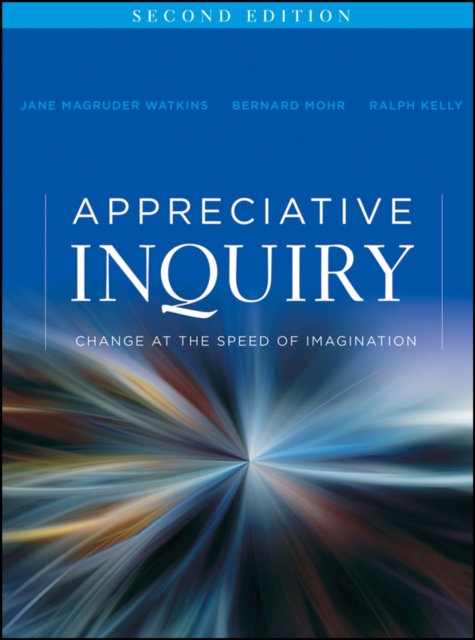
Appreciative Inquiry
Thoroughly revised and updated, the second edition of Appreciative Inquiry offers OD and HR professionals a user-friendly resource for discovering how they can tap into the power of the Appreciative Inquiry (AI) process. An innovative process, AI is an effective way to work with a company as an organic system whose success depends on a holistic approach to connect that organization's human, technical, and organizational functions.
This new edition meets the challenge of making the AI process accessible and updates three key areas of the process: the theoretical basis, fundamental assumptions and beliefs, and the basic processes. It includes step-by-step guidelines on how to apply AI in a variety of organizational situations and shows how it can be used with a wide range of initiatives, such as coaching, leadership development, strategic planning, and teambuilding.
\"If there's one book to read on AI, this is it. It provides the context and rationale for this paradigm changing approach to change at any level of system. Buy it, read it, use it and enjoy achieving great results and renewed energy and enthusiasm.\"
— Barbara Sloan, director, Organizational Development and Learning, New York University, Langone Medical Center
\"Appreciative Inquiry brings the freedom and creativity of AI together with the 'nuts and bolts' of how to actually do it all. It contains everything I would want to have as a fresh practitioner, from potential designs to sample questions and excellent Case Stories.\"
— David Shaked, founder and CEO, Almond Insight, United Kingdom
\"This book serves as a complete roadmap for those interested in the philosophy and practice of Appreciative Inquiry. The Case Stories encourage readers to find their own way on the journey by providing examples of successful interventions.\"
— Terry Egan, professor, Management Studies, Pepperdine University
eBook

Designing integrated care at the ecosystem level
Background: Just as care integration cannot always be realized only at the level of a single organization, a single care network may not always offer the scope to reach care integration. Individual care providers, care organizations and care networks are part of a larger constellation of ecosystem actors. Although existing care organizations and care networks can benefit from redesign in pursuit of integrated care, the care ecosystem offers a relatively unexplored level within which to design multiple forms of relationships between independent organizations, already existing care networks, and the multitude of other agencies, groups and patients that are involved. The forthcoming Springer volume “Designing Integrated Care Ecosystems. A Socio-Technical Perspective” focuses on the challenge of how to move the larger constellation of actors towards a more integrated care delivery, across organizational and network boundaries. The volume collects 16 international cases of care ecosystem design, of which 4 cases will be presented during the workshop. Aims and Objectives: The aim of the 90' workshop is to get participants acquainted with an ecosystem perspective on care integration, to explore possible design elements and principles, and to learn about design process challenges and characteristics at an ecosystem level. Format: The participants will be divided in four groups (preferably seated around four tables). We strive for mixed groups of people with different backgrounds, to include different perspectives. The book editors will first give a brief introduction on care ecosystems definition and relevance. Next, in each of the groups a case will be presented: Group 1: Designing a cardiac surgery patients pathway as part of an integrated care ecosystem (Todorka Kostadinova) Group 2: Co-creating value in the Diabetic Foot Care Ecosystem (Chris Lawer) Group 3: Collaborating at the intersection of facilities and organization design (Bernard Mohr) Group 4: Redesigning primary care ecosystems in the Flemish Community, Belgium (Ezra Dessers) After the case presentation, each group will try to identify key elements and principles for ecosystem design. The cases offer different angles, so that a useful synthesis can be derived from individual group sessions: from hospitals that redesign care processes with the broader ecosystem in mind (group 1 ), over ecosystem-level analyses and interventions (group 2 and 4), to the role of cross disciplinary collaboration in ecosystem design (group 3). Next, each group will be asked to report the results in a plenary pitch of 3’ max. The workshop facilitators will summarize the results and give their feedback, after which a plenary discussion will be held. Timing: 10’ welcome and introduction; 5’ explanation of today’s deliberation process and assignment; 30’ group work, of which 10’ case presentation and 20’ group discussion; 15’ plenary reporting (3’ per group – key learnings/insights); 10’ summary of outcomes, and feedback; 15’ plenary discussion; 5’ wrap-up and goodbye Target audience: Health care executives, managers and policy makers, but also interested scholars, practitioners and students of care innovation and organization design. Learnings: The ecosystem perspective holds a promising expectation to better understand and improve care integration across networks, organizations and individual actors.
Journal Article

Enhancing Patient Safety: Improving the Patient Handoff Process Through Appreciative Inquiry
Patient transfers from one care giver to another are an area of high safety consequence, as is evident by many studies and the Joint Commission on Accreditation of Healthcare Organization's Patient Safety Goals. The authors describe how one hospital made measurable improvements in a patient handoff process by using an unconventional approach to change called appreciative inquiry. Rather than identifying the root causes of ineffective handoffs, appreciative inquiry was used to engage staff in identifying and building on their most effective handoff experiences.
Journal Article

APPRECIATIVE INQUIRY: Change at the Speed of Imagination, SECOND EDITION
Thoroughly revised and updated, the second edition of Appreciative Inquiry offers OD and HR professionals a user-friendly resource for discovering how they can tap into the power of the Appreciative Inquiry (AI) process. An innovative process, AI is an effective way to work with a company as an organic system whose success depends on a holistic approach to connect that organization's human, technical, and organizational functions.This new edition meets the challenge of making the AI process accessible and updates three key areas of the process: the theoretical basis, fundamental assumptions and beliefs, and the basic processes. It includes step-by-step guidelines on how to apply AI in a variety of organizational situations and shows how it can be used with a wide range of initiatives, such as coaching, leadership development, strategic planning, and teambuilding.\"If there's one book to read on AI, this is it. It provides the context and rationale for this paradigm changing approach to change at any level of system. Buy it, read it, use it and enjoy achieving great results and renewed energy and enthusiasm.\" —Barbara Sloan, director, Organizational Development and Learning, New York University, Langone Medical Center\"Appreciative Inquiry brings the freedom and creativity of AI together with the 'nuts and bolts' of how to actually do it all. It contains everything I would want to have as a fresh practitioner, from potential designs to sample questions and excellent Case Stories.\" —David Shaked, founder and CEO, Almond Insight, United Kingdom\"This book serves as a complete roadmap for those interested in the philosophy and practice of Appreciative Inquiry. The Case Stories encourage readers to find their own way on the journey by providing examples of successful interventions.\" —Terry Egan, professor, Management Studies, Pepperdine University
eBook
Values and challenges in a care ecosystem design approach
Introduction: In order to tackle the challenges many care systems worldwide are faced with, care delivery needs to become a shared outcome of the deployment of several actors. The question raised is then how information, resources, activities and the skills of those different sovereign and unique organizations, independent care providers, informal care givers, and patients can be combined to achieve a result that none of the parties concerned can achieve independently. While much is known already about ways to improve care integration within single organizations, and a growing body of knowledge is being developed on care integration within organizational networks, far less is known on how to move the larger constellation of actors towards a more integrated care delivery, across organizational and network boundaries.Research questions to tackle are then:- How can we define care ecosystems?- Is designing ecosystems different from designing organizations and networks?- How do we understand ecosystem viability?Theory/Methods: Our theoretical framework is Socio-Technical Systems STS Design, which is a comprehensive and effective framework for designing complex systems. STS Design is about joint optimization of organizational performance and quality in people's work lives. We conducted an analysis of the literature on organizational care ecosystems, leading to a draft note on ecosystem definition and design. Next, we organized two sets of three online deliberation sessions with academics, consultants and practitioners, all of whom are engaged to write chapters on care ecosystem design cases and approaches from across the globe for a 2018 Springer book, entitled “Designing Integrated Care Ecosystems”. In total we had 30 individual participants. Additional discussions were held in a private LinkedIn group with 25 members.Results: A care ecosystem is a collection of actors which each are involved in some aspect of delivering care for a certain target group, and in which the collected actors are co-producing a result that none of the actors can achieve independently. Ecosystem design is seen as more complex in comparison to organization or network design. Since all ecosystems already exist, the design will be about creating a sociotechnical infrastructure which enables actors to more easily create innovations in the collaborative delivery of integrated care. If we define designing as the intentional creation of a desired future, designing ecosystems would imply having actors co-create shared purpose across new constellations and new ways of working among ecosystem actors, thus enhancing the viability of the whole ecosystem.Lessons learned: The ecosystem concept could help to better understand and improve care integration across networks, organizations and individual actors.Limitations: The results are based on a first scan of the relevant literature, two rounds of deliberations, and LinkedIn discussions.Next steps: The people involved in the deliberations are currently writing chapters on their respective experience with, and vision on designing care ecosystems. Simultaneously, we are performing an extensive literature review. We aim to gain a deeper understanding of the concept of care ecosystems and possibilities for their design. Evidently, further testing and validation of the proposed definition and design approach will be needed.
Journal Article

Whole System Design (WSD)
Rapid and repeatable redesign of business processes, supporting systems, and structures is one response to increasing competitive pressure. However, threshold challenge occurs when attention shifts from the technical system design (business process/work flow and equipment) to the social system design (roles, measures, and structures). During technical system design, strong emotions about loss-of status, authority, and certainty-can be suspended, but starting design of supporting social elements tends to unleash these concerns. The authors' thesis is that successful implementation is most likely when (a) the people who do the work are the ones engaged in the redesign of both the technical and social systems; (b) individual and structural change is addressed systemically among organizational development, information technology, and business process reengineering professionals; and (c) the predictable midpoint challenge (the threshold challenge) associated with shifting the focus of attention in whole system design (WSD) is understood and managed effectively.
Journal Article

Appreciative inquiry
\"This book shows how the Appreciative Inquiry process helps OD and HR professionals tap into inspiring \"high point\" accounts of personal or collective capacity. This new edition puts the focus on how AI really works and adds guidelines on how to apply AI in a variety of organizational situations and for a variety of initiatives such as coaching, leadership development, strategic planning, and teambuilding. It contains tools and other resources to help with immediate use in the workplace and new and updated case studies that show how it really works.\"--
Book
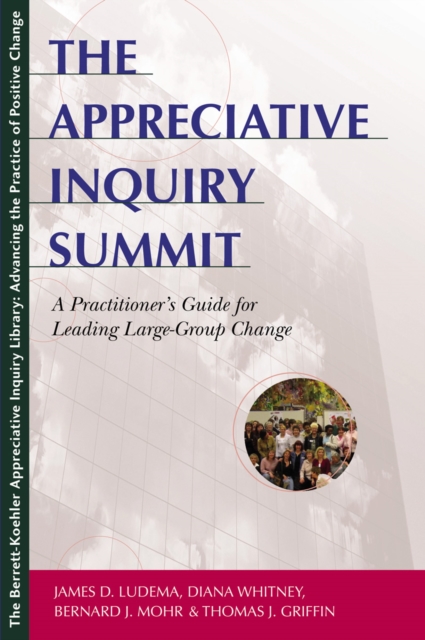
The Appreciative Inquiry Summit: a practioner's guide for leading large-group change
\"The Appreciative Inquiry Summit\" is about a revolutionary new method of accelerating positive organization change by involving a broad range of internal and external stakeholders in the change process. The Appreciative inquiry summit is typically a single event or series of events that bring people together to discover the organization's core competencies and strengths, envision opportunities for positive change, design the desired changes into the organization's systems, structures, strategies, and culture, and implement and sustain the change for extraordinary results. All summits have been used effectively with hundreds of organizations - corporations, non-profits, government, and communities - in a variety of applications. Executives, managers, and consultants are always looking for new high-leverage change methods that will support fast, sustainable improvements in organizational performance.
eBook
Valuation
This chapter contains sections titled:
Classical Evaluation
Evaluation from Appreciative Inquiry Perspective
Case Story: Valuation of the Effectiveness of AI for the Zambia Police Services Victim Support Unit, by Mette Jacobsgaard
Book Chapter