
Catalogue Search | MBRL


Are you sure you want to remove the book from the shelf?

{{itemTitle}}
1,655
result(s) for
"Moore, Jason"
Sort by:

Capitalism in the web of life : ecology and the accumulation of capital
\"Both green and red analyses of capitalism's deepening contradictions have acknowledged the close relation of economic and environmental crises. But environmentalists have not yet fully integrated social and historical factors in their scathing indictment of the current disaster. Capitalism in the Web of Life will undoubtedly help to change that. Charting the recurrent crises, and long cyclical expansions of capitalism as socio-ecological process over the past six centuries, Jason Moore provides a groundbreaking theory and historical account of capitalism's development that comprehends the transformation of nature as constitutive of capital accumulation. Along the way, he moves beyond the society/nature distinction that limits so much environmentalism\"-- Provided by publisher.
Book

Chapter 11: Genome-Wide Association Studies
Genome-wide association studies (GWAS) have evolved over the last ten years into a powerful tool for investigating the genetic architecture of human disease. In this work, we review the key concepts underlying GWAS, including the architecture of common diseases, the structure of common human genetic variation, technologies for capturing genetic information, study designs, and the statistical methods used for data analysis. We also look forward to the future beyond GWAS.
Journal Article

A history of the world in seven cheap things : guide to capitalism, nature, and the future of the planet
\"Nature, money, work, care, food, energy, and lives: these are the seven things that have made our world and will shape its future. In making these things cheap, modern commerce has transformed, governed, and devastated Earth. In A History of the World in Seven Cheap Things, Raj Patel and Jason W. Moore present a new approach to analyzing today's planetary emergencies. Bringing the latest ecological research together with histories of colonialism, indigenous struggles, slave revolts, and other rebellions and uprisings, Patel and Moore demonstrate that throughout history, crises have always prompted fresh strategies to make the world cheap and safe for capitalism. At a time of crisis in all seven cheap things, innovative and systemic thinking is urgently required. This book proposes a radical new way of understanding--and reclaiming--the planet in the turbulent twenty-first century\"--Provided by publisher.
Book

Metabolic rift or metabolic shift? dialectics, nature, and the world-historical method
In the flowering of Red-Green Thought over the past two decades, metabolic rift thinking is surely one of its most colorful varieties. The metabolic rift has captured the imagination of critical environmental scholars, becoming a shorthand for capitalism's troubled relations in the web of life. This article pursues an entwined critique and reconstruction: of metabolic rift thinking and the possibilities for a post-Cartesian perspective on historical change, the world-ecology conversation. Far from dismissing metabolic rift thinking, my intention is to affirm its dialectical core. At stake is not merely the mode of explanation within environmental sociology. The impasse of metabolic rift thinking is suggestive of wider problems across the environmental social sciences, now confronted by a double challenge. One of course is the widespread—and reasonable—sense of urgency to evolve modes of thought appropriate to an era of deepening biospheric instability. The second is the widely recognized—but inadequately internalized—understanding that humans are part of nature.
Journal Article

نعم للإرادة : لكل صاحب قلب كبير
يعد هذا الكتاب نعم للإرادة من المنهج السلوكي التربوي رائع يعلم الطفل كيف يستخلص من مشكلاته وكيف يبني شخصيته بشكل مميز ويعطي المربي حلولا لحل مشكلات أبنه تعنيه عن تجاوز الأزمة وإنهائها وهي قصة مخصصة للأطفال تستهدف الطفولة المبكرة وتعمل على اسثمار الطفل في بناء المهارات المختلفة المرتبطة بالخيال والأبتكار وقوة الشخصية والبحث عن حلول إبداعية وتستمد الطفل الكثير من العلم والمعرفة والمعلومات.
BOOK

Electronic health records and polygenic risk scores for predicting disease risk
Accurate prediction of disease risk based on the genetic make-up of an individual is essential for effective prevention and personalized treatment. Nevertheless, to date, individual genetic variants from genome-wide association studies have achieved only moderate prediction of disease risk. The aggregation of genetic variants under a polygenic model shows promising improvements in prediction accuracies. Increasingly, electronic health records (EHRs) are being linked to patient genetic data in biobanks, which provides new opportunities for developing and applying polygenic risk scores in the clinic, to systematically examine and evaluate patient susceptibilities to disease. However, the heterogeneous nature of EHR data brings forth many practical challenges along every step of designing and implementing risk prediction strategies. In this Review, we present the unique considerations for using genotype and phenotype data from biobank-linked EHRs for polygenic risk prediction.Electronic health records (EHRs) linked to biobanks provide new opportunities for developing and applying polygenic risk scores in the clinic. The authors review the opportunities and challenges that arise when using EHR data for the systematic evaluation of patient disease susceptibilities.
Journal Article
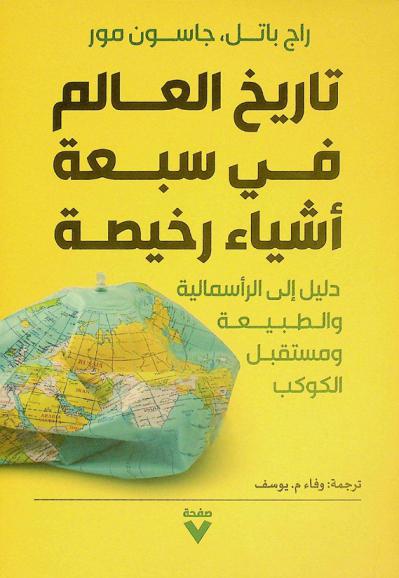
تاريخ العالم في سبعة أشياء رخيصة : دليل الرأسمالية، والطبيعة، ومستقبل الكوكب
حقق هذا الكتاب منذ صدوره ضجة كبرى في الأوساط الأكاديمية والثقافية، إذ تناول فكرة الرأسمالية من زوايا مختلفة قطعت مع القراءات الأكاديمية المغلقة. يربط الكتاب فكرة الرأسمالية بالطبيعة ويرى المؤلفان أن استغلال الطبيعة على نحو خاطئ ومتوحش مهد المجال لاستغلال البشر وبذلك نشأت الرأسمالية على ثنائية استغلال الطبيعة والإنسان، وهو استغلال جعل من العالم عالما رخيصا ففكرة الاستعمار هي التي جعلت من المال رخيصا بما أنها استطاعت توفيره من جماجم المضطهدين كما جعلت من الغذاء رخيصا بما أنها نهبت العوالم الجديدة ودمرت الحياة الإيكولوجية فيها كما دمرت حيوات الأفراد عبر تعزيز ثقافة العبودية والاستغلال والاضطهاد علاوة على آثارها في جميع مناحي الحياة. يأخذنا هذا الكتاب في رحلة مع الاكتشافات الكبرى التي شهدها العالم القديم وكيف كانت تلك الاكتشافات مدخلا لبروز عصور دموية ومريعة، علاوة على تطرقه إلى دور الأوبئة والجوائح في بروز فكرة الاستعمار بشكلها الحالي. يمكن القول إن هذا الكتاب من أبرز الكتب التي تؤرخ للعالم من منظور مختلف ومتحرر من التحيزات والمركزية الأوروبية التي سادت في أغلب البحوث الأكاديمية.
BOOK

Conservation machine learning: a case study of random forests
Conservation machine learning conserves models across runs, users, and experiments—and puts them to good use. We have previously shown the merit of this idea through a small-scale preliminary experiment, involving a single dataset source, 10 datasets, and a single so-called cultivation method—used to produce the final ensemble. In this paper, focusing on classification tasks, we perform extensive experimentation with conservation random forests, involving 5 cultivation methods (including a novel one introduced herein—
lexigarden
), 6 dataset sources, and 31 datasets. We show that significant improvement can be attained by making use of models we are already in possession of anyway, and envisage the possibility of repositories of
models
(not merely datasets, solutions, or code), which could be made available to everyone, thus having conservation live up to its name, furthering the cause of data and computational science.
Journal Article


PMLB: a large benchmark suite for machine learning evaluation and comparison
Background
The selection, development, or comparison of machine learning methods in data mining can be a difficult task based on the target problem and goals of a particular study. Numerous publicly available real-world and simulated benchmark datasets have emerged from different sources, but their organization and adoption as standards have been inconsistent. As such, selecting and curating specific benchmarks remains an unnecessary burden on machine learning practitioners and data scientists.
Results
The present study introduces an accessible, curated, and developing public benchmark resource to facilitate identification of the strengths and weaknesses of different machine learning methodologies. We compare meta-features among the current set of benchmark datasets in this resource to characterize the diversity of available data. Finally, we apply a number of established machine learning methods to the entire benchmark suite and analyze how datasets and algorithms cluster in terms of performance. From this study, we find that existing benchmarks lack the diversity to properly benchmark machine learning algorithms, and there are several gaps in benchmarking problems that still need to be considered.
Conclusions
This work represents another important step towards understanding the limitations of popular benchmarking suites and developing a resource that connects existing benchmarking standards to more diverse and efficient standards in the future.
Journal Article