
Catalogue Search | MBRL


Are you sure you want to remove the book from the shelf?

{{itemTitle}}
331
result(s) for
"Moore, Jason W"
Sort by:

Capitalism in the web of life : ecology and the accumulation of capital
\"Both green and red analyses of capitalism's deepening contradictions have acknowledged the close relation of economic and environmental crises. But environmentalists have not yet fully integrated social and historical factors in their scathing indictment of the current disaster. Capitalism in the Web of Life will undoubtedly help to change that. Charting the recurrent crises, and long cyclical expansions of capitalism as socio-ecological process over the past six centuries, Jason Moore provides a groundbreaking theory and historical account of capitalism's development that comprehends the transformation of nature as constitutive of capital accumulation. Along the way, he moves beyond the society/nature distinction that limits so much environmentalism\"-- Provided by publisher.
Book

Metabolic rift or metabolic shift? dialectics, nature, and the world-historical method
In the flowering of Red-Green Thought over the past two decades, metabolic rift thinking is surely one of its most colorful varieties. The metabolic rift has captured the imagination of critical environmental scholars, becoming a shorthand for capitalism's troubled relations in the web of life. This article pursues an entwined critique and reconstruction: of metabolic rift thinking and the possibilities for a post-Cartesian perspective on historical change, the world-ecology conversation. Far from dismissing metabolic rift thinking, my intention is to affirm its dialectical core. At stake is not merely the mode of explanation within environmental sociology. The impasse of metabolic rift thinking is suggestive of wider problems across the environmental social sciences, now confronted by a double challenge. One of course is the widespread—and reasonable—sense of urgency to evolve modes of thought appropriate to an era of deepening biospheric instability. The second is the widely recognized—but inadequately internalized—understanding that humans are part of nature.
Journal Article

A history of the world in seven cheap things : guide to capitalism, nature, and the future of the planet
\"Nature, money, work, care, food, energy, and lives: these are the seven things that have made our world and will shape its future. In making these things cheap, modern commerce has transformed, governed, and devastated Earth. In A History of the World in Seven Cheap Things, Raj Patel and Jason W. Moore present a new approach to analyzing today's planetary emergencies. Bringing the latest ecological research together with histories of colonialism, indigenous struggles, slave revolts, and other rebellions and uprisings, Patel and Moore demonstrate that throughout history, crises have always prompted fresh strategies to make the world cheap and safe for capitalism. At a time of crisis in all seven cheap things, innovative and systemic thinking is urgently required. This book proposes a radical new way of understanding--and reclaiming--the planet in the turbulent twenty-first century\"--Provided by publisher.
Book

Power, Profit, and Prometheanism, Part I
No civilization has been more Promethean than capitalism in its aspirations. Named after the Greek Titan who gave fire to humankind, Prometheanism is understood as a kind of environmental-but not (necessarily) environmentalist-strategy for the domination and management of something usually called Nature. Unfortunately, the discussion often stops there. But if Prometheanism is domination, How does it turn a profit? This is an elementary, yet frequently, unasked question of a civilization that dispenses with everything ill-suited to the law of value. The uncontroversial statement that capitalism is a system of profit-maximizing class power hasn't translated to a dialectical synthesis of power and profit in the web of life. There are surely many reasons for this. One of them is the systematic acceptance on the left of Nature as a value-free concept. And yet, historically, bourgeois naturalism has been the ideological lynchpin of successive Civilizing Projects and Malthusian moments. To ignore this is to disarm struggles for climate justice and planetary socialism.
Journal Article
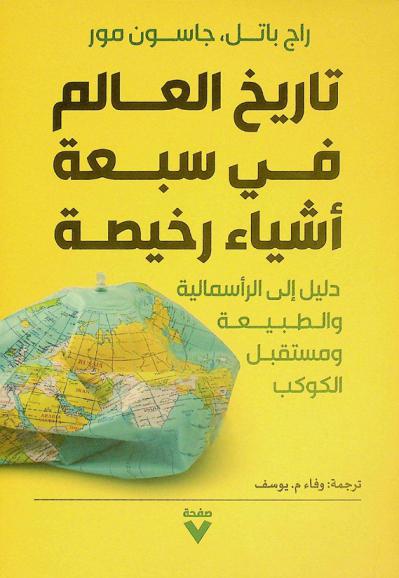
تاريخ العالم في سبعة أشياء رخيصة : دليل الرأسمالية، والطبيعة، ومستقبل الكوكب
حقق هذا الكتاب منذ صدوره ضجة كبرى في الأوساط الأكاديمية والثقافية، إذ تناول فكرة الرأسمالية من زوايا مختلفة قطعت مع القراءات الأكاديمية المغلقة. يربط الكتاب فكرة الرأسمالية بالطبيعة ويرى المؤلفان أن استغلال الطبيعة على نحو خاطئ ومتوحش مهد المجال لاستغلال البشر وبذلك نشأت الرأسمالية على ثنائية استغلال الطبيعة والإنسان، وهو استغلال جعل من العالم عالما رخيصا ففكرة الاستعمار هي التي جعلت من المال رخيصا بما أنها استطاعت توفيره من جماجم المضطهدين كما جعلت من الغذاء رخيصا بما أنها نهبت العوالم الجديدة ودمرت الحياة الإيكولوجية فيها كما دمرت حيوات الأفراد عبر تعزيز ثقافة العبودية والاستغلال والاضطهاد علاوة على آثارها في جميع مناحي الحياة. يأخذنا هذا الكتاب في رحلة مع الاكتشافات الكبرى التي شهدها العالم القديم وكيف كانت تلك الاكتشافات مدخلا لبروز عصور دموية ومريعة، علاوة على تطرقه إلى دور الأوبئة والجوائح في بروز فكرة الاستعمار بشكلها الحالي. يمكن القول إن هذا الكتاب من أبرز الكتب التي تؤرخ للعالم من منظور مختلف ومتحرر من التحيزات والمركزية الأوروبية التي سادت في أغلب البحوث الأكاديمية.
BOOK

Madeira, Sugar, and the Conquest of Nature in the \First\ Sixteenth Century: Part I: From \Island of Timber\ to Sugar Revolution, 1420–1506
Madeira is a small island with a large place in the origins of the modern world. Lying 560-some kilometers west of north Africa, Madeira was home to the modern world's first cash crop boom, a sugar revolution. In the first of two successive essays in this journal, I explain how the epoch-making acceleration of boom and bust on Madeira, during Braudel's \"first\" sixteenth century (c. 1450-1557), marked a new crystallization of the nature-society relations pivotal to the rise of capitalism. This new crystallization represented an ensemble of new capacities to exploit and extract extra-human nature much faster, and on a much larger scale, than ever before. It was a mode of socio-ecological conquest and commodification that was possible because of early capitalism's \"commodity frontier\" strategy, one premised on global expansion as a constitutive moment in the formation of the modern world-system—as capitalist world-ecology no less than world-economy. From this standpoint, the very conditions of Madeira's rapid ascent were also the conditions of its rapid decline after 1506. These stemmed from the rapid commodity-centered organization, and consequent exhaustion, of the relations governing human and extra-human nature: labor and land.
Journal Article

Trabajo Barato?: Tiempo, Capital y la Reproducción de la Naturaleza Humana
Continuing with the line of research in world-ecology, the author explains here the centrality of the reproduction of labor and unpaid work (human and extra-human) for the maintenance of capitalist accumulation cycles. Although the role that migrations play in these structural dynamics is only briefly mentioned in the chapter, the world-historical analysis of the centrality of cheap labor at a global level provides an excellent framework for the contents of this issue and for the development of future studies in this field. Siguiendo con la línea de investigación en ecología-mundo, el autor explica aquí la centralidad que ocupan la reproducción de la mano de obra y el trabajo no remunerado (humano y extra-humano) para el mantenimiento de los ciclos de acumulación capitalista. Aunque el papel que las migraciones cumplen en estas dinámicas estructurales es sólo brevemente mencionado en el capítulo, el análisis histórico-mundo de la centralidad del trabajo barato a nivel global aporta un marco inmejorable para los contenidos de este número y para el desarrollo de futuros estudios en este campo.
Journal Article
\The Modern World-System\ as Environmental History? Ecology and the Rise of Capitalism
This article considers the emergence of world environmental history as a rapidly growing but undertheorized research field. Taking as its central problematic the gap between the fertile theorizations of environmentally-oriented social scientists and the empirically rich studies of world environmental historians, the article argues for a synthesis of theory and history in the study of longue duree socio-ecological change. This argument proceeds in three steps. First, I offer an ecological reading of Immanuel Wallerstein's The Modern World-System. Wallerstein's handling of the ecological dimensions of the transition from feudalism to capitalism is suggestive of a new approach to world environmental history. Second, I contend that Wallerstein's theoretical insights may be effectively complemented by drawing on Marxist notions of value and above all the concept of \"metabolic rift,\" which emphasize the importance of productive processes and regional divisions of labor within the modern world-system. Finally, I develop these theoretical discussions in a short environmental history of the two great \"commodity frontiers\" of early capitalism - the sugar plantation and the silver mining complex.
Journal Article
Cheap Food & Bad Money: Food, Frontiers, and Financialization in the Rise and Demise of Neoliberalism
It is now widely understood that the \"end of cheap food\" has arrived. It is much less clear what this means for the ongoing crisis of neoliberalism, and for the future of the capitalist world-ecology. Taking the accumulation of capital and the production of nature as a world-historical unity, this paper explores the connections between a new era of financialization, the exhaustion of capitalism's longue durée model of agricultural revolutions, and the closure of the last remaining frontiers of appropriation since the 1970s. In this perspective, the \"food crisis\" and \"financial crisis\" are understood as expressions of neoliberalism's signal crisis—when prices for strategic commodities such as food, energy, and raw materials begin to rise rather than decline in any long accumulation cycle. This tipping point is a reversal of the system's capacity to produce more and more food, energy, and raw materials with less and less labor—fundamentally, a crisis of value relations. Although this reversal is often attributed to resource depletion, the reality is at once more complex, and more intractable. Neoliberal financializations, marked by an unprecedented penetration into the everyday lives of human and extra-human natures, have induced an upward spiral of socio-ecological unpredictability alongside deepening resource depletion. Among the consequences is a new phase of extra-human nature's revolt against the disciplines of capital, especially in world agriculture—the Superweed Effect. From glyphosate-resistant weeds to spiraling antibiotic resistance, ours is an era marked by the rising capacity of extra-human natures to elude capitalist control.
Journal Article
Madeira, Sugar, and the Conquest of Nature in the \First\ Sixteenth Century, Part II: From Regional Crisis to Commodity Frontier, 1506—1530
At the rosy dawn of sixteenth century capitalism, few places in this \"vast but weak\" world-economy were more pivotal than Madeira. A small island in the middle of the Atlantic Ocean, Madeira in 1500 was the greatest producer of early capitalism's most important cash crop, sugar. Every year between 1505 and 1509, some 2,000 tons of sugar flowed from Funchal, Madeira's capital, to Lisbon, Antwerp, Genoa, and many places beyond. Two decades later, the island's sugar complex had collapsed. In the second of two essays in Review, I illustrate how the socio-ecological regime that enabled Madeira's sugar revolution between 1450 and 1500 ensured the rapid decline of production after 1506. As we explored in Part I, this regime had everything to do with the forest. No cash crop devoured the forest so quickly as sugar. If dwindling fuel supplies were sugar's greatest vulnerability, the sources of sugar's boom and bust on Madeira were irreducibly world-historical and multi-layered. In Part II, I trace the connections between earth-moving and the broader structures of capital and empire, above all the socio-ecological architectures of the world market and the Portuguese Empire in Braudel's \"first\" sixteenth century (c. 450—1557). I build out the relations between deforestation, soil fertility, and faltering labor productivity in agriculture as decisive to sugar's rapid decline. Far from a narrowly regional phenomenon, this rapid decline was not only caused, but indeed necessitated, by the rise of capitalism as worldecology—a civilization that joins the endless conquest of nature and the endless accumulation in dialectical unity. Regional socio-ecological crises were not merely resolved through commodity-centered frontier movements; they were also created by them.
Journal Article