
Catalogue Search | MBRL


Are you sure you want to remove the book from the shelf?

{{itemTitle}}
69
result(s) for
"Paradis, Norman A."
Sort by:

Non-invasive biomarkers for detecting progression toward hypovolemic cardiovascular instability in a lower body negative pressure model
Occult hemorrhages after trauma can be present insidiously, and if not detected early enough can result in patient death. This study evaluated a hemorrhage model on 18 human subjects, comparing the performance of traditional vital signs to multiple off-the-shelf non-invasive biomarkers. A validated lower body negative pressure (LBNP) model was used to induce progression towards hypovolemic cardiovascular instability. Traditional vital signs included mean arterial pressure (MAP), electrocardiography (ECG), plethysmography (Pleth), and the test systems utilized electrical impedance via commercial electrical impedance tomography (EIT) and multifrequency electrical impedance spectroscopy (EIS) devices. Absolute and relative metrics were used to evaluate the performance in addition to machine learning-based modeling. Relative EIT-based metrics measured on the thorax outperformed vital sign metrics (MAP, ECG, and Pleth) achieving an area-under-the-curve (AUC) of 0.99 (CI 0.95–1.00, 100% sensitivity, 87.5% specificity) at the smallest LBNP change (0–15 mmHg). The best vital sign metric (MAP) at this LBNP change yielded an AUC of 0.6 (CI 0.38–0.79, 100% sensitivity, 25% specificity). Out-of-sample predictive performance from machine learning models were strong, especially when combining signals from multiple technologies simultaneously. EIT, alone or in machine learning-based combination, appears promising as a technology for early detection of progression toward hemodynamic instability.
Journal Article

Is this the next step for CPR?
Rather than continuing to optimize each of the broadly different techniques for increasing forward blood flow, we should evaluate a combination of techniques. Because human providers would likely be unable to apply such a combination, the next generation in the chain of survival, after immediate manual BLS, should be a machine. Between these two ends of the resuscitative spectrum, there continues to be a need for something innovative in the middle: BLS that is more than hands and mouths but less than invasive technologies. Since its initial adoption, multiple improvements to BLS have been proposed.
Journal Article

Should reperfusion be revisited?
The landmark studies of Kloner [5,6], Yellon, and others [7,8] clarified the hypothesis that this injury was fueled by the restoration of blood flow during resuscitation of patients in the setting of acute myocardial infarction, stroke, and cardiac arrest. The possibility that the combination of therapeutic hypothermia and the mechanistically-attractive-but-clinical-trial-failing pharma agents may be effective for ischemia-reperfusion injury may be the most exciting thing to happen in the field in quite some time.
Journal Article

Addition of a biomarker panel to a clinical score to identify patients at low risk for appendicitis
The diagnosis of pediatric acute appendicitis can be difficult. Although scoring systems such as the Pediatric Appendicitis Score (PAS) are helpful, they lack adequate sensitivity and specificity as standalone diagnostics. When used for risk stratification, they often result in large percentages of moderate-risk patients requiring further diagnostic evaluation.
We applied a biomarker panel (the APPY1 Test) that has high sensitivity and negative predictive value (NPV) to patients with PAS in the moderate-risk range (3-7) and reclassified those patients with a negative result to the low-risk group. We compared the specificity, sensitivity, and NPV of the original and reclassified low-risk groups at several different PAS low-risk cutoffs.
The application of a negative biomarker panel to a group of patients with a moderate risk for appendicitis (PAS, 3-7) resulted in 4 times more patients (586 vs 145) being safely classified as low risk. Reclassification increased the overall specificity or the proportion of patients without appendicitis who were correctly identified as low risk, from 10.3% to 42.0%. The high NPV (97.2%) in the original group was preserved (97.6%) in the reclassified low-risk group, as was the sensitivity (original 99.1% vs reclassified 96.9%).
The addition of negative biomarker test results to patients with a moderate risk of appendicitis based on the PAS can safely reclassify many to a low-risk group. This may allow clinicians to provide more conservative management in children with suspected appendicitis and decrease unnecessary resource utilization.
Journal Article
Intravenous calcium as a pressor in a swine model of hypoxic pseudo-pulseless electrical mechanical activity—a preliminary report
BackgroundPseudo-pulseless electrical activity (pseudo-PEA) is a lifeless form of profound cardiac shock characterized by measurable cardiac mechanical activity without clinically detectable pulses. Pseudo-PEA may constitute up to 40% of reported cases of cardiac arrest. Resuscitation from pseudo-PEA is often associated with hypotension refractory to catecholamine pressors. We hypothesized that this post-resuscitation state may be associated with hypocalcemic hypotension responsive to intravenous calcium.MethodsUsing pre-existing data from our hypoxic swine pseudo-PEA model, we measured blood pressure, hemodynamics, and electrolytes. Physiological data were analyzed on a heartbeat by heartbeat basis. The midpoint of the calcium response was defined using change of curvature feature detection. Hemodynamic parameters were shifted such that the value at the midpoint was equal to zero.ResultsIn 9 animals with refractory hypotension, we administered 37 boluses of intravenous calcium in the dosage range of 5-20 mg. Comparisons were made between the average values in the time period 40-37 s before the midpoint and 35-40 s after the midpoint. Of the 37 administered boluses, 34 manifested a change in the blood pressure, with mean aortic pressure, systolic and diastolic pressures all increasing post bolus administration.ConclusionsAdministration of intravenous calcium may be associated with a pressor-like response in refractory hypotension after resuscitation from pseudo-PEA. Relative ionized hypocalcemia may cause hypotension after resuscitation from pseudo-PEA. Therapy with intravenous calcium should be further investigated in this setting.
Journal Article
Outcomes from low versus high-flow cardiopulmonary resuscitation in a swine model of cardiac arrest
Return of spontaneous circulation (ROSC) is improved by greater vital organ blood flow during cardiopulmonary resuscitation (CPR). We tested the hypothesis that myocardial flow above the threshold needed for ROSC may be associated with greater vital organ injury and worse outcome.
Aortic and right atrial pressures were measured with micromanometers in 27 swine. After 10 minutes of untreated ventricular fibrillation, chest compression was performed with an automatic, load-distributing band. Animals were randomly assigned to receive flows just sufficient for ROSC (low flow: target coronary perfusion pressure = 12 mm Hg) or well above the minimally effective level (high flow: coronary perfusion pressure = 30 mm Hg). Myocardial flow was measured with microspheres, defibrillation was performed after 3.5 minutes of CPR, and ejection fraction was measured with echocardiography.
Return of spontaneous circulation was achieved by 9 of 9 animals in the high-flow group and 15 of 18 in the low-flow group. All animals in the high-flow group defibrillated initially into a perfusing rhythm, whereas 12 of 15 animals achieving ROSC in the low-flow group defibrillated initially into pulseless electrical activity (
P < .05, Fisher exact test). Compared with animals in the low-flow group, animals in the high-flow group had shorter resuscitation times, higher mean aortic pressures at ROSC, and higher ejection fractions at 2 hours post-ROSC (all
P < .05).
High-flow CPR significantly improved arrest hemodynamics, rates of ROSC, and post-ROSC indicators of myocardial status, all indicating less injury with higher flows. No evidence of organ injury from vital organ blood flow substantially above the threshold for ROSC was found.
Journal Article
Inhomogeneity and temporal effects in AutoPulse Assisted Prehospital International Resuscitation—an exception from consent trial terminated early
The ASPIRE trial (AutoPulse Assisted Prehospital International Resuscitation) was multicenter exception from consent clinical trial that compared mechanical cardiopulmonary resuscitation (CPR) with a device (AutoPulse-CPR) to traditional manual CPR (manual-CPR) in out-of-hospital cardiac arrest. Enrollment was suspended early due to safety concerns. One site (site C) made a potentially important protocol change midtrial, and enrollment at that site was noted to be independently associated with outcome.
The study used a post hoc reanalysis of source data and documentation using standard statistical approaches evaluating for possible secular, temporal, and trial design, factors that may have related to the trial's outcome.
The protocol change at site C also appears to have resulted in a delay in application of AutoPulse-CPR. Before and after the protocol change survival in patients receiving AutoPulse-CPR decreased from 19.6% to 4% (
P = .024). Logistic regression analysis showed site C was significantly different (
P = .008) from the remaining sites with respect to survival. Unlike site C, the other sites actually showed an increase over time in the primary end point of 4-hour survival (
P = .008) favorable to AutoPulse-CPR. There did not appear to be significant safety (
P = .42) nor efficacy concerns (
P = .17) at these sites.
The difference in survival that caused early suspension of ASPIRE appears to have been limited to one site after its protocols change. At the time the trial was suspended, the outcomes of patients at the other sites appear to have been trending in favor of the intervention.
Journal Article

Response to ASPIRE Investigators
Under a logical extension of this same principle, would it not also be reasonable for them to evaluate outcome in all of the intention-to-treat patients, not only the post-enrollment subgroup classified as \"primary cardiac\"?
Journal Article

Emergency Department Cardiopulmonary Bypass in the Treatment of Human Cardiac Arrest
To study the use of emergency department (ED) femoro-femoral cardiopulmonary bypass (CPB) in the resuscitation of medical cardiac arrest patients.
Prospective, uncontrolled trial.
Urban academic ED staffed with board-certified emergency physicians (EPs).
Ten patients with medical cardiac arrest unresponsive to standard therapy.
Femoro-femoral CPB instituted by EPs.
The time of cardiac arrest prior to CPB (mean±SD) was 32.0±13.6 min. The cardiac output while on CPB was 4.09±1.03 L/min with an average of 229±111 min on bypass. All 10 patients had resumption of spontaneous cardiac activity while on CPB. Seven of these were weaned from CPB with intrinsic spontaneous circulation. Of these, six patients were transferred from the ED to the operating room for cannula removal and vessel repair while the other patient died in the ED soon after discontinuing CPB. Mean survival was 47.8±44.7 h in the six patients leaving the ED. Although these patients had successful hemodynamic resuscitation, there were no long-term survivors.
CPB instituted by EPs is feasible and effective for the hemodynamic resuscitation of cardiac arrest patients unresponsive to advanced cardiac life support therapy. Future efforts need to focus on improving long-term outcome.
Journal Article
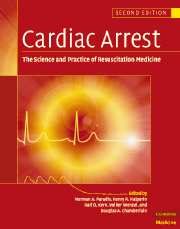
Cardiac Arrest
Cardiac Arrest is the definitive and most comprehensive reference in advanced life support and resuscitation medicine. This new edition brings the reader completely up-to-date with developments in the field, focusing on practical issues of decision making, clinical management and prevention, as well as providing clear explanations of the science informing the practice. The coverage includes information on the latest pharmacotherapeutic options, the latest chest compression techniques and airway management protocols, all backed by clearly explained, evidence-based scientific research. The content is consistent with the latest guidelines for practice in this area, as detailed by the major international governing organisations. This volume is essential reading for all those working in the hospital environments of emergency medicine, critical care, cardiology and anesthesia, as well as those providing care in the pre-hospital setting, including paramedics and other staff from the emergency services.
eBook