
Catalogue Search | MBRL


Are you sure you want to remove the book from the shelf?

{{itemTitle}}
227
result(s) for
"Pessoa, Ana Maria"
Sort by:

كواريشما، فكاك الرموز : رويات بوليسية قصيرة /
في الروايات القصيرة التي يضمها هذا الكتاب يكتشف القارىء وجها آخر من أوجه بيسوا كاتب يؤلف بسهولة في جنس الأدب البوليسي كما يكتب نصوصه الباروكية والطلائعية ويكتشف أيضا شخصية فريدة كواريشما المدعو فكاك الرموز وهو رجل تحري غير عادي يعيش في مدينة لشبونة وحيدا مع أفكاره المجردة يدخن السجائر ويتأمل غرائب هذه الدنيا ويشعر مثل الكاتب بالراحة في اللغة أكثر من الواقع. ويا لها من طريقة غريبة تلك التي يتبعها كواريشما في تحرياته إنه يفضل أن يعتمد على منطقه الفكري وطريقته في الاستدلال بدل النبش في مسرح الجريمة ببل إنه لا يتدخل إلا إذا وصلت تحريات الشرطة إلى الباب المسدود حينئذ يستنجد صديقه المفوض مانويل غيديش بهذا الفكر المتجسد في شخص غريب الأطوار.
Book

Student Participation: Issues for the Governance of Higher Education
The paper reports findings of a research project aimed at developing insight into student participation in the governance of higher education institutions. The project was carried out in two institutions in Portugal, analyzing numbers and forms of participation, identifying facilitators and constraints to participation, and analyzing the students’ perceptions of their own participation. The study was carried out in the context of the European purpose of creating a cohesive European Higher Education Area (EHEA), and in light of theoretical perspectives of the sociology of public action. The concept of participation put forward by the Council of Europe in 2003 was mobilized in the sense that true participation involves making a difference in decision-making. The research objectives required both quantitative and qualitative data collection; therefore, a mixed-methods approach was adopted, including document analysis, interviews, and a questionnaire. The cross-analysis of the data collected enabled the researchers to characterize the participation of students in formal governing bodies and in other institutional contexts, identify facilitators and constraints to participation resulting either from the legal framework, the institutional culture, or personal contexts, and simultaneously capture individual perceptions of participation on the part of the students. The results enabled the authors to make a set of recommendations for political action both at national and institutional levels.
Journal Article

حكايات منطقية يليها نص نظري للكاتب حول القصة البوليسية
يضم الكتاب مقدمة وأربع قصص بوليسية ويتضمن نصا نظريا حول جنس القصة البوليسية كتبه برز فيه نظرته الخاصة لهذا الجنس الأدبي من خلال قراءاته المتنوعة وذوقه المتميز وتنم آراؤه في هذه الدراسة غير المسبوقة في تاريخ الأدب البرتغالي أما المقدمة، فيضع فيها بيسوا بورتريها متكاملا لشخصية المفتش ويليام باينج الذى يحقق في مختلف القضايا التي تظهر في هذه القصص ويمثل هذا الرقيب السابق رجل التحري الذي يشكل الخيط الرابط بين قضاياها وإشكالياتها شخصيته مزيج من العبقرية والصراحة وتجسيد لقوة الاستنتاج المنطقي المبني على التخمين.
Book

Characterization of Mushroom Compounds and Effect on Neuronal ROS
Os cogumelos têm vindo a ser incluídos de forma cada vez mais frequente na alimentação humana, assumindo um papel importante, quer devido às suas características nutricionais e organoléticas, quer devido às diferentes formas de consumo, despertando sensações únicas, devido ao seu aroma e sabor que colocam e despertam em cada prato. Por outro lado, são também muito consumidos, devido às suas propriedades medicinais extraordinárias, sendo cada vez mais alvo de muitos estudos realizados neste âmbito. Estudos científicos e médicos demonstram as propriedades medicinais dos compostos extraídos de cogumelos para a prevenção das doenças mais diversas, sendo cada vez mais frequentes na prevenção e tratamento do cancro (Zaidman et al.,2005; Lemieszek et al.,2013).O objetivo deste trabalho consiste na caracterização química de quatro espécies de cogumelos, Boletus edulis, Tricholoma equestre, Ganoderma lucidume Ganoderma lingzhie no estudo do efeito de um dos seus compostos na atividade neuronal.Neste estudo, investigou-se a ação de polissacarídeos extraídos dos cogumelos na atividade antioxidante de uma zona sináptica. Os experimentos consistem na adição de diferentes concentrações de tais extratos na região CA3 do hipocampo do cérebro no sistema sináptico de fibras musgosas usando fatias de cérebro de 400 μm de espessura.Os resultados obtidos durante a caracterização química dos cogumelos permitiram verificar a existência de diferenças, em termos da sua composição em compostos fenólicos e polissacarídeos, quer ao nível qualitativo quer ano nível quantitativo. Este trabalho também permitiu tornar mais clara a distinção que deve existir no caso das espécies Ganoderma lucidume Ganoderma lingzhi,pois apesar de pertencerem à mesma espécie, apresentam diferenças qualitativas e quantitativas nos compostos neles presentes.Relativamente ao estudo do efeito dos polissacarídeos na formação de ROS em neurónios, foram testadas três concentrações diferentes: 0.1, 0.5 e 1 g/L, tendo-se registado uma maior diminuição da formação de espécies reactivas de oxigénio, quando se usaram concentrações destes compostos de 1 g / L. No entanto, tendo em conta o pequeno número de experiências realizado, não se pode garantir uma confiança nos resultados obtidos.
Dissertation
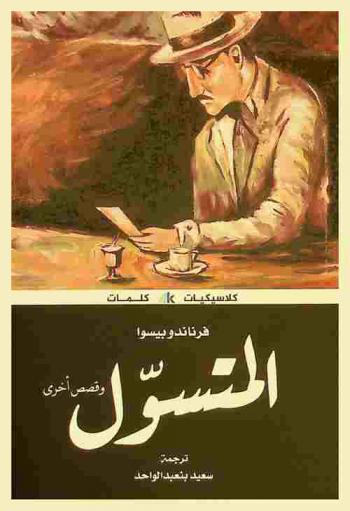
المتسول وقصص أخرى
يضم كتاب \"المتسول وقصص أخرى\" اثنى عشرة نص لم ينشر من قبل للكاتب والشاعر فرناندو بيسوا، تشكل جزءا يسيرا من النثر التخيلي الذي تركه الكاتب. إنها قصص فلسفية أو فكرية -كمْ يسميها بيسوا نفسه- ومفارقة لأن الحالات التي تقدمها تتعارض مع الحس المشترك، بعضها على شكل حكايات ذات مغزى، وأخرى ذات شكل مختلف. تقدم هذه القصص حوارات فلسفية على لسان حكماء يتخذون وجوها مختلفة وأقنعة متعددة، كالمتسول والزاهد والسكير، ويعرضون حكمتهم على من يصادفهم في الطريق، طريق التعلم وتكوين الذات. مثلا، قد يكون طريق السالك الذي يصادف رجلا ذا ملابس سوداء، أو طريق ذلك البحار الذي يحاور شخصا غريبا على رصيف الميناء. تعرض هذه النصوص السردية وجها مختلفا عن بيسوا، وقد تدهش القارئ بعمقها الفلسفي وجرأتها في طرح المواضيع المختلفة التي كانت تشغل الكاتب.
Book

Phenotypic, genetic and symbiotic characterization of Erythrina velutina rhizobia from Caatinga dry forest
Erythrina velutina (\"mulungu\") is a legume tree from Caatinga that associates with rhizobia but the diversity and symbiotic ability of \"mulungu\" rhizobia are poorly understood. The aim of this study was to characterize \"mulungu\" rhizobia from Caatinga. Bacteria were obteined from Serra Talhada and Caruaru in Caatinga under natural regeneration. The bacteria were evaluated to the amplification of nifH and nodC and to metabolic characteristics. Ten selected bacteria identified by 16S rRNA sequences. They were tested in vitro to NaCl and temperature tolerance, auxin production and calcium phosphate solubilization. The symbiotic ability were assessed in an greenhouse experiment. A total of 32 bacteria were obtained and 17 amplified both symbiotic genes. The bacteria showed a high variable metabolic profile. Bradyrhizobium (6), Rhizobium (3) and Paraburkholderia (1) were identified, differing from their geographic origin. The isolates grew up to 45 °C to 0.51 mol L-1 of NaCl. Bacteria which produced more auxin in the medium with l-tryptophan and two Rhizobium and one Bradyrhizobium were phosphate solubilizers. All bacteria nodulated and ESA 90 (Rhizobium sp.) plus ESA 96 (Paraburkholderia sp.) were more efficient symbiotically. Diverse and efficient rhizobia inhabit the soils of Caatinga dry forests, with the bacterial differentiation by the sampling sites.
Journal Article

Movimento da Escola Moderna Portuguesa : 1966-1996
O objecto de estudo deste trabalho é um movimento pedagógico de professores e outros profissionais de Educação denominado Movimento da.Escola Moderna Portuguesa (MEM).O MEM tem já uma história oficial, que tem vindo a organizar e a construir e à qual recorre sempre que pretende legitimar posições que assume no debate educativo nacional. Porém, foi em 1996 que o Movimento fez um esforço enorme no sentido de tomar mais visível essa história ao organizar uma Exposição composta por vários painéis que reflectiam a imagem que, do interior, o MEM quis e foi capaz de mostrar.É a partir dessa história e dos documentos que o Movimento sobre si tem produzido que pretendemos fazer uma leitura exterior do Movimento da Escola Moderna Portuguesa.Conhecer os antecedentes da sua formação, as razões da sua criação em 1966, o sentido que tido a sua existência pedagógica e associativa - teorias e princípios pedagógicos defendidos, assim como o conhecimento do que, ao longo da sua história, tem sido definido, e/ou criticado no interior e no exterior do MEM são alguns dos aspectos que nos levam a estudar, de uma forma mais aprofundada, o Movimento da Escola Moderna Portuguesa. Queremos ainda reflectir sobre o papel que esta associação pode desempenhar no actual contexto histórico, numa época em que é evidente o protagonismo dado à educação, em que é mais objectiva a preocupação com o sucesso escolar de todos e em que as questões da qualidade são agendadas e trazidas para o primeiro plano dos debates educativos.O Movimento da Escola Moderna Portuguesa será estudado entre 1966 e 1996. A primeira data justifica-se por ser aí que a tradição do MEM situa o início do seu percurso na História da Educação nacional. A segunda data, faz sentido por ter sido em 1996 que se comemoraram os trinta anos da existência do Movimento em Portugal.
Dissertation

Topical Insulin Accelerates Wound Healing in Diabetes by Enhancing the AKT and ERK Pathways: A Double-Blind Placebo-Controlled Clinical Trial
Wound healing is impaired in diabetes mellitus, but the mechanisms involved in this process are virtually unknown. Proteins belonging to the insulin signaling pathway respond to insulin in the skin of rats.
The purpose of this study was to investigate the regulation of the insulin signaling pathway in wound healing and skin repair of normal and diabetic rats, and, in parallel, the effect of a topical insulin cream on wound healing and on the activation of this pathway.
We investigated insulin signaling by immunoblotting during wound healing of control and diabetic animals with or without topical insulin. Diabetic patients with ulcers were randomized to receive topical insulin or placebo in a prospective, double-blind and placebo-controlled, randomized clinical trial (NCT 01295177) of wound healing.
Expression of IR, IRS-1, IRS-2, SHC, ERK, and AKT are increased in the tissue of healing wounds compared to intact skin, suggesting that the insulin signaling pathway may have an important role in this process. These pathways were attenuated in the wounded skin of diabetic rats, in parallel with an increase in the time of complete wound healing. Upon topical application of insulin cream, the wound healing time of diabetic animals was normalized, followed by a reversal of defective insulin signal transduction. In addition, the treatment also increased expression of other proteins, such as eNOS (also in bone marrow), VEGF, and SDF-1α in wounded skin. In diabetic patients, topical insulin cream markedly improved wound healing, representing an attractive and cost-free method for treating this devastating complication of diabetes.
ClinicalTrials.gov NCT01295177.
Journal Article
Oral Administration of Linoleic Acid Induces New Vessel Formation and Improves Skin Wound Healing in Diabetic Rats
Impaired wound healing has been widely reported in diabetes. Linoleic acid (LA) accelerates the skin wound healing process in non-diabetic rats. However, LA has not been tested in diabetic animals.
We investigated whether oral administration of pure LA improves wound healing in streptozotocin-induced diabetic rats.
Dorsal wounds were induced in streptozotocin-induced type-1 diabetic rats treated or not with LA (0.22 g/kg b.w.) for 10 days. Wound closure was daily assessed for two weeks. Wound tissues were collected at specific time-points and used to measure fatty acid composition, and contents of cytokines, growth factors and eicosanoids. Histological and qPCR analyses were employed to examine the dynamics of cell migration during the healing process.
LA reduced the wound area 14 days after wound induction. LA also increased the concentrations of cytokine-induced neutrophil chemotaxis (CINC-2αβ), tumor necrosis factor-α (TNF-α) and leukotriene B4 (LTB4), and reduced the expression of macrophage chemoattractant protein-1 (MCP-1) and macrophage inflammatory protein-1 (MIP-1). These results together with the histological analysis, which showed accumulation of leukocytes in the wound early in the healing process, indicate that LA brought forward the inflammatory phase and improved wound healing in diabetic rats. Angiogenesis was induced by LA through elevation in tissue content of key mediators of this process: vascular-endothelial growth factor (VEGF) and angiopoietin-2 (ANGPT-2).
Oral administration of LA hastened wound closure in diabetic rats by improving the inflammatory phase and angiogenesis.
Journal Article
Predicting congenital syphilis cases: A performance evaluation of different machine learning models
Communicable diseases represent a huge economic burden for healthcare systems and for society. Sexually transmitted infections (STIs) are a concerning issue, especially in developing and underdeveloped countries, in which environmental factors and other determinants of health play a role in contributing to its fast spread. In light of this situation, machine learning techniques have been explored to assess the incidence of syphilis and contribute to the epidemiological surveillance in this scenario.
The main goal of this work is to evaluate the performance of different machine learning models on predicting undesirable outcomes of congenital syphilis in order to assist resources allocation and optimize the healthcare actions, especially in a constrained health environment.
We use clinical and sociodemographic data from pregnant women that were assisted by a social program in Pernambuco, Brazil, named Mãe Coruja Pernambucana Program (PMCP). Based on a rigorous methodology, we propose six experiments using three feature selection techniques to select the most relevant attributes, pre-process and clean the data, apply hyperparameter optimization to tune the machine learning models, and train and test models to have a fair evaluation and discussion.
The AdaBoost-BODS-Expert model, an Adaptive Boosting (AdaBoost) model that used attributes selected by health experts, presented the best results in terms of evaluation metrics and acceptance by health experts from PMCP. By using this model, the results are more reliable and allows adoption on a daily usage to classify possible outcomes of congenital syphilis using clinical and sociodemographic data.
Journal Article