
Catalogue Search | MBRL


Are you sure you want to remove the book from the shelf?

{{itemTitle}}
25
result(s) for
"Peters, Michael A., author"
Sort by:
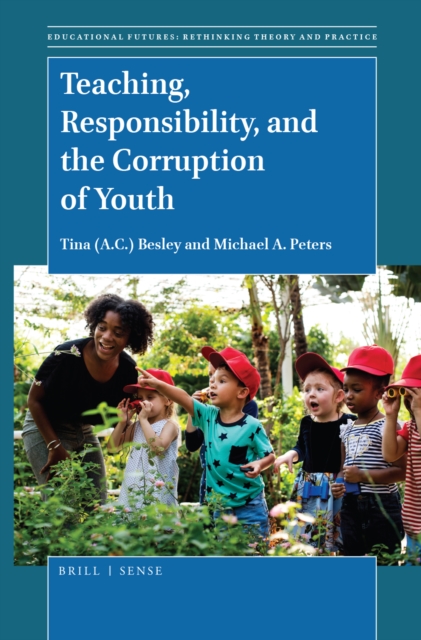
Teaching, Responsibility, and the Corruption of Youth
Teaching, Responsibility, and the Corruption of Youth explores the notion of responsibility in a complex world focusing on practices of truth-telling, interculturalism and ethnocentrism, the sources of anti-Westernism, the end of multi-culturalism, the refugee crisis and the demands of global citizenship.
eBook

Governmentality studies in education
\"Michel Foucault's concept of governmentality originated in a lecture series in the late 1970s at the Collلege de France and soon became the basis for a range of historical and contemporary studies across the social sciences and humanities\"-- Provided by publisher.
BOOK
Education, globalization, and the state in the age of terrorism
Education plays an important role in challenging, combating and in understanding terrorism in its different forms, whether as counter-terrorism or as a form of human rights education. Just as education has played a significant role in the process of nation-building, so education also plays a strong role in the process of empire, globalization and resistance to global forces-and in terrorism, especially where it is linked to emergent statehood. This book focuses on the theme of education in an age of terrorism, exploring the conflicts of globalization and global citizenship, feminism post-9/11, youth identities, citizenship and democracy in a culture of permanent war, and the relation between education and war, with a focus on the war against Iraq.
eBook
Virtues of Openness
The movement toward greater openness represents a change of philosophy, ethos, and government and a set of interrelated and complex changes that transform markets altering the modes of production and consumption, ushering in a new era based on the values of openness: an ethic of sharing and peer-to-peer collaboration enabled through new architectures of participation. These changes indicate a broader shift from the underlying industrial mode of production-a \"productionist\" metaphysics-to a postindustrial mode of consumption as use, reuse, and modification where new logics of social media structure different patterns of cultural consumption and symbolic analysis becomes a habitual and daily creative activity. The economics of openness constructs a new language of \"presuming\" and \"produsage\" in order to capture the open participation, collective co-creativity, communal evaluation, and commons-based production of social and public goods. Information is the vital element in the \"new\" politics and economy that links space, knowledge, and capital in networked practices and freedom is the essential ingredient in this equation if these network practices are to develop or transform themselves into 'knowledge cultures'. The Virtues of Openness investigates the social processes and policies that foster openness as an overriding educational value evidenced in the growth of open source, open access, and open education and their convergences that characterize global knowledge communities. The book argues that openness seems also to suggest political transparency and the norms of open inquiry, indeed, even democracy itself as both the basis of the logic of inquiry and the dissemination of its results.
The Virtues of Openness examines the complex history of the concept of the open society before beginning a systematic investigation of openness in relation to the book, the \"open text\" and the written word. These change
eBook

Citizenship, Human Rights and Identity: Prospects of a Liberal Cosmopolitan Order
This book focuses on the notion of citizenship in relation to the notions of human rights, identity and culture. It poses the question of the prospects of a liberal cosmopolitan order dealing with a number of interrelated themes: ethics, emancipation and what Derrida calls the “new humanities;” identity, war and crimes against humanity; citizenship, and education rights within a knowledge economy; colonization, development and peace; changing notions of democracy within an information society; and culture, difference and otherness. These are the themes that make problematic aspects of the liberal cosmopolitan order. One of the main tropes connecting these themes is how the primary liberal values of freedom, emancipation and equality work out in a globalized world. The interrelationship of these values are problematized in different settings as they relate to issues of global world order with a focus on the adaptability of the liberal framework of values and law in creating a genuine cosmopolitan order.
eBook
The Pedagogy of the Open Society
Social processes and policies that foster openness as an overriding value as evidenced in the growth of open source, open access and open education and their convergences that characterize global knowledge communities that transcend borders of the nation-state. Openness seems also to suggest political transparency and the norms of open inquiry, indeed, even democracy itself as both the basis of the logic of inquiry and the dissemination of its results. Openness is a value and philosophy that also offers us a means for transforming our institutions and our practices. This book examines the interface between learning, pedagogy and economy in terms of the potential of open institutions to transform and revitalize education in the name of the public good.
eBook
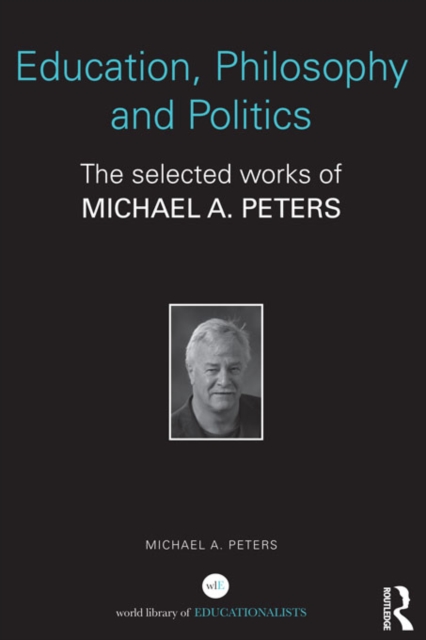
Education, Philosophy and Politics
In the World Library of Educationalists series, international experts themselves compile career-long collections of what they judge to be their finest pieces - extracts from books, key articles, salient research findings, major theoretical and/practical contributions - so the world can read them in a single manageable volume.
Michael A. Peters has spent the last 30 years researching, thinking and writing about some of the key and enduring issues in education. He has contributed over 60 books (authored, co-authored and edited) and 500 articles to the field.
In Education, Philosophy and Politics, Michael A. Peters brings together 15 of his key writings in one place, including chapters from his best-selling books and articles from leading journals. Starting with a specially written Introduction, which gives an overview of Michael's career and contextualises his selection, the essays are then arranged thematically to create a pathway of a way of thinking in philosophy of education which is forward looking but takes account of tradition and the past. The subjects of the chapters include;
Wittgenstein Studies
Philosophical Critique of Modernity
French Poststructuralism
Jean-Francois Lyotard
Foucault & Deleuze
Derrida
American Pragmatism
Rorty
Cavell
Philosophy and racism
Through this book, readers can follow the themes and strands that Michael A. Peters has written about for over three decades and clearly see his important contribution to the field of education.
eBook
Individualism And Community
Examining, in the widest sense, the changes in political philosophy that have occurred in Western capitalist states since the early 1980s, this book focuses on the introduction of neo-liberal principles in the combined area of social and education policy. New Zealand presents a paradigm example of the neo-liberal shift in political philosophy. From constituting the social laboratory of the Western world in the 1930s in terms of social welfare provision, New Zealand has become the neo-liberal experiment of the fully marketised society in the 1990s. Against the theoretical background of educational theory and practice, this book examines neo-liberalism and its critiques as responses to the so-called crisis of the welfare state and argues for a reformulated critical social policy in the postmodern condition. The conclusions about social policy drawn by the authors can be generalized to similar situations in other Western capitalist countries.
eBook

Transformative Civic Engagement Through Community Organizing
Maria Avila presents a personal account of her experience as a teenager working in a factory in Ciudad Juarez to how she got involved in community organizing. She has since applied the its distinctive practices of community organizing to civic engagement in higher education, demonstrating how this can help create a culture that values and rewards civically engaged scholarship and advance higher education's public, democratic mission.
Adapting what she learned during her years as an organizer with the Industrial Areas Foundation, she describes a practice that aims for full reciprocity between partners and is achieved through the careful nurturing of relationships, a mutual understanding of personal narratives, leadership building, power analysis, and critical reflection. She demonstrates how she implemented the process in various institutions and in various contexts and shares lessons learned. Community organizing recognizes the need to understand the world as it is in order to create spaces where stakeholders can dialogue and deliberate about strategies for creating the world as we would like it to be. Maria Avila offers a vision and process that can lead to creating institutional change in higher education, in communities surrounding colleges and universities, and in society at large.
This book is a narrative of her personal and professional journey and of how she has gone about co-creating spaces where democracy can be enacted and individual, institutional, and community transformation can occur. In inviting us to experience the process of organizing, and in keeping with its values and spirit, she includes the voices of the participants in the initiatives in which she collaborated - stakeholders ranging from community partners to faculty, students, and administrators in higher education.
eBook