
Catalogue Search | MBRL


Are you sure you want to remove the book from the shelf?

{{itemTitle}}
6
result(s) for
"Petrovic-Trifunovic, Tamara"
Sort by:

Political disaffection and disengagement in Serbia
The aim of this paper is to examine the extent of political disaffection and disengagement of Serbian citizens from a comparative European perspective, as well as to explore the relationships between two phenomena and determine the effects of several potential predictors (structural inequalities, gender, generational differences, urban environment, political awareness and competences, national and European identification, and political discontent) on different aspects of political disaffection and disengagement. In order to do so, we have used European Social Survey data (9th round, 2018), and singled out four different subdimensions of political disaffection and disengagement: assessment of responsiveness of the political system (external political efficacy), institutional trust, assessment of individual interest in politics and capabilities to engage in political processes (internal political efficacy), and the level of actual political engagement (political participation). The aim of the paper is to shed light on different systemic, structural and conjunctural factors that may contribute to shaping political attitudes and patterns of actions in contemporary Serbia and pose several theoretical and research questions that need further investigation.
Journal Article
Articulation of resistance in the discourse of the 1996/97 Serbian protests: Political struggle through culture and symbolic geography
The present article analyzes the discursive articulation of resistance to the regime of Slobodan Milosevic during the civil and student protests in Serbia in the winter of 1996/97. By applying critical discourse analysis to the opposition press of the time, we find that the rhetoric during the protests centered around the notions of civilization and culture. In variations of orientalism, balkanism and ?urbocentric exclusivism,? the ?Us? and ?Them? identifications were constructed through mutually interlaced semantic pairs: civilization - backwardness, culture - primitivism, Europe - Balkans/Orient, urbanity - rurality and democracy - communism. By drawing on existing research on the role of symbolic geography and cultural distinctions in the creation of social cleavages in the post-Yugoslav societies, our analysis presents how cultural traits and affiliations, ?urbanity? and individual characteristics, such as intelligence, critical ability and sense of humor, were used for the framing of protests, but also as means of political struggle in the protests. A detailed reconstruction of discursive strategies of reporting on the protests allows for a contemporary assessment of the limits of protest politics articulated in this way, and its comparison with a recent wave of mobilization of citizens of Serbia in 2016 and 2017. nema
Journal Article

The Hybrid Discourse of the Serbian Antibureaucratic Revolution
This article investigates the discursive logic of the antibureaucratic revolution through discourse analysis of three Serbian dailies: Politika, Borba, and Večernje Novosti. We conceptualize this discursive logic as a “hybrid discourse,” employed by Slobodan Milošević’s faction of the political elite and by prominent Serbian press outlets in their discussions and reporting on the diverse Serbian protest movements of the day. The core of the hybrid discourse, as our analysis demonstrates, consisted of the symbolic interweaving of different types of citizens’ discontent in order to present them as one single demand for societal “reform” that resonated with the agenda of the Serbian political elite. We argue that the hybrid discourse and the antibureaucratic revolution itself had a structural role related to the crisis of systemic legitimacy in Yugoslavia. The hybrid discourse performed the operation of what we term the “reversing of the symbolic fixing of antagonism between the ordinary actors’ discontents and the structurally inevitable reforms,” introducing instead the discursive fusion of the two vocabularies.
Journal Article
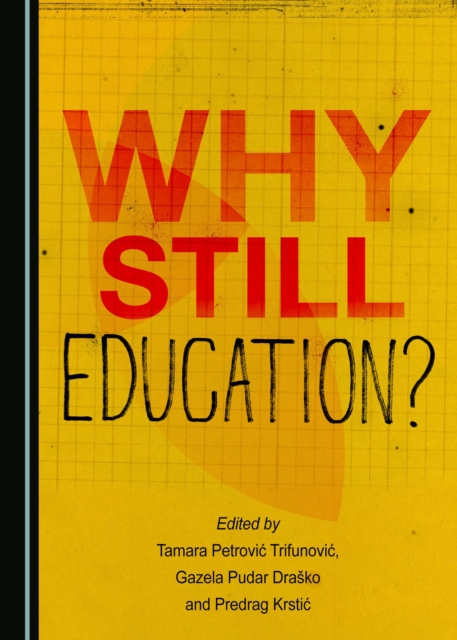
Why still education?
Why Still Education? will appeal to researchers of education - scholars and students alike - in the fields of philosophy, sociology, pedagogy, andragogy, psychology, political theory, anthropology, and history, as well as experts in education management and educational practitioners, such as teachers and textbook authors. The question posed by the title is separated in the book into three more specific questions; the first of which, titled \"Education for What?\", investigates the eternal issue the purpose of education. The second section, which examines the most appropriate approaches and expected outcomes for a child-centred perspective, is called \"Education for Whom?\"; and the third part, \"Whose Education?\", takes national, gender and other subtle or self-explanatory characteristics of education and looks at them from the standpoint of discrimination. The volume offers nine different chapters, which provide illuminating and interesting answers to these questions, and, thus, allow them to be more thoroughly resolved and enable rational discourse about them.
eBook
Artikulacija otpora u diskursu o protestima 1996/97. u Srbiji: politička borba vođena jezikom kulture i simboličke geografije
The present article analyzes the discursive articulation of resistance to the regime of Slobodan Milošević during the civil and student protests in Serbia in the winter of 1996/97. By applying critical discourse analysis to the opposition press of the time, we find that the rhetoric during the protests centered around the notions of civilization and culture. In variations of orientalism, balkanism and „urbocentric exclusivism,” the „Us” and „Them” identifications were constructed through mutually interlaced semantic pairs: civilization – backwardness, culture – primitivism, Europe – Balkans/Orient, urbanity – rurality and democracy – communism. By drawing on existing research on the role of symbolic geography and cultural distinctions in the creation of social cleavages in the post-Yugoslav societies, our analysis presents how cultural traits and affiliations, „urbanity” and individual characteristics, such as intelligence, critical ability and sense of humor, were used for the framing of protests, but also as means of political struggle in the protests. A detailed reconstruction of discursive strategies of reporting on the protests allows for a contemporary assessment of the limits of protest politics articulated in this way, and its comparison with a recent wave of mobilization of citizens of Serbia in 2016 and 2017.
Journal Article
Otklon od politike i dezangažman u Srbiji
The aim of this paper is to examine the extent of political disaffection and disengagement of Serbian citizens from a comparative European perspective, as well as to explore the relationships between two phenomena and determine the effects of several potential predictors (structural inequalities, gender, generational differences, urban environment, political awareness and competences, national and European identification, and political discontent) on different aspects of political disaffection and disengagement. In order to do so, we have used European Social Survey data (9th round, 2018), and singled out four different subdimensions of political disaffection and disengagement: assessment of responsiveness of the political system (external political efficacy), institutional trust, assessment of individual interest in politics and capabilities to engage in political processes (internal political efficacy), and the level of actual political engagement (political participation). The aim of the paper is to shed light on different systemic, structural and conjunctural factors that may contribute to shaping political attitudes and patterns of actions in contemporary Serbia and pose several theoretical and research questions that need further investigation
Journal Article