
Catalogue Search | MBRL


Are you sure you want to remove the book from the shelf?

{{itemTitle}}
55
result(s) for
"Plaxton, Michael"
Sort by:

Implied Consent and Sexual Assault
In R. v. Ewanchuk, the Supreme Court of Canada held that sexual touching must be accompanied by express, contemporaneous consent. In doing so, the Court rejected the idea that sexual consent could be \"implied.\" Ewanchuk was a landmark ruling, reflecting a powerful commitment to women's equality and sexual autonomy. In articulating limits on the circumstances under which women can be said to \"consent\" to sexual touching, however, the decision also restricts their autonomy - specifically, by denying them a voice in determining the norms that should govern their intimate relationships and sexual lives.In Implied Consent and Sexual Assault, Michael Plaxton argues that women should have the autonomy to decide whether, and under what circumstances, sexual touching can be appropriate in the absence of express consent. Though caution should be exercised before resurrecting a limited doctrine of implied consent, there are reasons to think that sexual assault law could accommodate a doctrine without undermining the sexual autonomy or equality rights of women. In reaching this conclusion, Plaxton challenges widespread beliefs about autonomy, consent, and the objectives underpinning the offence of sexual assault in Canada.Drawing upon a range of contemporary criminal law theorists and feminist scholars, Implied Consent and Sexual Assault reconsiders the nature of mutuality in a world dominated by gender norms, the proper scope of criminal law, and the true meaning of sexual autonomy.
eBook
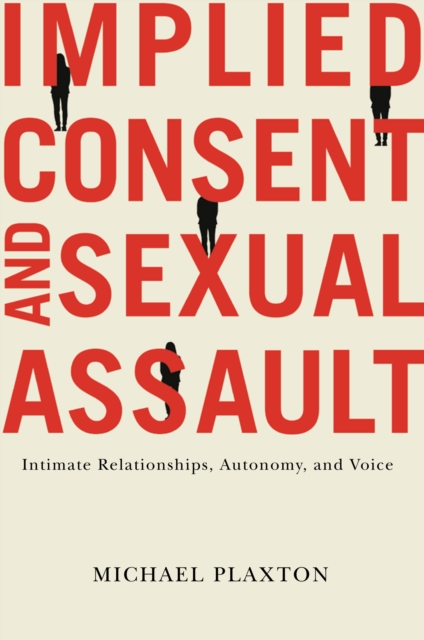
Implied consent and sexual assault : intimate relationships, autonomy, and voice
In R. v. Ewanchuk, the Supreme Court of Canada held that sexual touching must be accompanied by express, contemporaneous consent. In doing so, the Court rejected the idea that sexual consent could be \"implied.\" Ewanchuk was a landmark ruling, reflecting a powerful commitment to women's equality and sexual autonomy. In articulating limits on the circumstances under which women can be said to \"consent\" to sexual touching, however, the decision also restricts their autonomy - specifically, by denying them a voice in determining the norms that should govern their intimate relationships and sexual lives. In Implied Consent and Sexual Assault, Michael Plaxton argues that women should have the autonomy to decide whether, and under what circumstances, sexual touching can be appropriate in the absence of express consent. Though caution should be exercised before resurrecting a limited doctrine of implied consent, there are reasons to think that sexual assault law could accommodate a doctrine without undermining the sexual autonomy or equality rights of women. In reaching this conclusion, Plaxton challenges widespread beliefs about autonomy, consent, and the objectives underpinning the offence of sexual assault in Canada. Drawing upon a range of contemporary criminal law theorists and feminist scholars, Implied Consent and Sexual Assault reconsiders the nature of mutuality in a world dominated by gender norms, the proper scope of criminal law, and the true meaning of sexual autonomy.
eBook

Objective Fault, Strict Liability, and Javanmardi
This brief case note discusses the Supreme Court of Canada's recent decision in Javanmardi. Though the decision brings welcome clarity to the law of unlawful act manslaughter, it obscures and distorts the essential distinction between true crimes and public welfare offences. This leads to a number of practical difficulties in the Court's reasoning.
Journal Article

Nussbaum on Sexual Instrumentalization
In “The Wrongness of Rape”, Gardner and Shute argued that the English offence of rape primarily targets the wrong of objectification. They tie objectification closely to instrumentalization—to the “conversion of subjects into instruments or tools”. In doing so, they explicitly purport to follow Nussbaum’s understanding of what is morally problematic about objectification. In this paper, I want to explore more closely just what Nussbaum understands by instrumentalization, focusing in particular upon the meaning and role of mutuality in her analysis. Doing so gives us insight into why sexual touching in three broad contexts may not be considered instances of instrumentalization: spontaneous sexual touching in a romantic context; non-spontaneous sexual touching in the context of intimate relationships; and prostitution. The last point may be most controversial given Gardner and Shute’s own stated view that prostitution involves instrumentalization. Even when we look to sexual touching in intimate relationships, however, Nussbaum seems to introduce ideas of implied consent that appear nowhere in Gardner and Shute’s paper.
Journal Article
What's Right With Section 33.1
The upshot of s. 33.1 is this: A criminal defendant charged with an offence of interpersonal violence cannot claim that he was, at the relevant time, in a state akin to automatism--and therefore lacked voluntariness or general intent--where the condition was caused by the defendant's voluntary consumption of alcohol or drugs. Here, Plaxton and Mathen reflect on what is right about s. 33.1--or at least the moral instincts behind it.
Journal Article

Arguments of Virtue and Constitutional Criminal Procedure
Though Ronald Dworkin has directed his most recent book, 'Is Democracy Possible Here?', at a lay audience, its accessibility gives academics an opportunity to consider his more philosophically rigorous works with fresh eyes. In particular, it gives us a chance to re-evaluate Dworkin's distinction between principles and policies and to reconsider the place of arguments of virtue in his theory of constitutional interpretation. Furthermore, we are better able to understand various cases and doctrines in constitutional criminal procedure when we acknowledge the role of arguments of virtue in legal debates.
Journal Article

REFLECTIONS ON WALDRON'S ARCHETYPES
Jeremy Waldron argued that the government lawyers responsible for the 'torture memos' acted unprofessionally by undermining the prohibition on torture. He did so partly on the basis that that the torture prohibition represents a 'legal archetype' which cannot be undermined without doing considerable harm to large bodies of law. This paper argues that, however much intuitive appeal Waldron's archetype-based analysis may have, its force is inherently limited. This is so for two reasons. First, the claim that the torture prohibition is an archetype for non-brutality can only make a meaningful difference to the integrity of the legal order insofar as 'brutality' is understood widely. Waldron, though, reads 'brutality' in a narrow fashion. Second, and more importantly, the claim that archetypes are uniquely important to legal reasoning and the legal order is deeply problematic.
Journal Article

The Concept of Legislation: Jackson v Her Majesty's Attorney General
In Jackson and Others v Her Majesty's Attorney General, the Appellate Committee of the House of Lords faced an unusual case - one in which it had to decide not only what Parliament intended, but whether it created a statute in the first place. Though the Committee was unanimous in finding that Parliament did indeed create a statute, the decision reveals deep divisions within the panel concerning the status of the doctrine of parliamentary supremacy and a profound difference in commitment to an exclusively source-based approach to law.
Journal Article
The Shaky Foundations of Corbett
In R. v. Corbett, a majority of the Supreme Court of Canada held that a trial judge may refuse to allow the cross-examination of a criminal defendant on her prior convictions where its prejudicial effect would exceed its probative value. Over the past twenty years, the Corbett application has become an accepted and embedded feature of Canadian criminal procedure. The reasoning employed in Corbett, however, is deeply problematic, particularly in light of the Supreme Court's recent decision in Ferguson. Specifically, it is unclear whether the residual discretion to exclude evidence of prior convictions, recognized in Corbett, was driven by constitutional necessity or policy. It may also be that it was inappropriate to read judicial discretion into s. 12 of the Canada Evidence Act, given the Supreme Court's subsequent reasoning in Ferguson. In light of these considerations, we should hesitate to rely upon Corbett as broad authority for the view that a discretion to exclude relevant evidence can be read into statutory provisions that do not expressly allow for such discretion. [PUBLICATION ABSTRACT]
Journal Article
Irruptions of Motive in the War on Terrordagger
In R. v. Khawaja, Rutherford J. severed the motive requirement from the definition of terrorism contained in section 83.01 of the Criminal Code. In doing so, he drew upon the traditional doctrine that motive is irrelevant to criminal liability. This article disputes the idea that motive is irrelevant. It makes the modest argument that the criminal law has long passed political judgements on the value or disvalue of particular motives, and that if political factors creep into the definition of terrorism, it does so in the criminal law generally. [PUBLICATION ABSTRACT]
Journal Article