
Catalogue Search | MBRL


Are you sure you want to remove the book from the shelf?

{{itemTitle}}
92
result(s) for
"Raab, Nigel"
Sort by:


All Shook Up
Earthquakes, nuclear accidents, and floods were among the many unexpected tragedies that struck the Soviet Union over its history. Requiring the immediate mobilization of vast resources and aid, and embedded within a specific context and time, these catastrophes provide critical insights into the nature of the twentieth-century Communist state. All Shook Up takes a close look at the representation in film, the political repercussions, and the social opportunities of large-scale catastrophes in separate Soviet epochs, including the 1927 earthquake in the Crimean peninsula, the 1948 earthquake in Ashgabat, the Tashkent earthquake in 1966, the Chernobyl explosion in 1986, and the Armenian earthquake in 1988. Juxtaposing various disaster responses and demonstrating the ways both Soviet authorities and citizens molded them to their own cultural needs, Nigel Raab highlights the radical shifts in disaster policy from one leader to the next. Given the opportunity to act outside regular parameters, Soviet residents not only rebuilt their devastated cities, but also experimented with new values and crafted their own worldview while the state struggled to return the situation to normal. Based on archival research conducted in Russia and Ukraine, All Shook Up fills a gap in a global literature and challenges stereotypical representations of the Soviet Union as a monolithic state.
eBook


Democracy Burning?
Nineteenth-century commentators often claimed that Russia burned to the ground every thirty years. In an empire whose cities were built of wood, firefighters had a visible presence throughout Russia’s urban centres and became politically active across the country. Democracy Burning? studies the political, cultural, and social values of volunteer firefighters and reveals the ways in which their public organizations cooperated with the authoritarian state.
eBook
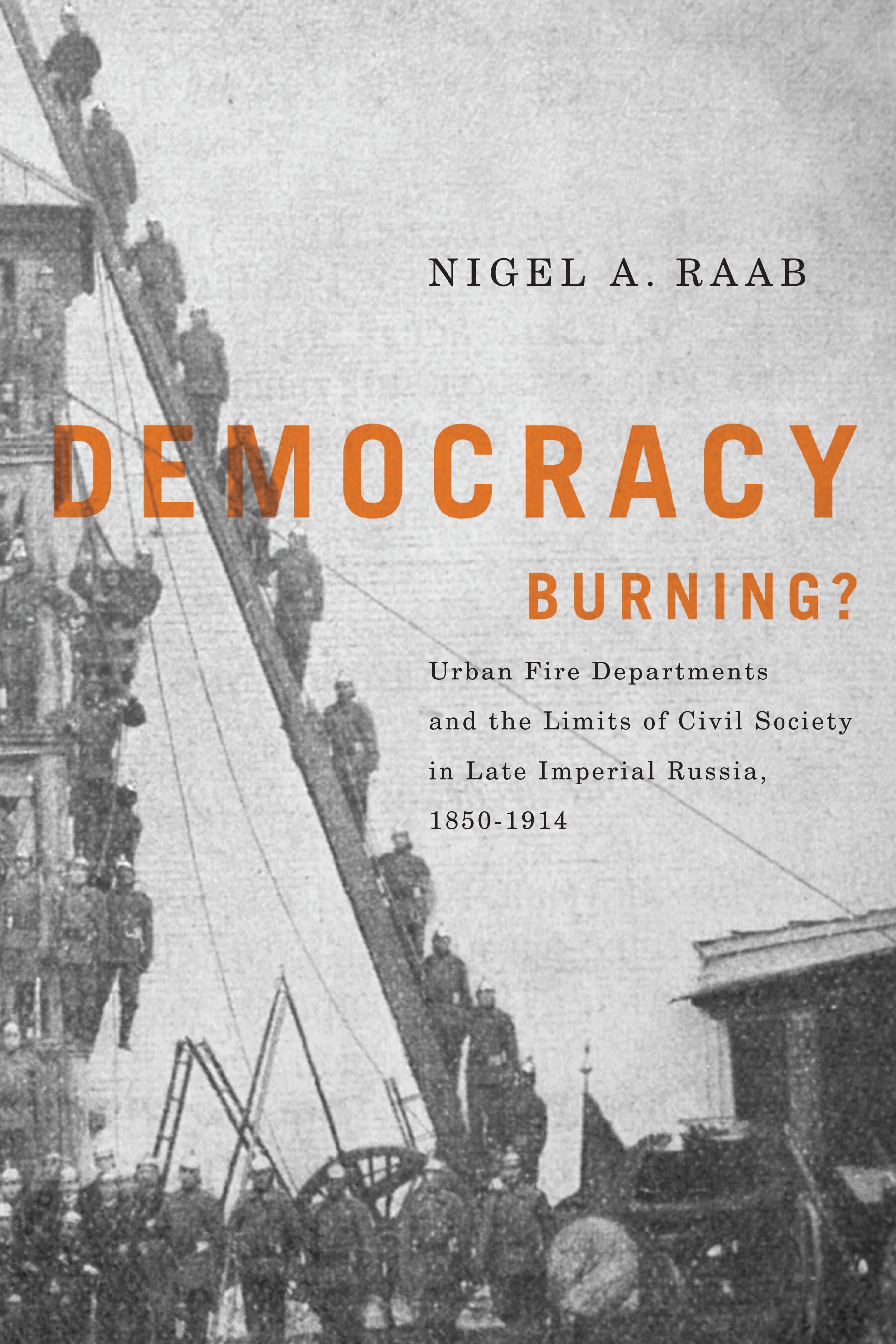
Democracy Burning?
Nineteenth-century commentators often claimed that Russia burned to the ground every thirty years. In an empire whose cities were built of wood, firefighters had a visible presence throughout Russia's urban centres and became politically active across the country. Democracy Burning? studies the political, cultural, and social values of volunteer firefighters and reveals the ways in which their public organizations cooperated with the authoritarian state. Nigel Raab considers the important roles that nationalism, regionalism, militarism, photography, and civil society played in fire departments and challenges prevailing notions that volunteer organizations opposed the state. His analysis not only provides insights into questions about a nascent civic consciousness in the years leading to revolution but also reveals new and important information about other aspects of urban life. A skilled work of history and urban studies, Democracy Burning? forces us to rethink the way we consider large public organizations and their relation to authoritarian governments.
eBook

The Crisis from Within
In The Crisis from Within, Nigel Raab explores weaknesses that emerge when using interdisciplinary theories in historical analysis. With chapters that focus on knowledge, language, memory, imagining and inventing, and civil society, the analysis reveals how theoretical applications can be the source of interpretive confusion.By drawing from a global range of historical works, Nigel Raab demonstrates how this problem concerns all historical sub-fields. From science in the seventeenth century to communism in the twentieth century, theories often overdetermine analysis in a way the historian never intended. After the enthusiastic reception of theory for over a generation, The Crisis from Within argues that the time has come to pause and think seriously about how we wish to proceed with theory.
eBook

The Crisis from Within
In The Crisis from Within, Nigel Raab examines analytic problems which emerge when philosophical and literary theories are introduced in historical analysis. By drawing from a vast range of historical works, it highlights dangers inherent to using theory.
eBook

The Tashkent Earthquake of 1966: The Advantages and Disadvantages of a Natural Tragedy
The Tashkent Earthquake of 1966: The Advantages and Disadvantages of a Natural Tragedy In April 1966, just months after the Central Asian capital of Tashkent had been in the diplomatic spotlight as host of a meeting between the heads of India and Pakistan, an earthquake demolished the city’s core. The earthquake was immediately reported in major media outlets and within days of the tragedy, Brezhnev visited and seized the moment to enhance his image. Based on sources from architectural journals, the minutes of Komsomol meetings, regional newspapers, and archived official discussions, the article asks questions about the complex issue of disaster relief in Tashkent: what strategies did the authoritarian Soviet state develop to bring order to these chaotic situations? In these tragic circumstances, what unexpected opportunities emerged for Soviet citizens? How might a natural disaster work to their advantage? From the official perspective, the article argues that the Brezhnev state carefully crafted a media blitz to steer public attitudes of the disaster; the re - construction of Tashkent became a cause celebre throughout the Soviet Union. From an unofficial perspective, the article demonstrates the openings that emerged in the aftermath of the earthquake. For example, the regional media had its own concerns that did not always reflect those of the centralized state. Similarly, architects in Uzbekistan envisioned the new Soviet Tashkent as an amalga - mation of Western ideas and the Muslim makhalla, challenging official claims about building a new Soviet city. And the Komsomol youth were rushed in from all four corners of the USSR to build but were quickly distracted by sex and alcohol. By drawing on disaster theories from Kenneth Hewitt, the article focuses on the often-ignored social and cultural aspects of disaster response. In doing so, the article reveals the sheer diversity of experience in tragic circumstances and adds color to the Brezhnev years, which have often been presented in the blandest tones.
Journal Article

Digital Research with All Our Senses
I want to start with the thoughts of two librarians. The first, well known to all, is Jorge Luis Borges, and the second is Rafael Ball, the head librarian at the ETH or Technological University in Zurich, Switzerland. Borges wrote The Library of Babel to explore ideas of infinity and our ability to capture all knowledge in the universe. Theoretically, his universal library has an “infinite number of hexagonal galleries” organized in the shape of a sphere (51). The hexagon, the sphere, and the symmetry of its organization all give a mathematical feel to the library, but Borges’s library also
Book Chapter
The Tashkent Earthquake of 1966: The Advantages and Disadvantages of a Natural Tragedy
The Tashkent Earthquake of 1966: The Advantages and Disadvantages of a Natural Tragedy In April 1966, just months after the Central Asian capital of Tashkent had been in the diplomatic spotlight as host of a meeting between the heads of India and Pakistan, an earthquake demolished the city’s core. The earthquake was immediately reported in major media outlets and within days of the tragedy, Brezhnev visited and seized the moment to enhance his image. Based on sources from architectural journals, the minutes of Komsomol meetings, regional newspapers, and archived official discussions, the article asks questions about the complex issue of disaster relief in Tashkent: what strategies did the authoritarian Soviet state develop to bring order to these chaotic situations? In these tragic circumstances, what unexpected opportunities emerged for Soviet citizens? How might a natural disaster work to their advantage? From the official perspective, the article argues that the Brezhnev state carefully crafted a media blitz to steer public attitudes of the disaster; the re - construction of Tashkent became a cause celebre throughout the Soviet Union. From an unofficial perspective, the article demonstrates the openings that emerged in the aftermath of the earthquake. For example, the regional media had its own concerns that did not always reflect those of the centralized state. Similarly, architects in Uzbekistan envisioned the new Soviet Tashkent as an amalga - mation of Western ideas and the Muslim makhalla, challenging official claims about building a new Soviet city. And the Komsomol youth were rushed in from all four corners of the USSR to build but were quickly distracted by sex and alcohol. By drawing on disaster theories from Kenneth Hewitt, the article focuses on the often-ignored social and cultural aspects of disaster response. In doing so, the article reveals the sheer diversity of experience in tragic circumstances and adds color to the Brezhnev years, which have often been presented in the blandest tones.
Journal Article