
Catalogue Search | MBRL


Are you sure you want to remove the book from the shelf?

{{itemTitle}}
1,382
result(s) for
"Reed, Mark S"
Sort by:
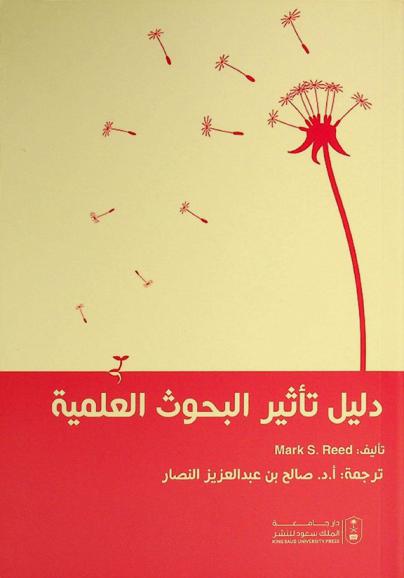
دليل تأثير البحوث العلمية
يعد هذا الكتاب مرجعا شاملا لكل ما يحتاجه الباحثون وطلاب الدراسات العليا ومتخذوا القرار لبدء رحلتهم في إثبات الفوائد الاقتصادية والاجتماعية لمشروعاتهم البحثية، ووضع نتائجهم موضع التطبيق، وإحداث التأثير المطلوب، فإن لم يكن لديك تصور عن الكيفية التي يمكن أن يحدث بها بحثك الفرق فسوف يساعدك هذا الكتاب في تحديد الأدوات العملية التي يمكنك القيام بها للبدء في رحلتك نحو إحداث التأثير، وإن كنت تعرف أنواع التأثير التي ترغب في أن يحدثها بحثك ولا تملك المهارات أو الأفكار أو الثقة الكافية في تحقيق ذلك، فإن هذا الكتاب سيعطيك الأدوات اللازمة للمضي قدما، وإن كنت بالفعل تحدث الفرق وتريد أن ترتقي بهذا الفرق إلى مستوى أعلى فسوف يساعدك هذا الكتاب في صقل ممارستك لتصبح باحثا أكثر فاعلية، ويصبح بحثك أكثر تحقيقا للتأثير المطلوب.
Book

Re-thinking research impact: voice, context and power at the interface of science, policy and practice
The world is facing unprecedented challenges on a scale that has never been seen before, and the need for evidence-informed solutions has never been greater. As a result, academics, policy-makers, practitioners, and research funders are increasingly seeking to undertake or support research that achieves tangible impacts on policy and practice. However, the impact of research is inherently subjective, with the same outcome perceived as either beneficial or negative by different groups, or by the same group in different contexts. It is therefore important to consider factors that may increase the likelihood that outcomes from research are perceived as beneficial (or otherwise) by interested/affected groups and non-academic partners, to help researchers avoid causing potentially harmful impacts, despite their best intentions. In this overview article, we discuss three considerations for re-thinking how research can deliver such outcomes: (i) sensitivity to context, (ii) representation and legitimisation of diverse voices and (iii) the management of power dynamics. We then discuss how these can be enacted in research and engagement processes that are designed to incorporate multiple ways of viewing reality and knowledge, as researchers become increasingly aware of their positionality, privilege, assumptions and biases. By considering how research and impact generation processes are mediated by context, power and voice, it may be possible to envision just transformations of knowledge systems that foreground the knowledge and needs of diverse groups, including those who have been historically marginalised, and without systematically recognising or privileging one group over another.
Journal Article


How does the context and design of participatory decision making processes affect their outcomes? Evidence from sustainable land management in global drylands
Although the design of participatory processes to manage social-ecological systems needs to be adapted to local contexts, it is unclear which elements of process design might be universal. We use empirical evidence to analyze the extent to which context and process design can enable or impede stakeholder participation and facilitate beneficial environmental and social outcomes. To explore the role of design and minor variations in local context on the outcomes of participatory processes, we interviewed participants and facilitators from 11 case studies in which different process designs were used to select sustainable land management options in Spain and Portugal. We analyzed interview data using quantitative and qualitative approaches. Results showed that although some aspects of local context affected process outcomes, factors associated with process design were more significant. Processes leading to more beneficial environmental and social outcomes included the following: the legitimate representation of stakeholders; professional facilitation including structured methods for aggregating information and balancing power dynamics among participants; and provision of information and decision-making power to all participants. Although processes initiated or facilitated by government bodies led to significantly less trust, information gain, and learning, decisions in these processes were more likely to be accepted and implemented. To further test the role of context in determining the outcomes of participation, we interviewed facilitators from a process that was replicated across 13 dryland study sites around the world, reflecting much greater national variations in context. The similarity of outcomes across these sites suggested that the socio-cultural context in which the process was replicated had little impact on its outcomes, as long as certain design principles were fulfilled. Overall, our findings provide a solid empirical basis for good practice in the design of participatory processes in the management of social-ecological systems.
Journal Article

How research data deliver non-academic impacts: A secondary analysis of UK Research Excellence Framework impact case studies
This study investigates how research data contributes to non-academic impacts using a secondary analysis of high-scoring impact case studies from the UK’s Research Excellence Framework (REF). A content analysis was conducted to identify patterns, linking research data and impact. The most prevalent type of research data-driven impact related to “practice” (45%), which included changing how professionals operate, changing organizational culture and improving workplace productivity or outcomes. The second most common category was “government impacts”, including reducing government service costs and enhancing government effectiveness or efficiency. Impacts from research data were developed most frequently through “improved institutional processes or methods” (40%) and developing impact via pre-analyzed or curated information in reports (32%), followed by “analytic software or methods” (26%). The analysis found that research data on their own rarely generate impacts. Instead they require analysis, curation, product development or other forms of significant intervention to leverage broader non-academic impacts.
Journal Article
Building university-based boundary organisations that facilitate impacts on environmental policy and practice
Responding to modern day environmental challenges for societal well-being and prosperity necessitates the integration of science into policy and practice. This has spurred the development of novel institutional structures among research organisations aimed at enhancing the impact of environmental science on policy and practice. However, such initiatives are seldom evaluated and even in cases where evaluations are undertaken, the results are rarely made publicly available. As such there is very little empirically grounded guidance available to inform other organisations in this regard. To help address this, the aim of this study is to evaluate the Baltic Eye Project at Stockholm University-a unique team consisting of researchers from different fields, science communicators, journalists and policy analysts-working collectively to support evidence-informed decision-making relating to the sustainable management of the Baltic Sea environment. Specifically, through qualitative interviews, we (1) identify the impacts achieved by the Baltic Eye Project; (2) understand the challenges and barriers experienced throughout the Baltic Eye Project; and (3) highlight the key features that are needed within research organisations to enhance the impact of science on policy and practice. Results show that despite only operating for three years, the Baltic Eye Project has achieved demonstrable impacts on a range of levels: impacts on policy and practice, impacts to individuals working within the organisation and impacts to the broader University. We also identify a range of barriers that have limited impacts to date, such as a lack of clear goals at the establishment of the Baltic Eye Project and existing metrics of academic impact (e.g. number of publications). Finally, based on the experiences of employees at the Baltic Eye Project, we identify the key organisational, individual, financial, material, practical, political, and social features of university-based boundary organisations that have impact on policy and practice. In doing so this paper provides empirically-derived guidance to help other research organisations increase their capacity to achieve tangible impacts on environmental policy and practice.
Journal Article
Integrating ecosystem markets to co-ordinate landscape-scale public benefits from nature
Ecosystem markets are proliferating around the world in response to increasing demand for climate change mitigation and provision of other public goods. However, this may lead to perverse outcomes, for example where public funding crowds out private investment or different schemes create trade-offs between the ecosystem services they each target. The integration of ecosystem markets could address some of these issues but to date there have been few attempts to do this, and there is limited understanding of either the opportunities or barriers to such integration. This paper reports on a comparative analysis of eleven ecosystem markets in operation or close to market in Europe, based on qualitative analysis of 25 interviews, scheme documentation and two focus groups. Our results indicate three distinct types of markets operating from the regional to national scale, with different modes of operation, funding and outcomes: regional ecosystem markets, national carbon markets and green finance. The typology provides new insights into the operation of ecosystem markets in practice, which may challenge traditionally held notions of Payment for Ecosystem Services. Regional ecosystem markets, in particular, represent a departure from traditional models, by using a risk-based funding model and aggregating both supply and demand to overcome issues of free-riding, ecosystem service trade-offs and land manager engagement. Central to all types of market were trusted intermediaries, brokers and platforms to aggregate supply and demand, build trust and lower transaction costs. The paper outlines six options for blending public and private funding for the provision of ecosystem services and proposes a framework for integrating national carbon markets and green finance with regional ecosystem markets. Such integration may significantly increase funding for regenerative agriculture and conservation across multiple habitats and services, whilst addressing issues of additionality and ecosystem service trade-offs between multiple schemes.
Journal Article

Publishing social science research in Conservation Biology to move beyond biology
Fil: Jones, Julia P.G.. Bangor University. School of Environment, Natural Resources and Geography; Reino Unido
Journal Article

Participatory Indicator Development: What Can Ecologists and Local Communities Learn from Each Other
Given the growing popularity of indicators among policy-makers to measure progress toward conservation and sustainability goals, there is an urgent need to develop indicators that can be used accurately by both specialists and nonspecialists, drawing from the knowledge possessed by each group. This paper uses a case study from the Kalahari, Botswana to show how participatory and ecological methods can be combined to develop robust indicators that are accessible to a range of users to monitor and enhance the sustainability of land management. First, potential environmental sustainability indicators were elicited from pastoralists in three study sites. This knowledge was then evaluated by pastoralists, before being tested empirically using ecological and soil-based techniques. Despite the wealth of local knowledge about indicators, this knowledge was thinly spread. The knowledge was more holistic than published indicator lists for monitoring rangelands, encompassing vegetation, soil, livestock, wild animal, and socioeconomic indicators. Pastoralist preferences for vegetation and livestock indicators match recent shifts in ecological theory suggesting that livestock populations reach equilibrium with key forage resources in semiarid environments. Although most indicators suggested by pastoralists were validated through empirical work (e.g., decreased grass cover and soil organic matter content, and increased abundance of Acacia mellifera and thatching grass), they were not always sufficiently accurate or reliable for objective degradation assessment, showing that local knowledge cannot be accepted unquestioningly. We suggest that, by combining participatory and ecological approaches, it is possible to derive more accurate and relevant indicators than either approach could achieve alone.
Journal Article

Knowledge exchange: a review and research agenda for environmental management
There is increasing emphasis on the need for effective ways of sharing knowledge to enhance environmental management and sustainability. Knowledge exchange (KE) are processes that generate, share and/or use knowledge through various methods appropriate to the context, purpose, and participants involved. KE includes concepts such as sharing, generation, coproduction, comanagement, and brokerage of knowledge. This paper elicits the expert knowledge of academics involved in research and practice of KE from different disciplines and backgrounds to review research themes, identify gaps and questions, and develop a research agenda for furthering understanding about KE. Results include 80 research questions prefaced by a review of research themes. Key conclusions are: (1) there is a diverse range of questions relating to KE that require attention; (2) there is a particular need for research on understanding the process of KE and how KE can be evaluated; and (3) given the strong interdependency of research questions, an integrated approach to understanding KE is required. To improve understanding of KE, action research methodologies and embedding evaluation as a normal part of KE research and practice need to be encouraged. This will foster more adaptive approaches to learning about KE and enhance effectiveness of environmental management.
Journal Article