
Catalogue Search | MBRL


Are you sure you want to remove the book from the shelf?

{{itemTitle}}
65
result(s) for
"Sapon-Shevin, Mara"
Sort by:

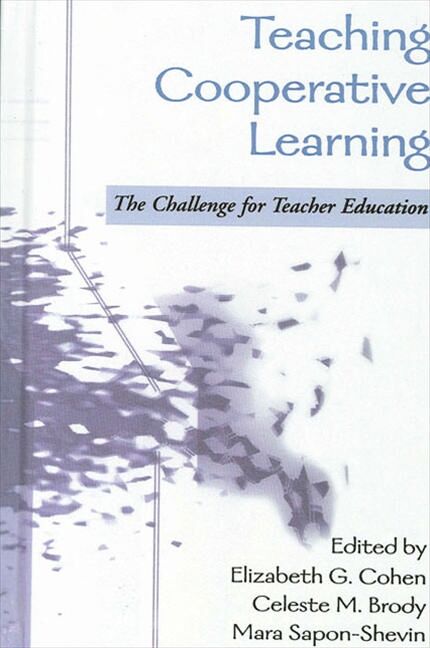
Teaching Cooperative Learning
Winner of the 2004 Critics' Choice Award presented by the
American Educational Studies Association Teacher educators
from ten institutions and programs in the United States, Canada,
and Germany describe the ways in which they have changed teacher
preparation to more fully incorporate cooperative learning
concepts. Analytical commentaries on the programs highlight the
learning experience of these programs as well as underlying issues
of needed reforms in teacher education. Included among best
practices in education, cooperative learning may require a shift in
program philosophy and disciplinary areas to meet the challenge of
complex organizations and diverse student populations. As the
essays in the volume demonstrate, a new alignment of field
experiences to provide support for novices to implement cooperative
strategies, and to receive timely and effective supervision for
these attempts, may also be required.
eBook


Cooperative learning and middle schools: What would it take to really do it right?
The article identifies some of the problems with current cooperative-learning strategies and implementation, links those limitations to both the wider cooperative-learning movement and the nature of middle schools, and calls for conceptualizing and structuring cooperative learning within a much larger educational, social, economic, and political context. (SM)
Journal Article
Full inclusion as disclosing tablet: Revealing the flaws in our present system
Explores the possibilities of full inclusion for students with disabilities by responding to myths that block thoughtful and comprehensive implementation (for example, that there is no research or data, segregation is not inherently a problem, special educators are extinct, special services require special places, and other children's education will suffer). (SM)
Journal Article

Teaching cooperative learning
Teacher educators from ten institutions and programs in the United States, Canada, and Germany describe the ways in which they have changed teacher preparation to more fully incorporate cooperative learning concepts. Analytical commentaries on the programs highlight the learning experience of these programs as well as underlying issues of needed reforms in teacher education.
Included among best practices in education, cooperative learning may require a shift in program philosophy and disciplinary areas to meet the challenge of complex organizations and diverse student populations. As the essays in the volume demonstrate, a new alignment of field experiences to provide support for novices to implement cooperative strategies, and to receive timely and effective supervision for these attempts, may also be required.
eBook
Special education and the Holmes agenda for teacher education reform
This article explores implications of the omission of special education from the Holmes Group effort to change and improve teacher education and subsequent planning for educational reform. It discusses Holmes efforts to include special education and outlines critical steps in ensuring success and inclusiveness in school and teacher education reform. (SM)
Journal Article

Critical Multicultural Education as an Analytical Point of Entry into Discussion of Intersectional Scholarship: A Focus on Race, as Well as Class, Gender, Sexuality, Dis/Ability, and Family Configuration
This article examines the uses of intersectional analysis in three research arenas: the school-to-prison pipeline, religious identity and curriculum development, and inclusive education. More specifically, this article explores how scholarly inquiry shifts, even when all three arenas use an overlapping dimension of analysis (race), as well as when they use other unique dimensions (class, gender, religion, sexuality, dis/ability, and family configuration). The research on the school-to-prison pipeline explores white female teacher disciplinary practices with minority male students. The religious identity and curriculum development research examines the false separation of state and religion, and constructed conflict between religion and sexuality in teaching and learning. The inclusive education-focused research problematizes ability grouping in schools, especially for so-called non-traditional families. The article explores how scholarly inquiry shifts, even when all three arenas use an overlapping dimension of analysis (race), as well as when they use other unique dimensions. Intersectional analysis is revealed as always uncoverable in scholarship, once researcher intersectional consciousness emerges.
Journal Article
