
Catalogue Search | MBRL


Are you sure you want to remove the book from the shelf?

{{itemTitle}}
52
result(s) for
"Schecter, Darrow"
Sort by:


The critique of instrumental reason from Weber to Habermas
This volume analyses the critique of instrumental reason from Weber through to the present day. Weber constitutes the starting point because he represents a key moment in political and theoretical transition. It explores how Habermas moves away from a Weberian-Marxist version of social theory towards a more optimistic approach.
eBook


Beyond hegemony
Since the Enlightenment, liberal democrat governments in Europe and North America have been compelled to secure the legitimacy of their authority by constructing rational states whose rationality is based on modern forms of law. The first serious challenge to liberal democratic practices of legal legitimacy comes in Marx’s early writings on Rousseau and Hegel. Marx discovers the limits of formal legal equality that does not address substantive relations of inequality in the workplace and in many other spheres of social life. Beyond Hegemony investigates the authoritarianism and breakdown of those state socialist governments in Russia and elsewhere which claim to put Marx’s ideas on democracy and equality into practice. The book explains that although many aspects of Marx’s critique are still valid today, his ideas need to be supplemented by the contributions to social theory made by Nietzsche, Foucault, the critical theory of the Frankfurt School as well as the libertarian socialism of G.D.H. Cole. What emerges is a new theory of political legitimacy which indicates how it is possible to move beyond liberal democracy whilst avoiding the authoritarian turn of state socialism.Schecter points out the weaknesses of the many extra-legal accounts of non-formal legitimacy now on offer, such as those based on friendship and identity. He then argues that the first step beyond hegemony depends on the discovery of forms of legitimate legality and demonstrates why the conditions of legitimate law can be identified.
eBook

Critical theory and sociological theory : on late modernity and social statehood
Democracy in the twenty-first century faces a number of major challenges, populism, neoliberalism and globalisation being three of the most prominent. This book examines such challenges by investigating how the conditions of democratic statehood have been altered at several key historical intervals since 1945. It demonstrates that the formal mechanisms of democratic statehood, such as elections, have always been complemented by civic, cultural, educational, socio-economic and constitutional institutions that mediate between citizens and state authority. Rearticulating critical theory with a contemporary focus, the book shows why a sociological approach is urgently needed to address conceptual deficits and explain how the formal mechanisms of democratic statehood need to be complemented and updated in new ways today.
Book

Beyond hegemony
Since the Enlightenment, liberal democrat governments in Europe and North America have been compelled to secure the legitimacy of their authority by constructing rational states whose rationality is based on modern forms of law. The first serious challenge to liberal democratic practices of legal legitimacy comes in Marx’s early writings on Rousseau and Hegel. Marx discovers the limits of formal legal equality that does not address substantive relations of inequality in the workplace and in many other spheres of social life. Beyond Hegemony investigates the authoritarianism and breakdown of those state socialist governments in Russia and elsewhere which claim to put Marx’s ideas on democracy and equality into practice. The book explains that although many aspects of Marx’s critique are still valid today, his ideas need to be supplemented by the contributions to social theory made by Nietzsche, Foucault, the critical theory of the Frankfurt School as well as the libertarian socialism of G.D.H. Cole. What emerges is a new theory of political legitimacy which indicates how it is possible to move beyond liberal democracy whilst avoiding the authoritarian turn of state socialism. Schecter points out the weaknesses of the many extra-legal accounts of non-formal legitimacy now on offer, such as those based on friendship and identity. He then argues that the first step beyond hegemony depends on the discovery of forms of legitimate legality and demonstrates why the conditions of legitimate law can be identified.
eBook


UNITY, IDENTITY AND DIFFERENCE: REFLECTIONS ON HEGEL'S DIALECTICS AND NEGATIVE DIALECTICS
This paper looks at key points of convergence and divergence in Hegel and Adorno on the question of the dialectics of humanity and nature as these unfold in institutions. Bearing in mind the distinct historical periods in which they worked, particular attention is paid to the ways in
which their respective epistemologies deliver very different assessments of social and political life in modern societies. This is illustrated by contrasting Hegel's notion of recognition with the utopian dimension of Adorno's ideas on non-identity and mimetic reconciliation. It
is shown that in opposition to those who regard Adorno exclusively as a philosopher and aesthetic theorist, his ideas have social and juridical relevance, as well as continuing resonance in the history of political thought.
Journal Article
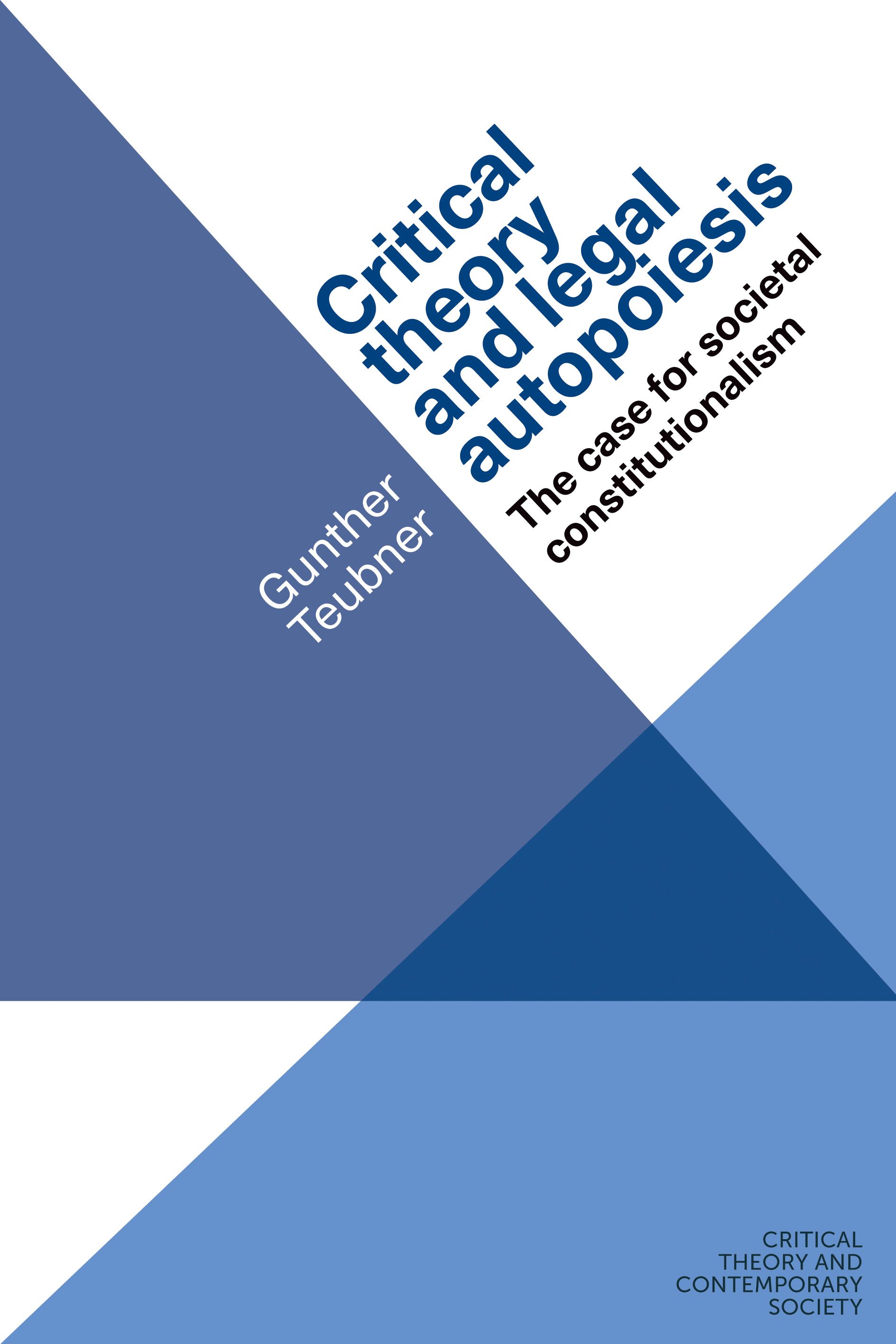
Critical theory and legal autopoiesis
This volume collects and revises the key essays of Gunther Teubner, one of the world’s leading sociologists of law. Written over the past twenty years, these essays examine the ‘dark side’ of functional differentiation and the prospects of societal constitutionalism as a possible remedy. Teubner's claim is that critical accounts of law and society require reformulation in the light of the sophisticated diagnoses of late modernity in the writings of Niklas Luhmann, Jacques Derrida and select examples of modernist literature. Autopoiesis, deconstruction and other post-foundational epistemological and political realities compel us to confront the fact that fundamental democratic concepts such as law and justice can no longer be based on theories of stringent argumentation or analytical philosophy. We must now approach law in terms of contingency and self-subversion rather than in terms of logical consistency and rational coherence.
eBook
