
Catalogue Search | MBRL


Are you sure you want to remove the book from the shelf?

{{itemTitle}}
46
result(s) for
"Spadoni, Robert"
Sort by:

Uncanny Bodies
In 1931 Universal Pictures released Dracula and Frankenstein, two films that inaugurated the horror genre in Hollywood cinema. These films appeared directly on the heels of Hollywood's transition to sound film. Uncanny Bodies argues that the coming of sound inspired more in these massively influential horror movies than screams, creaking doors, and howling wolves. A close examination of the historical reception of films of the transition period reveals that sound films could seem to their earliest viewers unreal and ghostly. By comparing this audience impression to the first sound horror films, Robert Spadoni makes a case for understanding film viewing as a force that can powerfully shape both the minutest aspects of individual films and the broadest sweep of film production trends, and for seeing aftereffects of the temporary weirdness of sound film deeply etched in the basic character of one of our most enduring film genres.
eBook
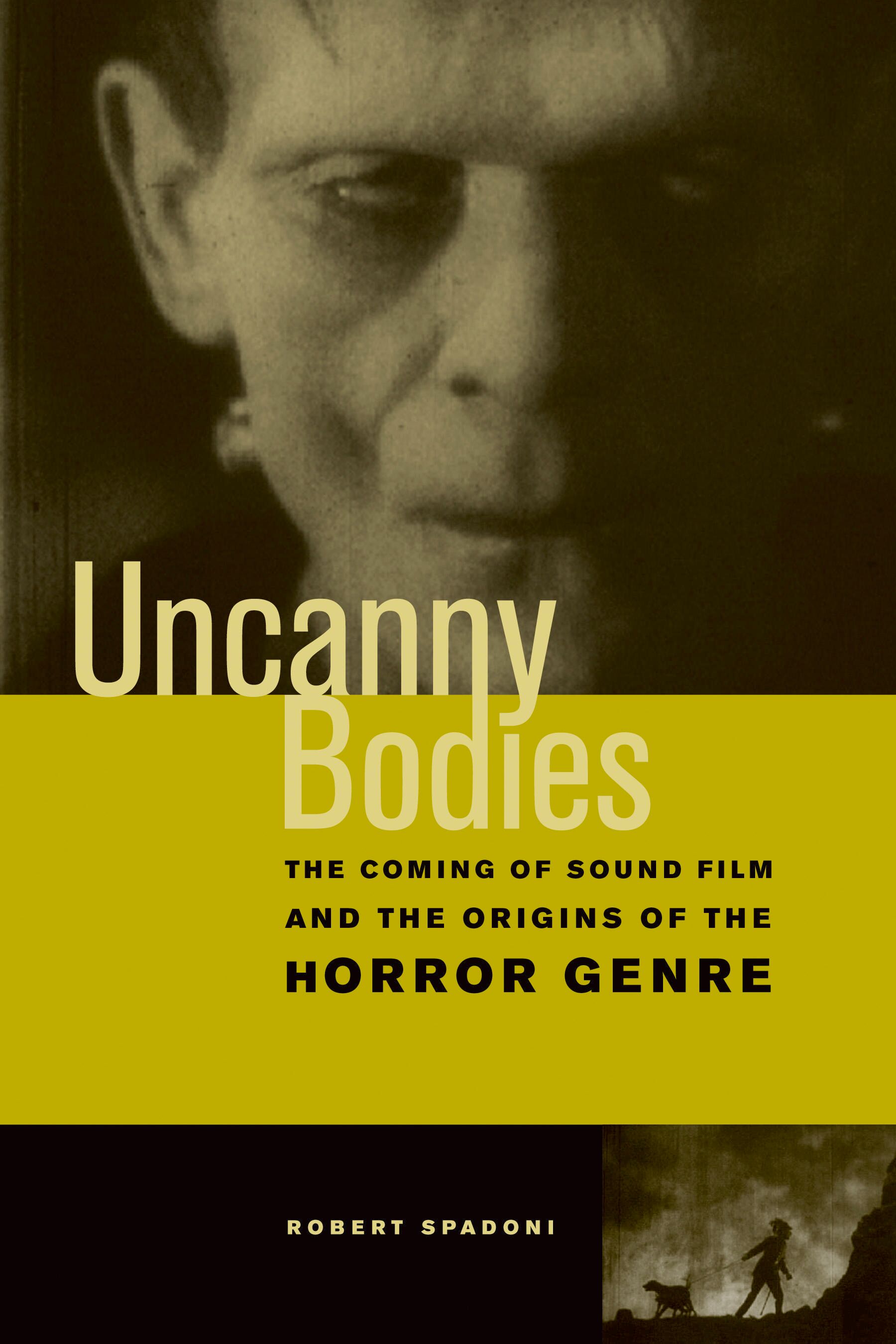
Uncanny Bodies
In 1931 Universal Pictures released Dracula and Frankenstein, two films that inaugurated the horror genre in Hollywood cinema. These films appeared directly on the heels of Hollywood's transition to sound film. Uncanny Bodies argues that the coming of sound inspired more in these massively influential horror movies than screams, creaking doors, and howling wolves. A close examination of the historical reception of films of the transition period reveals that sound films could seem to their earliest viewers unreal and ghostly. By comparing this audience impression to the first sound horror films, Robert Spadoni makes a case for understanding film viewing as a force that can powerfully shape both the minutest aspects of individual films and the broadest sweep of film production trends, and for seeing aftereffects of the temporary weirdness of sound film deeply etched in the basic character of one of our most enduring film genres.
eBook

Old Times in Werewolf of London
Sigmund Freud, \"Three Essays on the Theory of Sexuality\" Introduction FILMS ABOUT MEN WHO TURN INTO ravening wolves are ripe for an approach to the horror genre, pioneered by Robin Wood, that sees the films staging a return of the repressed, eruptions (in the case of werewolf films) of primal carnality that must be contained and eradicated before the societal status quo can be restored and reaffirmed (Wood 7-22). Richard Dyer notes that decades after theorists stopped believing this, notions of \"in-betweenism\" continue to inform both how gays are characterized in popular culture texts, such as films, and how some gay men characterize themselves (Dyer with Pidduck 33-37; Dyer 30-37).
Journal Article
FRANKENSTEIN AND THE VATS OF HOLLYWOOD
FrankensteinsurpassedDraculaat the box office and with the critics.¹ Many reviewers hailed James Whale’s film as superior to Browning’s, finding the film not only artistically more impressive but also scarier and more shocking.² How scary the film was on its first release is suggested by the fact that at the time, and unlike any time since then, the view of Boris Karloff’s monster as a sympathetic figure was not unanimously taken for granted. The monster’s accidental drowning of the little girl, for example, a scene that critics have long singled out as especially moving, prompted one initial reviewer
Book Chapter
LUDICROUS OBJECTS, TEXTUALIZED RESPONSES
Bela Lugosi could make a stronger impression as an undead creature after George Arliss and Myrna Loy had stopped doing the same. Indeed, virtually from the moment the sound transition began, the uncanniness of sound film began to fade. This was in part because, virtually from the beginning, thenoveltyof sound film began to fade. In 1932 Carl Laemmle Jr. remarked that “the fact that the screen now has a voice is no longer a novelty.”¹ In 1930 the foreign correspondent who, as I note in chapter 1, implied that Parisians who did not understand English were going to
Book Chapter
DRACULA AS UNCANNY THEATER
Viewers today callDraculatheatrical, and ones in 1931 might not have disagreed. Then, the film’s theatricality simultaneously announced itself and transformed the whole film into an uncanny cinematic spectacle. This spectacle was made incandescent by the moment’s proximity to the coming of sound. Lighting up the center of Browning’s “phantasm assembly” was the figure of Count Dracula.
Compared to prior imaginings of Stoker’s vampire, the one in Browning’s film stands out for certain basic features that he lacks. He exhibits none of the overt sexual interest in his victims that we find in Deane and Balderston’s play and Bromfield’s
Book Chapter
THE UNCANNY BODY OF EARLY SOUND FILM
The coming of sound fueled a number of genre developments in Hollywood cinema. One obvious example is the film musical. Less obvious is how the horror genre also dramatized and explored potentials that synchronized sound brought to Hollywood films. Where do we situate this outgrowth of the sound transition in relation to others of the period? We can start by noting that some genre developments were inspired by impressions, widespread at the time, that the coming of sound marked a huge forward leap in cinematic realism.
Signs of this impression appear everywhere in commentaries on the new films. Many noted that human
Book Chapter
THE MYSTERY OF DRACULA
The first word out of the mouth of a horror film fan at the mention of the 1931Draculais likely to be “classic.” All agree that the film casts a long shadow over the history of its genre and that its influence would be hard to overstate. The second word out of the same fan’s mouth might be “creaky,” “stagy,” “funny,” or possibly “bad.” The film does not enjoy the same classic status as, say,Casablanca,in which the work’s sterling quality and timeless appeal lift it high above the context of its first screenings. The capacity ofDracula
Book Chapter