
Catalogue Search | MBRL


Are you sure you want to remove the book from the shelf?

{{itemTitle}}
19
result(s) for
"Vennik, Jane"
Sort by:

A qualitative process evaluation of a nasal spray intervention to prevent respiratory tract infections
Nasal sprays could be used to prevent and manage respiratory tract infections (RTIs). As part of a randomized controlled trial (ISRCTN17936080), participants received one of two nasal sprays (gel-based vs. saline) and a digital intervention. The digital intervention used behaviour change theories to encourage nasal spray use to reduce the severity and occurrences of RTIs. We explored participants’ experiences of the digital intervention and nasal spray. We interviewed 31 participants (aged 19–80), sampled from the two nasal spray intervention trial arms across 3 winter seasons (including at the height of COVID-19). We analysed the interviews using thematic analysis and found two themes regarding facilitators and barriers to nasal spray use. The facilitators of nasal spray use revolved around belief in nasal spray efficacy for infection, belief the nasal spray is safe, motivation to avoid infection, sense of control over infection, and how the nasal spray is integrated into lifestyle. Barriers to nasal spray use included the belief the nasal spray is ineffective, belief the nasal spray is unnecessary, and usage difficulties. Overall, the results highlight the role of beliefs, lifestyle integration, and usage difficulties in nasal spray adherence, with implications for future digital interventions, such as addressing concerns about the nasal spray being perceived as medication.
Journal Article
Feasibility trial of a new digital training package to enhance primary care practitioners’ communication of clinical empathy and realistic optimism
Patients can benefit when primary care practitioners communicate clinical empathy and optimism during consultations, but previous training interventions for practitioners are overly time-consuming and evidence on patient outcomes is limited. This study assessed the feasibility of a cluster-randomized controlled trial in UK general practice to evaluate effects of a new brief digital learning package in empathy and optimism (EMPathicO) for primary care practitioners.
The study ran January to October 2020, with COVID-19 related modifications (mostly, practitioner and patient data had to be collected separately) from March 2020. 9 practices and 12 primary care practitioners recruited from UK (Southern England, Midlands). 12 practitioners completed EMPathicO training and 11 completed qualitative telephone interviews. Patients recruited through social media completed web-based questionnaires at baseline (<2 weeks post-consultation) and 2-week follow-up (n = 437). Purposively sampled patients completed qualitative telephone interviews (n = 30). Data analysed descriptively and thematically.
Practitioners were keen to reflect on and enhance communication skills and were willing to undertake digital training, even during COVID-19 pandemic. However, some practices and practitioners would have declined if video-recording consultations was a mandatory aid to reflection during training. Practitioners found EMPathicO brief, relevant and engaging and could implement techniques taught in the training. Patients found the online questionnaires acceptable, though retention was suboptimal at 57%; minor easily remedied feasibility and process issues were identified (including incentivizing participation); and patients were enthusiastic about research to improve communication.
An agile research strategy enabled useful feasibility data to be collected despite the challenges of the COVID pandemic. It is feasible to proceed to a full trial of the effects of EMPathicO on patient outcomes in primary care, if video-recording consultations is optional not mandatory. Feasibility work to develop and test sophisticated questionnaire structures is valuable when planning primary care patient surveys. Registration: ISRCTN21215037. Registered: 06/02/2020. https://doi.org/10.1186/ISRCTN21215037.
Journal Article

Chronic rhinosinusitis: a qualitative study of patient and clinician experiences of the MACRO randomised controlled trial of surgical versus medical management
ObjectivesTo explore patient and clinician experiences of participation in the MACRO randomised controlled trial (RCT)—which found endoscopic sinus surgery (ESS) to be clinically effective whereas clarithromycin was no better than placebo for chronic rhinosinusitis (CRS)—and to identify barriers and facilitators to the implementation of the trial results.DesignQualitative study embedded within the multicentre MACRO RCT. Semistructured interviews with patients and clinicians were analysed using thematic analysis.Setting21 secondary and tertiary ear, nose and throat centres in England and Scotland participating in the MACRO RCT.Participants20 CRS patients (16 with nasal polyps, 4 without) were interviewed approximately 6 months after trial completion, and 17 clinical staff including principal investigators (PIs), associate PIs and research nurses.ResultsThis study explored patients’ and clinicians’ experiences of the trial to identify barriers and facilitators to implementing the findings. Adopting the outcomes of the trial would involve recommending surgery to more patients with CRS. Yet patient and clinician interviews highlighted polarised views on ESS among patients, between those with positive experiences and expectations of ESS and those expressing fear of complications and hesitancy to receive surgery. During the trial, many participants randomised to surgery reported rapid improvement in symptoms, but with postoperative challenges for some patients including pain, unexpected symptoms and variations in recovery period. Priorities for implementation include providing patients with information about risks and support to make informed choices. Clinicians also reflected on the resource implications for offering ESS to more patients.ConclusionsESS is effective for CRS, but patient hesitancy and recovery concerns persist. Implementation requires clear communication, recognition and respect for individual preferences, tailored support for decision-making and post-surgical care to optimise acceptance and outcomes.Trial registration numberISRCTN36962030.
Journal Article

“Chiropractic is manual therapy, not talk therapy”: a qualitative analysis exploring perceived barriers to remote consultations by chiropractors
Background
Remote consultations (RCs) enable clinicians to continue to support patients when face-to-face appointments are not possible. Restrictions to face-to-face care during the COVID-19 pandemic has accelerated a pre-existing trend for their adoption. This is true for many health professionals including some chiropractors. Whilst most chiropractors in the UK have used RCs in some form during the pandemic, others have not. This study seeks to understand the views of chiropractors not using RCs and to explore perceived potential barriers.
Methods
A national online survey was completed by 534 registered practicing UK chiropractors on the use of RCs. Respondents had the opportunity of providing open-ended responses concerning lack of engagement in RCs during the COVID-19 pandemic. Textual responses obtained from 137 respondents were coded and analysed using thematic analysis.
Results
The use of RCs provided an opportunity for chiropractors to deliver ongoing care during the COVID-19 pandemic. However, many chiropractors expressed concern that RCs misaligned with their strong professional identity of providing ‘hands-on’ care. Some chiropractors also perceived that patients expected physical interventions during chiropractic care and thus considered a lack of demand when direct contact is not possible. In the absence of a physical examination, some chiropractors had concerns about potential misdiagnosis, and perceived lack of diagnostic information with which to guide treatment. Clinic closures and change in working environment led to practical difficulties of providing remote care for a few chiropractors.
Conclusions
The COVID-19 pandemic may have accelerated changes in the way healthcare is provided with RCs becoming more commonplace in primary healthcare provision. This paper highlights perceived barriers which may lead to reduced utilisation of RCs by chiropractors, some of which appear fundamental to their perceived identity, whilst others are likely amenable to change with training and experience.
Journal Article
Experiences of using a physical activity and exercise digital intervention to reduce respiratory tract infections: a qualitative process evaluation
ObjectivesIncreasing physical activity and effectively managing stress can positively impact immunity and may reduce the duration of respiratory tract infections (RTIs). As part of a larger trial, participants accessed a digital behavioural change intervention that encouraged physical activity and stress management to reduce RTIs. We aimed to understand the barriers and facilitators to engaging in physical activity and stress reduction.DesignA qualitative process analysis from semistructured interviews of the behavioural intervention in a randomised control trial.SettingPrimary care in the UK.Participants34 participants (aged 18–82 years) in the behavioural intervention arm.InterventionsThe larger trial involved four interventions: a gel-based antiviral nasal spray; a saline water-based nasal spray; a behavioural intervention; usual care. In this study, we focused on participants allocated to the behavioural intervention. The behavioural intervention included two components: one to increase physical activity (getting active) and another for stress management techniques (healthy paths) to reduce RTIs.ResultsWe analysed the interviews using thematic analysis with a critical realist perspective (focusing on). We developed five themes: digital intervention engagement, views on intervention allocation, the role of getting active, the role of healthy paths and benefits reinforcing behaviour. Participants’ views on the relevance and benefit of the behavioural intervention shaped their engagement with the intervention website and behaviour. Facilitators of intervention engagement included awareness of inactivity, goal setting, increasing immunity, positive outcome expectations and benefits from changing behaviour. Barriers to engagement included negative outcome expectations, such as around efficacy of the behaviours.ConclusionsOverall, the results highlighted the importance of positive expectations for a digital intervention promoting physical activity and stress management for RTI reduction. Future interventions should consider how to clearly communicate a broad range of perceived benefits to users.Trial registrationsThe trial was prospectively registered with International Standard Randomized Controlled Trial Number (ISRCTN) registry (17936080).
Journal Article
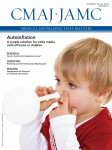
Effect of nasal balloon autoinflation in children with otitis media with effusion in primary care: an open randomized controlled trial
Otitis media with effusion is a common problem that lacks an evidence-based nonsurgical treatment option. We assessed the clinical effectiveness of treatment with a nasal balloon device in a primary care setting.
We conducted an open, pragmatic randomized controlled trial set in 43 family practices in the United Kingdom. Children aged 4–11 years with a recent history of ear symptoms and otitis media with effusion in 1 or both ears, confirmed by tympanometry, were allocated to receive either autoinflation 3 times daily for 1–3 months plus usual care or usual care alone. Clearance of middle-ear fluid at 1 and 3 months was assessed by experts masked to allocation.
Of 320 children enrolled, those receiving autoinflation were more likely than controls to have normal tympanograms at 1 month (47.3% [62/131] v. 35.6% [47/132]; adjusted relative risk [RR] 1.36, 95% confidence interval [CI] 0.99 to 1.88) and at 3 months (49.6% [62/125] v. 38.3% [46/120]; adjusted RR 1.37, 95% CI 1.03 to 1.83; number needed to treat = 9). Autoinflation produced greater improvements in ear-related quality of life (adjusted between-group difference in change from baseline in OMQ-14 [an ear-related measure of quality of life] score −0.42, 95% CI −0.63 to −0.22). Compliance was 89% at 1 month and 80% at 3 months. Adverse events were mild, infrequent and comparable between groups.
Autoinflation in children aged 4–11 years with otitis media with effusion is feasible in primary care and effective both in clearing effusions and improving symptoms and ear-related child and parent quality of life. Trial registration: ISRCTN, No. 55208702.
Journal Article

Maximising recruitment to a randomised controlled trial for chronic rhinosinusitis using qualitative research methods: the MACRO conversation study
Background
Randomised controlled trials (RCTs) are considered the ‘gold standard’ of medical evidence; however, recruitment can be challenging. The MACRO trial is a NIHR-funded RCT for chronic rhinosinusitis (CRS) addressing the challenge of comparing surgery, antibiotics and placebo. The embedded MACRO conversation study (MCS) used qualitative research techniques pioneered by the University of Bristol QuinteT team to explore recruitment issues during the pilot phase, to maximise recruitment in the main trial.
Methods
Setting: Five outpatient Ear Nose and Throat (ENT) departments recruiting for the pilot phase of the MACRO trial (ISRCTN Number: 36962030, prospectively registered 17 October 2018). We conducted a thematic analysis of telephone interviews with 18 recruiters and 19 patients and 61 audio-recordings of recruitment conversations. We reviewed screening and recruitment data and mapped patient pathways at participating sites. We presented preliminary findings to individual site teams. Group discussions enabled further exploration of issues, evolving strategies and potential solutions. Findings were reported back to the funder and used together with recruitment data to justify progression to the main trial.
Results
Recruitment in the MACRO pilot trial began slowly but accelerated in time to progress successfully to the main trial. Research nurse involvement was pivotal to successful recruitment. Engaging the wider network of clinical colleagues emerged as an important factor, ensuring the patient pathway through primary and secondary care did not inadvertently affect trial eligibility. The most common reason for patients declining participation was treatment preference. Good patient-clinician relationships engendered trust and supported patient decision-making. Overall, trial involvement appeared clearly presented by recruiters, possibly influenced by pre-trial training. The weakest area of understanding for patients appeared to be trial medications. A clear presentation of medical and surgical treatment options, together with checking patient understanding, had the potential to allay patient concerns.
Conclusion
The MACRO conversation study contributed to the learning process of optimising recruitment by helping to identify and address recruitment issues. Although some issues were trial-specific, others have applicability to many clinical trial situations. Using qualitative research techniques to identify/explore barriers and facilitators to recruitment may be valuable during the pilot phase of many RCTs including those with complex designs.
Journal Article
Patient perceptions of vulnerability to recurrent respiratory tract infections and prevention strategies: a qualitative study
ObjectivesRespiratory tract infections (RTIs) are extremely common, usually self-limiting, but responsible for considerable work sickness absence, reduced quality of life, inappropriate antibiotic prescribing and healthcare costs. Patients who experience recurrent RTIs and those with certain comorbid conditions have higher personal impact and healthcare costs and may be more likely to suffer disease exacerbations, hospitalisation and death. We explored how these patients experience and perceive their RTIs to understand how best to engage them in prevention behaviours.DesignA qualitative interview study.SettingPrimary care, UK.Methods23 participants who reported recurrent RTIs and/or had relevant comorbid health conditions were interviewed about their experiences of RTIs. Interviews took place as the COVID-19 pandemic began. Data were analysed using inductive thematic analysis.ResultsThree themes were developed: Understanding causes and vulnerability, Attempting to prevent RTIs, Uncertainty and ambivalence about prevention, along with an overarching theme; Changing experiences because of COVID-19. Participants’ understandings of their susceptibility to RTIs were multifactorial and included both transmission via others and personal vulnerabilities. They engaged in various approaches to try to prevent infections or alter their progression yet perceived they had limited personal control. The COVID-19 pandemic had improved their understanding of transmission, heightened their concern and motivation to avoid RTIs and extended their repertoire of protective behaviours.ConclusionsPatients who experience frequent or severe RTIs are likely to welcome and benefit from advice and support regarding RTI prevention. To engage people effectively, those developing interventions or delivering health services must consider their beliefs and concerns about susceptibility and prevention.
Journal Article
Talking in primary care (TIP): protocol for a cluster-randomised controlled trial in UK primary care to assess clinical and cost-effectiveness of communication skills e-learning for practitioners on patients’ musculoskeletal pain and enablement
IntroductionEffective communication can help optimise healthcare interactions and patient outcomes. However, few interventions have been tested clinically, subjected to cost-effectiveness analysis or are sufficiently brief and well-described for implementation in primary care. This paper presents the protocol for determining the effectiveness and cost-effectiveness of a rigorously developed brief eLearning tool, EMPathicO, among patients with and without musculoskeletal pain.Methods and analysisA cluster randomised controlled trial in general practitioner (GP) surgeries in England and Wales serving patients from diverse geographic, socioeconomic and ethnic backgrounds. GP surgeries are randomised (1:1) to receive EMPathicO e-learning immediately, or at trial end. Eligible practitioners (eg, GPs, physiotherapists and nurse practitioners) are involved in managing primary care patients with musculoskeletal pain. Patient recruitment is managed by practice staff and researchers. Target recruitment is 840 adults with and 840 without musculoskeletal pain consulting face-to-face, by telephone or video. Patients complete web-based questionnaires at preconsultation baseline, 1 week and 1, 3 and 6 months later. There are two patient-reported primary outcomes: pain intensity and patient enablement. Cost-effectiveness is considered from the National Health Service and societal perspectives. Secondary and process measures include practitioner patterns of use of EMPathicO, practitioner-reported self-efficacy and intentions, patient-reported symptom severity, quality of life, satisfaction, perceptions of practitioner empathy and optimism, treatment expectancies, anxiety, depression and continuity of care. Purposive subsamples of patients, practitioners and practice staff take part in up to two qualitative, semistructured interviews.Ethics approval and disseminationApproved by the South Central Hampshire B Research Ethics Committee on 1 July 2022 and the Health Research Authority and Health and Care Research Wales on 6 July 2022 (REC reference 22/SC/0145; IRAS project ID 312208). Results will be disseminated via peer-reviewed academic publications, conference presentations and patient and practitioner outlets. If successful, EMPathicO could quickly be made available at a low cost to primary care practices across the country.Trial registration number ISRCTN18010240.
Journal Article
Clarithromycin and endoscopic sinus surgery for adults with chronic rhinosinusitis with and without nasal polyps: study protocol for the MACRO randomised controlled trial
Background
Chronic rhinosinusitis (CRS) is a common source of ill health; 11% of UK adults reported CRS symptoms in a worldwide population study. Guidelines are conflicting regarding whether antibiotics should be included in primary medical management, reflecting the lack of evidence in systematic reviews. Insufficient evidence to inform the role of surgery contributes to a fivefold variation in UK intervention rates. The objective of this trial is to establish the comparative effectiveness of endoscopic sinus surgery (ESS) or a prolonged course of antibiotics (clarithromycin) in adult patients with CRS in terms of symptomatic improvement and costs to the National Health Service compared with standard medical care (intranasal medication) at 6 months.
Methods/design
A three-arm parallel-group trial will be conducted with patients who remain symptomatic after receiving appropriate medical therapy (either in primary or secondary care). They will be randomised to receive: (1) intranasal medication plus ESS, (2) intranasal medication plus clarithromycin (250 mg) or (3) intranasal medication plus a placebo. Intranasal medication (current standard medical care) is defined as a spray or drops of intranasal corticosteroids and saline irrigations. The primary outcome measure is the SNOT-22 questionnaire, which assesses disease-specific health-related quality of life. The study sample size is 600. Principal analyses will be according to the randomised groups irrespective of compliance. The trial will be conducted in at least 16 secondary or tertiary care centres with an internal pilot at six sites for 6 months.
Discussion
The potential cardiovascular side effects of macrolide antibiotics have been recently highlighted. The effectiveness of antibiotics will be established through this trial, which may help to reduce unnecessary usage and potential morbidity. If ESS is shown to be clinically effective and cost-effective, the trial may encourage earlier intervention. In contrast, if it is shown to be ineffective, then there should be a significant reduction in surgery rates. The trial results will feed into the other components of the MACRO research programme to establish best practice for the management of adults with CRS and design the ideal patient pathway across primary and secondary care.
Trial registration
ISRCTN36962030
. Registered on 17 October 2018.
Journal Article