
Catalogue Search | MBRL


Are you sure you want to remove the book from the shelf?

{{itemTitle}}
80
result(s) for
"Wilson, Flannery"
Sort by:

New Taiwanese cinema in focus : moving within and beyond the frame
This book places Taiwanese cinema from the 1980s onwards in both national and transnational contexts. In the Taiwanese film industry, the dichotomy between arthouse and commercially viable films is heavily emphasized by both scholars and the local media. Ostensibly, this dichotomy stems from two separate desires on the part of filmmakers. Arthouse filmmakers in Taiwan are largely dependent on international distributors for funding, and, as a result, they aim to reach international audiences. On the other hand, mainstream commercial films in Taiwan tend to be produced without international export in mind. On a textual level, however, this dichotomy is not so clear-cut. Although the opposition between arthouse and commercial film may be very real in financial terms, in the context of the films themselves, the national and transnational (or inter-textual) aspects of Taiwanese cinema are not oppositional. These unlikely relationships create the need for a new way of thinking about transnationalism altogether. It provides a nuanced picture of the Taiwanese film industry since democratization and isolation from the Peoples Republic of China. It features close readings of the films of Tsai Ming-liang, Edward Yang, Hou Hsiaohsien, and others. It connects Taiwanese cinema to the global cinema landscape more generally. It refines the study of transnationalism by positing a new mode for viewing contemporary national cinema movements.
Book

New Taiwanese Cinema in Focus
In the Taiwanese film industry, the dichotomy between 'art-house' and commercially viable films is heavily emphasized. However, since the democratization of the political landscape in Taiwan, Taiwanese cinema has become internationally fluid. As the case studies in this book demonstrate, filmmakers such as Hou Hsiao-hsien, Edward Yang, Tsai Ming-liang, and Ang Lee each engage with international audience expectations. New Taiwanese Cinema in Focus therefore presents the Taiwanese New Wave and Second Wave movements with an emphasis on intertextuality, citation and trans-cultural dialogue. Wilson argues that the cinema of Taiwan since the 1980s should be read emblematically; that is, as a representation of the greater paradox that exists in national and transnational cinema studies. She argues that these unlikely relationships create the need for a new way of thinking about 'transnationalism' altogether, making this an essential read for advanced students and scholars in both Film Studies and Asian Studies.
eBook
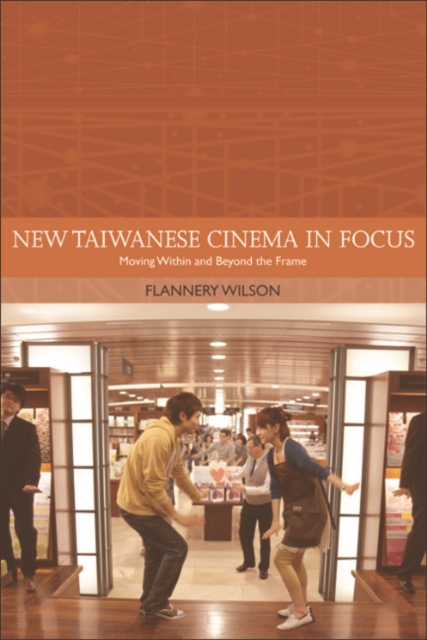
New Taiwanese Cinema in Focus
In the Taiwanese movie industry, the dichotomy between arthouse and commercially viable films is heavily emphasized by both scholars and the local media. This text provides a nuanced picture of the Taiwanese film industry since democratization and isolation from the Peoples Republic of China.
eBook
Charting the Course: Defining the Taiwanese Cinematic ‘Tradition’
What if we stopped asking whether cinema can be some sort of magic door opening onto absolute time, and instead asked about cinema's role in the construction of different temporalities in different societies, politics, cultures, classes and so forth. (Berry, in Khoo and Metzger, 113)Historical Context, Cultural BackgroundContemporary Taiwanese cinema (from the 1980s to the present) must be understood in relation to, and in reaction against, earlier forms of film-making on the island. Though I do not consider the large body of films that were produced between 1895 and the early 1980s to comprise the New Taiwanese cinematic ‘tradition’, one cannot understand the context out of which this tradition arose without looking back into history. One must look beyond the frame, so to speak, to see within it.The earliest films which were produced on the island of Taiwan were Japanese products, examples of ‘imperial Japanese film culture’ (Gaskett 3). Japan controlled the majority of media content in the earlier half of the century, a control that was tied directly to a rapid succession of Japanese military victories. This control extended in both ways: not only did Japanese filmmakers ‘set up shop’ in their extended empire, but non-Japanese filmmakers from within that empire were drawn away from their own countries and into Japan.
Book Chapter
Taiwanese–Italian Conjugations: The Fractured Storytelling of Edward Yang's The Terrorizers and Michelangelo Antonioni's Blow-Up
Frederic Jameson describes Edward Yang's films as miniature showcases for alienation in a modernised Taipei - as spaces in which conventional plots and characters no longer exist - spaces in which linear narrative is replaced with moments of coincidence and points of intersection. Yang also makes explicit use of voiceovers and dialogue to express the 'heaviness' of life in modern-day Taipei, unlike other Taiwanese art house directors, such as Tsai Ming-liang. The combination of these factors forms the basis of Yang's style: though he does film space unconventionally, as Jameson suggests, he also relies heavily on dialogue or 'words' more generally. My analysis of Yang's films within this chapter, therefore, relies on a careful consideration of both these aspects: camera movement and dialogue. I also analyse a case study for comparative purposes, in response to questions such as: why is Yang so frequently compared with Italian director Michelangelo Antonioni? Is there any validity to this comparison? Premised on the assumption that is Yang a 'universal' film-maker, I argue that Italian director Michelangelo Antonioni's Blow-Up and Yang's Terrorizers contain overlapping themes and plot devices to such an extent that they can be considered analogies for modernism more generally. I return to these connections shortly.
We must first go back to the early 1980s to see how Yang entered the scene. Yang was talented but he was also lucky. In 1982, four directors were chosen by Taiwan’s Central Motion Picture Corporation to contribute to a special anthology of short films, entitled In Our Time, which were supposed to represent everyday stories of Taiwan from the 1950s to the 1970s. The resulting anthology contained the films of four young directors: Chang Yi, Ko I-chen, Tao Te-chen, and Edward Yang. Yang’s short film, entitled ‘Expectations’ (also translated as ‘Desires’), tells the story of a young girl, entering puberty, who discovers her sexuality while lusting after her handsome college-age neighbour. In one particularly noteworthy scene, the young teenage girl, Fen, discovers that she has her period for the first time.
Book Chapter

Mapping Hou Hsiao-hsien's Visuality: Setting, Silence and the Incongruence of Translation in Flight of the Red Balloon
In his 2001 text, An Accented Cinema: Exilic and Diasporic Filmmaking, Hamid Naficy defines his concept of 'accented cinema' as: 'fragmented, multilingual, epistolary, self-reflexive ... amphibolic, doubled, crossed' and so on. For Naficy, 'accented cinema' contains: '... lost characters; subject matter and themes that involve journeying, historicity, identity, and displacement' (4). At the end of this long list of adjectives, Naficy adds that accented cinema is often a collective undertaking (that is, it is often co-produced), and that the films themselves tend to reflect the film-maker's identity as an exile or migrant.
In an interview with French director Olivier Assayas, Hou Hsiao-hsien describes himself as a Taiwanese film-maker who is 'culturally Chinese'. Though this term, 'culturally Chinese' does create a misleading sense of the uniformity of culture, Naficy's terminology can be similarly misleading. Though Naficy's description of 'accented cinema' is helpful in that it contains a general list of qualities that most non-Hollywood films share, the term again reinforces a binary. If, on the one hand, 'dominant cinema' is 'considered universal and without accent', then, on the other hand, says Naficy: 'the films that diasporic and exilic subjects make are accented' (Naficy 4). Despite his beautifully rich and imaginative description of accented cinema, and despite his work to add pinches of ambivalence into the equation, Naficy has still, fundamentally, divided cinema into two classes: one 'dominant' and 'universal', the other 'exilic' and 'accented'.
Book Chapter
The Chinese/Hollywood Aesthetic of Ang Lee: ‘Westernized’, Capitalist … and Box Office Gold
'Thank you movie god!'
Ang Lee, winning the Oscar for Best Director for Life of Pi, 25 February 2013
Hollywood was kind to Ang Lee in 2013. At the 85th Academy Awards, Lee won his second Oscar for Best Director, since Brokeback Mountain in 2005, for Life of Pi (released in theatres in late 2012). Including the nomination of Life of Pi for Best Picture, this was the fifth Oscar nomination of Lee's career. The win was regarded as a triumph, not only for Lee but for Taiwan more generally. President Ma Ying-jeou thanked Lee for 'pushing Taiwan toward the world'; adding in the same congratulatory message, 'Taiwanese are proud of you'. Towards the end of his acceptance speech, Lee thanked Taiwan for allowing him and his crew to film there: 'I could not make this movie without the help of Taiwan. We shot there. I want to thank everybody there who helped us, especially the seat of Taichung ... Thank you academy. Xie xie. Namaste.' Chinese media outlets on the mainland, unlike in Taiwan, were quick to censor this part of Lee's speech. Online commenters on the popular Chinese microblogging site Sino Weibo expressed both pride and anger over Lee's win. Ang Lee is a good \"hua ren\" director, did you hear the word 'China' in it? Don't put feathers in your own cap,' one Weibo user commented.
Book Chapter
Filming Disappearance or Renewal? The Ever-Changing Representations of Taipei in Contemporary Taiwanese Cinema
In the late summer of 2011, Taiwan's National Cultural Association awarded Presidential Culture Awards to two members of the film industry: ‘veteran’ director Hou Hsiao-hsien and Lee Lieh, an actress turned producer. It was the first time that anyone from the film industry had been chosen for the culture award. Though Lee Lieh was relatively new to producing in 2011, she had already produced two major blockbuster hits for Taiwan: Orz Boys/Jiong nan hai (directed by Yang Yache, 2008) and Monga/Bang-kah (directed by Doze Niu, 2010). Monga, released during the Chinese New Year period, grossed NT$270 million ($8.4 million) and became the third most successful Taiwanese film of all time after Wei Tu-sheng's Cape No. 7/Haijiao qi hao (2008) and Ang Lee's Lust Caution (2007). In reaction to her major success as a producer, a reporter from Screen Daily described Lee ‘as one of the most efficient and profitable producers by the Taiwanese film industry’. Another reporter commented on the Taiwanese media's prediction that the film industry was in the process of a strong revival. After the success of Cape No. 7 and Monga, the Taiwanese media began to report that the industry was likely to recoup over NT$1.5 billion in box office gross receipts.
Book Chapter
Tsai Ming-liang's Disjointed Connectivity and Lonely Intertextuality
Tsai's central subject is the loneliness of the human condition … his characters are invariably profoundly sad and alone but, seen from afar, the absurdity of their existence emerges, the tragicomic truth that, as lonely as they feel, they are always much closer to each other than their limited awareness allows them to recognize. (Rapfogel 26)Tsai Ming-liang's inclination towards loneliness, alienation and ‘slowness’ in his films can be traced back to the earlier years of his life and career. Born in Kuching, Malaysia in 1957, Tsai spent a great deal of his youth attending local screenings of international films with his grandparents (Hughes, n.p.). Tsai has commented that his ‘slow-paced childhood’ allowed him to observe life in his home town from a leisurely perspective, arguably, according to Darren Hughes, the same perspective that characterises the slow style of his films. At the age of twenty, Tsai moved to Taipei and entered the Chinese Culture University where he studied film and drama and was exposed to the most famous of the European auteurs such as Michelangelo Antonioni, François Truffaut and Robert Bresson. In 1982, the year that Tsai graduated from the Chinese Culture University, Taiwan was in an era of transformation: America had passed the Taiwan Relations Act in 1979 and democratisation was in sight.
Book Chapter